
How to Develop a Taxi App Like Uber: Cost, Features, and Timeline
From Concept to Launch: A Comprehensive Guide to Developing a Taxi App

As the on-demand economy grows, developing a taxi app like Uber has become an attractive business model for entrepreneurs and businesses. Taxi apps provide convenience, seamless user experiences, and an efficient way to manage transportation services.
This blog will walk you through the process of developing a taxi app like Uber, covering essential features, cost breakdown, and development timeline.
1. Understanding the Taxi App Model: How Does Uber Work?
Uber revolutionized the taxi industry by introducing a platform that connects riders with drivers through a mobile app. The app provides real-time tracking, secure payments, and easy access to transportation. There are two main stakeholders in a taxi app:
- Riders: Users who book rides through the app.
- Drivers: Users who provide transportation services via the app.
2. Key Features of a Taxi App Like Uber
To build a successful taxi app, you need two separate apps: one for passengers and one for drivers, along with an admin panel to manage and monitor operations. Here’s a breakdown of the essential features:
a) Passenger App Features
- Registration & Login: Social media login or email-based registration is essential to onboard users quickly.
- Ride Booking Interface: A user-friendly interface to select pickup/drop-off locations, choose ride types, and book a ride with a few taps.
- Real-Time GPS Tracking: Enables riders to track drivers in real-time from the moment a ride is booked until the ride is completed.
- Fare Estimation: Instant calculation of the estimated fare based on distance, time, and demand.
- Ride Scheduling: Allows passengers to book rides in advance for specific times.
- Payment Gateway Integration: A secure method for accepting various payment methods (credit cards, wallets, PayPal, etc.).
- Push Notifications: Alerts passengers about ride confirmations, driver arrival, fare details, and promotions.
- Rating & Reviews: Allows riders to rate their experience and provide feedback for continuous improvement.
b) Driver App Features
- Driver Profile & Verification: Enables drivers to create a profile, upload necessary documents, and go through a verification process.
- Trip Request Handling: A screen to accept or decline ride requests.
- Navigation Assistance: Real-time GPS navigation to guide drivers to the rider’s location and destination.
- Earnings Dashboard: Displays completed trips, earnings, bonuses, and other financial details for drivers.
- Ride History: A record of all past trips and feedback received from passengers.
- In-App Chat or Call: Secure communication between drivers and passengers.
- Push Notifications: Alerts for trip requests, trip cancellations, and other real-time information.
c) Admin Panel Features
- Dashboard & Analytics: Real-time data on active users, trips, revenue, and other key metrics.
- Driver Management: Tools to verify, approve, or block drivers based on performance and feedback.
- Fare & Surge Pricing Management: Set and adjust fares dynamically based on factors like distance, demand, and time of day.
- Real-Time Tracking: Monitor drivers and passengers for safety and service optimization.
- Complaint Management: A platform to handle user complaints and resolve issues.
- Revenue & Commission Management: Manage payments, commissions, and taxes from the platform.
3. Tech Stack for Taxi App Development
Choosing the right tech stack is critical for the success of your app. Here are some essential tools and technologies you may need:
- Backend Development: Node.js, Ruby on Rails, or Python with Django
- Frontend Development: React Native, Swift (iOS), Kotlin or Java (Android)
- Real-Time Location & Maps: Google Maps API, Mapbox, or Apple Maps
- Payments: Stripe, PayPal, Braintree, or a custom payment gateway
- Push Notifications: Firebase Cloud Messaging (FCM), Apple Push Notification Service (APNS)
- Database: MongoDB, PostgreSQL, or MySQL for data storage
- Cloud Hosting: AWS, Google Cloud, or Microsoft Azure for scalable backend infrastructure
4. Cost of Developing a Taxi App Like Uber
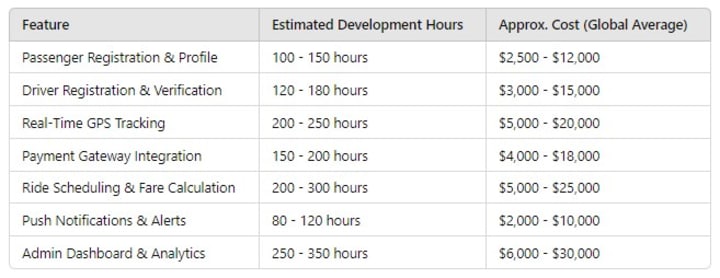
The cost to develop a taxi app depends on various factors like app complexity, features, tech stack, and development location. Here’s a rough cost breakdown:
a) Development Costs by Region
- US/Canada: $100 - $250 per hour
- Western Europe: $80 - $200 per hour
- Eastern Europe: $40 - $100 per hour
- India/Asia: $20 - $70 per hour
b) Cost Breakdown Based on Features
c) Total Estimated Cost
For a basic version of a taxi app with core features:
- MVP (Minimum Viable Product): $60,000 - $120,000
- Full-Scale App with Advanced Features: $150,000 - $300,000+
5. Development Timeline for a Taxi App Like Uber
Developing a taxi app involves several stages, from initial concept development to final deployment. Here's a breakdown of the timeline:
a) Stage 1: Discovery & Planning (2-4 weeks)
- Market research, competitor analysis, and feature prioritization.
- Creating a product roadmap and defining technical requirements.
b) Stage 2: Design & Prototyping (4-6 weeks)
- Wireframing and UX/UI design for the passenger, driver, and admin apps.
- Prototype creation to test user flows and make early improvements.
c) Stage 3: Backend & Frontend Development (4-6 months)
- Backend development to handle user requests, ride management, and payments.
- Frontend development for iOS and Android apps, focusing on user experience.
- Integration of APIs (Google Maps, payment gateways, etc.).
d) Stage 4: Testing & Quality Assurance (4-6 weeks)
- Conducting comprehensive testing to identify bugs and performance issues.
- Beta testing to gather user feedback and fix any issues before launch.
e) Stage 5: Deployment & Maintenance (Ongoing)
- Deploy the app on the App Store and Google Play Store.
- Ongoing maintenance, updates, and feature enhancements based on user feedback.
Total Development Time: 6 - 9 months for a full-featured app.
6. Challenges in Developing a Taxi App
Developing a taxi app involves overcoming several challenges:
- Real-Time Synchronization: Ensuring that the real-time tracking, ride requests, and driver availability sync seamlessly is critical.
- Surge Pricing Implementation: Implementing dynamic pricing based on demand can be complex but essential for profitability.
- Security & Compliance: Ensuring secure payment gateways, data privacy, and regulatory compliance across multiple regions.
- Driver Retention: Developing features that keep drivers satisfied, such as flexible payouts and earnings tracking, is key to success.
Conclusion
Developing a taxi app like Uber involves a detailed understanding of the market, precise feature integration, and robust technical execution. By focusing on key functionalities, choosing the right tech stack, and partnering with experienced developers, you can successfully bring your taxi app idea to life. While the costs and timeline can vary, a well-developed taxi app is a long-term investment with high returns in the ever-growing on-demand economy.
About the Creator
Mutual Aid: A Factor of Evolution
Mutual Aid: A Factor of Evolution is a 1902 collection of anthropological essays by Russian naturalist and anarchist philosopher Peter Kropotkin. The essays, initially published in the English periodical The Nineteenth Century between 1890 and 1896, explore the role of mutually beneficial cooperation and reciprocity (or "mutual aid") in the animal kingdom and human societies both past and present. It is an argument against theories of social Darwinism that emphasize competition and survival of the fittest, and against the romantic depictions by writers such as Jean-Jacques Rousseau, who thought that cooperation was motivated by universal love. Instead, Kropotkin argues that mutual aid has pragmatic advantages for the survival of human and animal communities and, along with the conscience, has been promoted through natural selection.
By New Oasis International Foundation about 8 hours ago in Writers
The Blue Ridge Stalker
Tom had left the Ford down the way, its spark plugs finally exhausted and no mechanics for a dozen miles back through the foothills to Strossburg. No matter, he had worn his boots—almost as if he planned for this to happen. The puzzle he sought to solve emanated from the woods clinging to the slopes above; the valley behind held no mysteries.
By Stephen A. Roddewig3 days ago in Fiction




Comments
There are no comments for this story
Be the first to respond and start the conversation.