
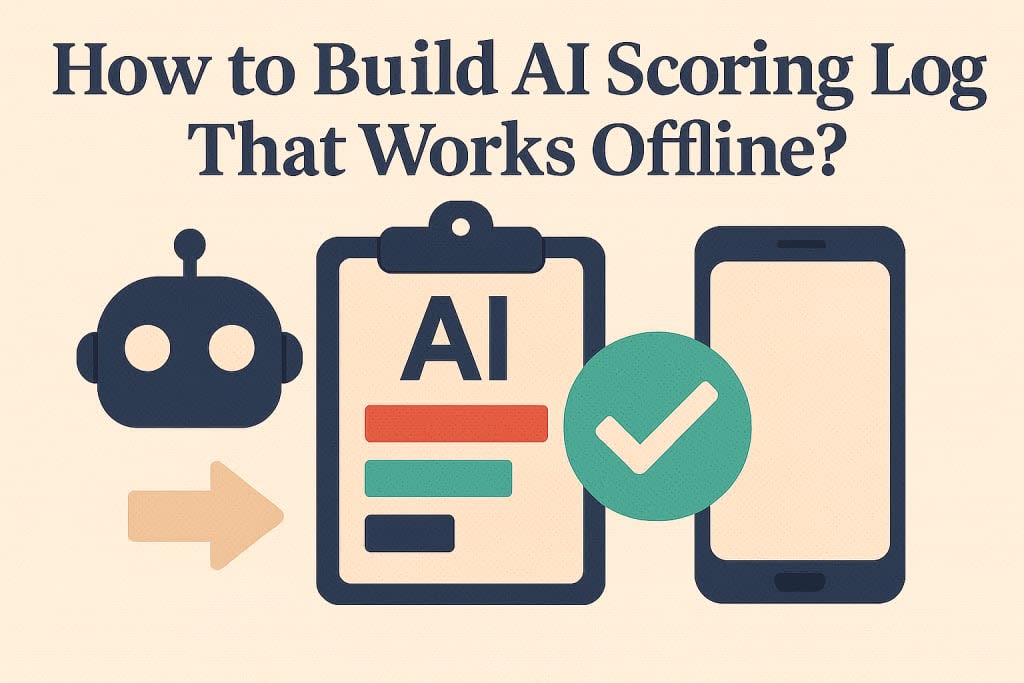
How to Build AI Scoring Logic That Works Offline?
A night a broken scoring engine forced me to rethink what “intelligent” really means.

The rain in Seattle has a way of stretching time. It doesn’t fall loudly the way storms do in other cities. It drifts, it lingers, and it wraps around the window until the outside world feels half-drawn. That night, long after most people had left the office, the only light in the room came from my laptop and the reflection of streetlamps leaking through the glass. I had stayed late to watch the logs of our scoring engine in real time, letting each line scroll past like a confession.
The device sitting on my desk was supposed to calculate a simple score in under a second. Instead, the moment the network cut out, everything froze. The UI held its breath. The logs stalled mid-process. A blank placeholder stayed on the screen long enough for any user to assume the app had stopped caring. And in a way, it had. The scoring logic depended on a remote endpoint that wasn’t responding. A single assumption—“the network will be available”—had surfaced itself like a fault line.
I leaned back in my chair and exhaled, listening to the soft hum of the building. A message earlier that day had described something similar happening to a field worker miles away from the city. They had been offline for hours, trying to record observations with the app, and the scoring screen had refused to move. It wasn’t just a minor issue. It had broken their workflow entirely.
That’s when the room felt heavier than it should have. Technology doesn’t fail loudly. It fails in the quiet spaces where people need it to behave without asking questions.
When offline breaks more than logic
I’ve always believed that offline behavior reveals the truth about an app. Online, the system has help. It has the cloud, servers, fallback routes. Offline strips everything down. It asks whether your code can stand on its own feet.
The scoring logic we had built looked elegant on diagrams. Neural weights downloaded from an API. A normalization step tied to the latest configuration file. A final computation based on user inputs and context models retrieved during earlier sync. It behaved perfectly as long as the network stayed steady.
But the moment you cut the connection, it crumbled like a structure with hidden cracks.
I stared at the logs again and noticed something embarrassing. The scoring sequence performed a version check with the server before any local calculations began. It wasn’t heavy. It wasn’t expensive. It was just… blocking. A single call holding everything hostage.
I’ve seen similar mistakes before. Years earlier, while working on a project connected with mobile app development Seattle clients, we discovered a navigation flow that depended on a remote configuration file to render the first screen. When the network failed, the entire flow stalled. No error. No fallback. Just stillness. That memory came back sharply, reminding me that “intelligence” inside an app doesn’t always come from advanced models. Sometimes intelligence is the simple act of knowing when not to ask for help.
When your assumptions reveal themselves
I took a sip from the mug beside me—cold by then—and reopened the architecture document. It became painfully clear where we had gone wrong. Our model wasn’t designed to think alone. It behaved like someone who needed to call a friend for advice before answering even the simplest question.
Everything needed restructuring. Not rewriting. Rethinking.
I opened a blank page and wrote the first rule in bold letters:
Scoring must behave like a local decision-maker.
Not a dependent one. Not a cautious one. Not a “wait for server approval” one. A decision-maker.
The second rule followed easily:
Remote logic should enhance scoring, never block it.
It sounds obvious when written plainly, but it’s the part most teams forget. We fall in love with the idea of real-time optimization, dynamic weighting, cloud-tailored results. But field workers, travelers, commuters, volunteers—none of them care where the intelligence lives. They care that it shows up when they need it.
Turning the system inside out
I started by extracting the core scoring computation into a local engine. No version checks. No external dependencies. Just math, stored parameters, and the device’s own understanding of context.
Next came building a lightweight local store. Each model update would be downloaded asynchronously and saved quietly in the background, without stopping anything. If a sync failed that day, scoring would continue using the last successful snapshot. People don’t pause their work because the cloud is unavailable. The app shouldn’t either.
I redesigned the process to create little time-stamped scoring snapshots. A score would reflect the best available information at the moment of calculation, not the most recent update from the server. The difference sounds technical, but the impact is human. It means the device carries enough identity to make decisions even when isolated.
By then, the office was completely silent. The building had that late-night emptiness where every small sound feels exaggerated. I tested the new sequence in airplane mode. First run: smooth. Second run: steady. Third run: instant.
There was no hesitation. No waiting. No blinking. The score appeared the way a thought appears—directly, without ceremony.
When simple changes feel like breakthroughs
A few days later, we ran a field test in a location with spotty connectivity. The wind was sharp that morning, brushing past the equipment cases lined up beside the trail. The tester opened the app, tapped the scoring screen, and looked up at me with a quick nod. The number appeared immediately.
It wasn’t the type of success you celebrate with applause. It was quieter. It was something like relief. A confirmation that the device respected the person using it.
That moment taught me something I had overlooked. A good offline system doesn’t just survive without a network. It behaves gracefully. It treats the user’s time as valuable. It removes doubt.
Offline performance isn’t a feature. It’s a promise.
When models learn to wait their turn
Once the core engine stabilized, I revisited the supporting logic—the contextual models, the personalization layers, the environmental parameters. None of them needed to run at launch. They could load later. They could sync while the user moved through other screens. They could update during quiet hours.
The more I rearranged, the more the structure made sense. Work that once felt urgent became optional. Work that once happened first now waited politely for its turn.
The scoring engine no longer behaved like a frightened system asking for reassurance. It behaved like something confident enough to stand on its own.
The moment I understood what “offline-first” really meant
Before this project, I assumed offline-first meant caching data aggressively, optimizing storage, reducing API calls. But that wasn’t the heart of it.
Offline-first means designing the system so a user never feels abandoned.
- It means placing their experience above your architecture.
- It means trusting the device instead of leaning on servers.
- It means letting intelligence flow even when the world outside is quiet.
The more the engine matured, the more it resembled something human—making decisions with whatever it had, not whatever it wished it had.
The quiet ending that mattered more than the launch
On the final evening of testing, I sat again in the same chair overlooking the same rainy streets. But this time, the room felt different. Lighter. The system that once stalled under pressure now behaved like it understood how to be alone.
I opened the scoring screen one last time. The number appeared instantly, without flicker or hesitation. There was something strangely comforting about that moment, watching the engine perform without needing validation from anywhere else.
That night reinforced something I’d forgotten over the years. The best engineering decisions don’t always feel dramatic. They feel natural—steady, quiet, grounded. The kind of decisions that disappear into the background because they work so well no one thinks about them again.
When the score surfaced on the screen with complete certainty, I closed my laptop and listened to the rain tapping against the window. The city was still grey, still half-asleep, still carrying that quiet Seattle melancholy. But the engine worked. And in its stillness, it taught me something I didn’t expect.
- Intelligence doesn’t need connectivity.
- It needs clarity.
- It needs independence.
- It needs the freedom to act when the network goes silent.
And when it does, the people who rely on it feel something they rarely talk about—trust that doesn’t require explanation.
About the Creator
John Doe
John Doe is a seasoned content strategist and writer with more than ten years shaping long-form articles.
Early March 2026: 4 Goals Accomplished
It's early March and I've now accomplished my 4th writing goal for the year of 2026. Before diving into the behind-the-scenes of it... why not tell you up front what that accomplishment was? I was published in a 2nd publication for this year. Published in Helix Literary Magazine out of Central Connecticut State University. You can read it for free right now!
By Stephen Kramer Avitabile7 days ago in Writers
Knives and Forks
Alright, it’s enough, I’m not going to fall asleep anyway, and I can’t stand another hour of staring at this ceiling. Thoughts just drift through my mind, and from all this lying around, my calves start to cramp again. At least I slept through most of yesterday. Paying that debt I built with lifestyle. That helps. With that, I can push through today until the evening, as I did so many times before. I blame her for it anyway. It was definitely her who tore me out of my dreams at half past two in the morning. She did it, and now she’s pretending that nothing happened.
By George Roast6 days ago in Writers



Comments
There are no comments for this story
Be the first to respond and start the conversation.