
How AI Reduces Claim Denials in Medical Billing and Coding
How intelligent automation prevents coding errors, strengthens compliance, and improves first-pass claim acceptance.
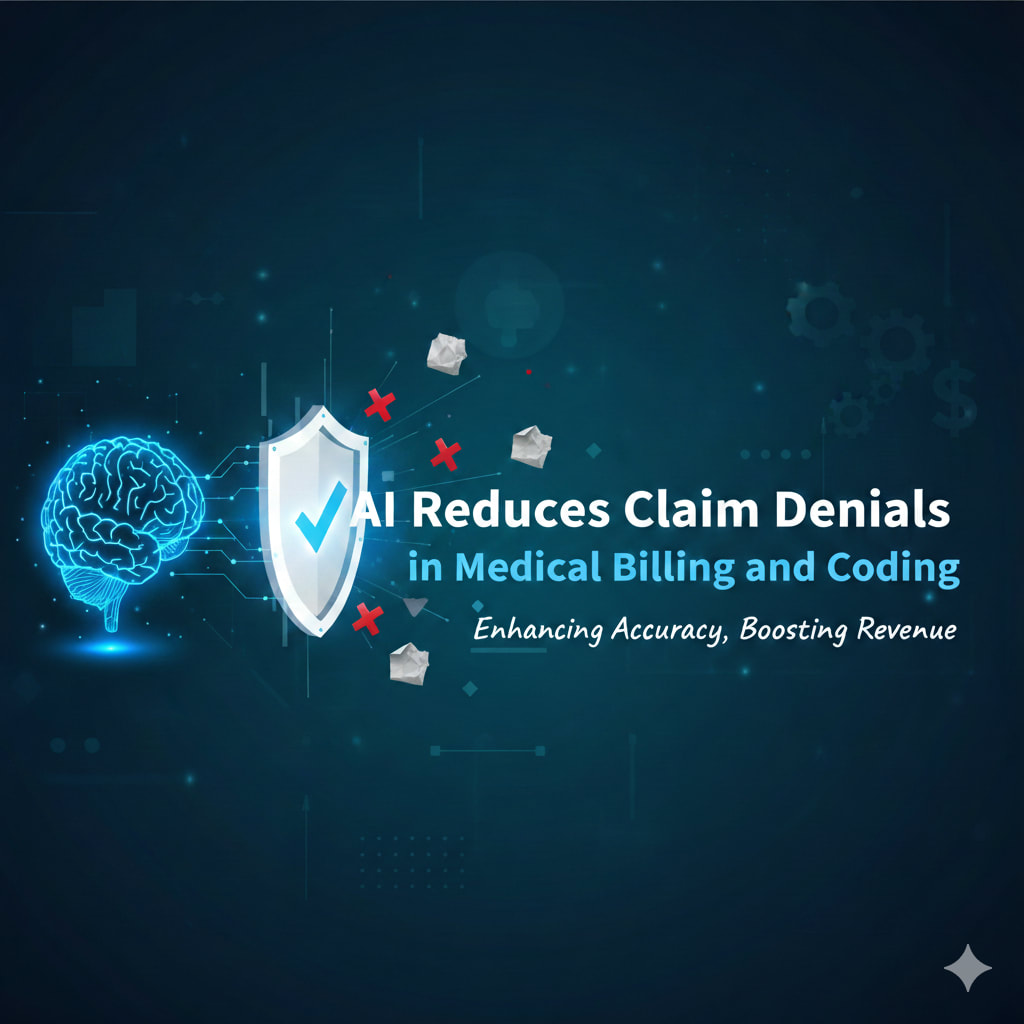
Claim denials continue to be a major source of revenue loss for healthcare providers. Manual billing processes, evolving payer rules, and inconsistent documentation often lead to avoidable errors. AI is changing this by helping billing teams detect risks earlier and submit cleaner claims.
Why Claim Denials Happen in Medical Billing
Before understanding how AI helps, it’s important to recognize common denial triggers:
- Incorrect or mismatched CPT, ICD-10, or HCPCS codes
- Missing or insufficient clinical documentation
- Eligibility and authorization errors
- Payer-specific policy changes not applied in time
- Delayed or incomplete claim submissions
Traditional workflows catch these issues after denial—when rework is already costly.
How AI Improves Accuracy in Medical Billing and Coding
AI-driven systems strengthen billing accuracy by analyzing data at scale and in real time. In ai medical billing and coding, AI acts as an intelligent validation layer before claims reach payers.
Key improvements include:
- Automated code validation against payer rules
- Early detection of missing modifiers or documentation gaps
- Consistent application of coding guidelines across teams
- Reduced reliance on manual cross-checking
Preventing Denials with Predictive Analytics
AI doesn’t just look at individual claims—it learns from historical outcomes.
Using predictive models, AI can:
- Identify claim attributes with a high risk of denial
- Detect recurring payer-specific rejection patterns
- Flag providers or procedures with higher denial rates
- Prioritize high-risk claims for additional review
This proactive approach allows billing teams to intervene before submission.
Real-Time Support for Coders and Billing Teams
AI tools support coders without replacing human expertise.
They help by:
- Suggesting accurate codes based on clinical notes
- Highlighting incomplete or unclear documentation
- Ensuring compliance with payer and regulatory requirements
- Reducing repetitive manual review tasks
This results in faster coding cycles and fewer preventable errors.
Business Impact of AI-Driven Denial Reduction
When AI is integrated into billing workflows, organizations typically see:
- Higher first-pass claim acceptance rates
- Faster reimbursements and improved cash flow
- Lower denial management and rework costs
- Increased productivity for billing and coding teams
Final Thoughts
AI is transforming denial management from a reactive process into a preventive strategy. By improving accuracy, predicting risk, and supporting coders in real time, ai medical billing and coding solutions help healthcare organizations protect revenue while reducing operational strain.
About the Creator
Keep reading
More stories from Lilly Scott and writers in Writers and other communities.
Common Challenges in AI Agent Development and How to Solve Them
AI agents promise autonomy, speed, and decision-making at scale—but building them in the real world is rarely straightforward. Organizations investing in AI Agent Development services quickly realize that success depends on far more than model selection or prompt design. Teams often struggle not with the idea of AI agents, but with data reliability, system integration, governance, and long-term performance. This article breaks down the most common challenges in AI agent development and offers practical, experience-backed solutions that actually work in production environments.
By Lilly Scotta day ago in Writers
Writing About Writing: The Rainbow Trap
The good thing about living in modern times is that LGBTQ representation in media is increasing. Not just in niche and Independant media, either, but also in mainstream media. Books, movies, TV shows, comics... they're finally catching on that LGBTQ+ people form a significant part of their audience, and deserve to see themselves on screen and in fiction, not just as victims in documentaries and true crime shows.
By Natasja Roseabout 7 hours ago in Writers
One Story Below Is True
Anne Bernays and Pamela Painter — What If? Writing Exercise for Fiction Writers prompts The Exercise — In two or three sentences, write down three unusual, startling, or amusing things you did or that happened to you. One thing must be true; the other two must be lies. Use details. Read them to a group, and they may ask questions to help them guess which one is and which ones are not. The Objective - To understand how we can exaggerate events in our lives, appropriate the lives of others - friends, enemies, strangers - or just plain out and out lie. All these are ways of using what we see and experience to produce fiction.
By Denise E Lindquistabout 18 hours ago in Writers
A Letter to the Firestarter
Dear Firestarter, We can all see you, we've been watching you since you began. In case you didn't know we were here before you and we will be here after. We witnessed your rise, your setbacks, your guilt and your lies. We witnessed you start the fire.
By Donny Foley6 days ago in Poets


Comments
There are no comments for this story
Be the first to respond and start the conversation.