
Highlighted Poet Robin Gow
A review of of a Revolute poet


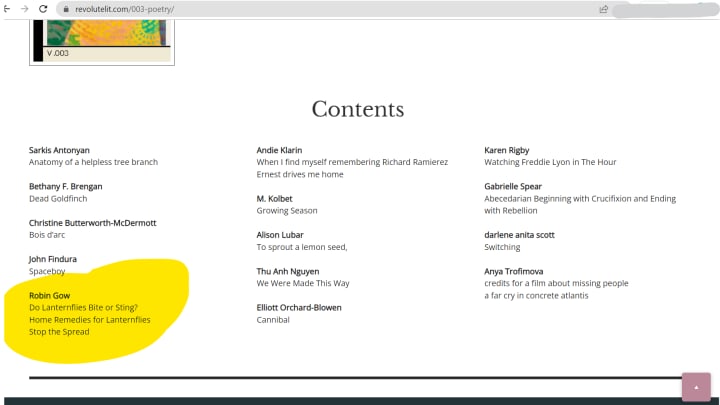
I recently wrote a breakdown and review of Revolute, a literary magazine. As part of the review I identified the poet whose works most resonated with me. This poet is Robin Gow.
Highlighted Poet: Robin Gow
Gow's bio reads:
Robin Gow is a trans and queer poet and YA/MG author from rural Pennsylvania.
The pieces that grabbed me were three poems about lanternflies:
- Do Lanternflies Bite or Sting,
- Home Remedies for Lanternflies,
- Stop the Spread
I selected Robin Gow for how their poems wrapped me up by the end I was swallowed before I could realize it.
My Take? Go read them. They're worth it.
Though at the time I wasn't into prose poems or lanternflies, I opted to carefully read Gow's pieces rather than give a quick skim to test my perception of the lens Revolute runs its poetry selections though. If I had based whether I wanted to read these particular poems on the titles I would have missed out. They were plain, simple, direct, not poetic. They could almost be queries you quickly tap into a google search bar. I'm glad I took my time with them; I was extremely impressed.
Gow took me on a journey I didn't know I was signing up for and before I realized it, it turned out I wanted to be there for that surprise journey. I wanted to stick it out. I needed to know the author's relationship with and to lanternflies.
Analysis

Do Lanternflies Bite or Sting
The first piece, Do Lanternflies Bite or Sting, was written in a classic (non-rhyming) stanza scheme, a simple and visually easy form to follow. Just a note, my interpretation is just that. I can't say how Gow intended the poem and its pieces to be received.
Gow starts by identifying themself through a very simple second person POV that sets the stage for us to enter the poem and sit there.
"How does your body protect itself?"
They invite us in further by relating us to themselves in first person by putting on the costume of the lanterfly,
"Once, I grew a pair of lanternfly wings..."
These lines may seem simple but they lay the foundation for the author to build on. After the entrance of these lines, they take us into their particular experience of the poems micro-word, how it impacts them in self protection, how they envy the lanternfly, try to be the lanternfly, and yet misunderstand the lanternfly and by extension their own possibilities.
Gow sinks us into the existence of the little bug with each passing line, parsing the narrator's own existence through the lanternflies vulnerability. I felt turned inside out and right side in. I was a lanternfly. I was instinct. I was human. I was hunted. I was damaged. I was damage. Active damage. Damage in the process of damaging. I felt this deeply as Gow questions near the end:
"We are always asking, “How will this hurt me?”
instead “How will I hurt this?”
This query, these exact words, have probably been repeated thousands of times in lectures, conversations, articles, stories and poems. What makes them powerful here is how we are brought to them, amid supplication, speculation, a longing, for the other side of vulnerability that lanternflies live - collecting and existing without constant fear, just to exist, as lanternflies do.
I haven't replicated the specific poem to break it down line by line; I think you should read the poem in it's entirety (its not excessively long).
I was surprised to find two more pieces on the topic. They were also crowned with mundane titles. How many poems on lanternflies can one write of the caliber to contribute a well curated online journal? I asked myself.

Home Remedies for Lanternflies
I'm not a fan of prose poetry (and also not a fan of the third form Gow uses - a justified wall of text), though I have, ironically, written in both forms. Walls of texts are hard for me to read and I have a strong instinct to pass pieces in these formats by.
Because I'm struggling with writing prose poetry, it's something I'm trying to pay attention to in order to gain a grasp, which gave me a little courage to think about pressing on. Gow had captured my attention so far regarding lanternflies enough for me to bypass my barriers and dip my toe in the second piece Home Remedies for Lanternflies. I could have been lost here, but Gow grabs me right away, asking
"Have you tried becoming a different species? Have you really given mammals a try yet? "
Why yes, yes I have. Or no. I haven't. Have I?
Even though the technical format is different, Gow has repeated the same magic that drew me into the first piece by literally referencing me the reader and putting me in the skin of someone else. Who has tried becoming? The lanternflies? Gow? The reader? I 'd have to read to find out.
Gow then immediately puts us in their body.
"Once, I counted the chambers of my heart and found thousands upon thousands. "
I have to be careful at this point to not dissect each line, quote by quote. I don't have permission to replicate the entire piece, though I think there is validity in fair use to analyze a poem by breaking out each of its lines. But I want you to go over and look at the second poem. I want you to experience it in its fullness in its original publication. So I'll only highlight a few more.
Gow's poetic magic seems to lie in how they weave simple lines with sprinklings of poetics, and then use that to stuff the reader inside the narrator. This passage in the second piece highlights this experience:
"Do you have trouble sleeping at night? I am asked by a survey. I lie and say, “No.” I stay up past the lanternflies. I think probably chickadees have several words for “always.” Do poets make language or does language make the poet?"
Gow begins the ending with a barrage of supplicating searching questions. I rode them like a bug on a joggers hat. I too wanted to know the answers posed in the poem.
Who would want to get rid of them? I need my lanternflies? What is a remedy for language? For the company of strangers?
As I reached the end I felt...spun...and at rest at the same time.

Stop the Spread
Ordinarily I would not have wanted to read what was clearly a theme on lanternflies. I can't tell you why. There's nothing wrong with it. The concept just made me feel uninterested. And yet, because of the work so far, I continued on to the third piece Stop the Spread.
My brain balked at the form, the wall o'text, but the thing is, balking or not, droning on about lanternflies or not, I couldn't hold myself back.
"Stop! Its just lanternflies." No.
"Isn't this long wall of text hard to read [so lets stop]?" Yes. Shush. I'm reading about the narrator's relationship with these buggies.
It had caught me: I was now in the lanternfly obsession soup too.
The piece starts off simple again, yet another line that could be the introduction to a social media post, a blog paragraph, a journal entry.
But then it does this:
"Laugh and crush bouquets of wings. Count lanternflies on the way to the deli. Speak lanternfly. Love lanternfly. Farm lanternfly. Dress up as the lanternfly. Swallow lanternfly."
...and its on. You're thin little legs are on Gow's shoulder, bouncing with their jog. You could fly away, but would you want to? These words are surely going up gravel slopes and down tree trunks. Where are these glyphs taking us? I didn't just need to find out: I couldn't even stop to think "Oh I need to know where this is going." I just happened to be there for a ride I didn't want off of.
The thing about this piece is that it takes the balance of mundanity and poetics the reader is now used to and tosses it aside. Yup, just tosses that puppy in the mud, mundanity clutching for dear life. What's left, in the aftermath of the narrator sweating and dripping, is a satisfied sensation when finally lifting off the author's shoulder.
Sometimes I have to really push myself when reading certain poems, especially in challenging formats, because I want to see how the author explores something. I want to see what their language does, if there is vocabulary I can learn, if there is a line to snag me. The poetry can be of decent publishing caliber but if I have to root around, snuffle and sniff for these things for whatever reason (probably related to me and my tired brain) I'd rather doomscroll the internet or stream a series.
There are plenty of times I don't regret pushing on--for fragments I've hoovered up, vocabulary I've learned, or a skill I didn't know I needed.
But sometimes after reading a piece somewhere in the world, I deeply wish for my time back. I wonder how or why an editor picked this piece of the hundreds they probably received. I think to myself, what did I even read? Can I buy a little eternal sunshine of the spotless mind?
Here neither happened. Here, I sat back, blinked and then murmured, "Wow. That was really good. I can't believe I just read three consecutive pieces on lanternflies, two in forms that make my brain bleed, and now I want to read them again." Yes. I wanted to read them again. And I did read them again. And then again.
Go ahead and give these poems a go and then if you feel like it tell me in the comments which piece you liked best or a few of your favorite lines. If they're not your cup of tea, what piece was your favorite in any of the three issues of Revolute?
___________________________________________
Thanks for visiting my page. I added this little blurb on Entry Letter A just to see how it works out. So far I like it so I'll keep adding it.
If you'd like to see more of my work here are two of my favorite poems that I've written:
Butter Cream: https://shopping-feedback.today/poets/butter-cream%3C/a%3E
When we were young: https://shopping-feedback.today/poets/when-we-were-young-m7bv010dxa%3C/a%3E%3C/p%3E%3Cstyle data-emotion-css="14azzlx-P">.css-14azzlx-P{font-family:Droid Serif,Georgia,Times New Roman,Times,serif;font-size:1.1875rem;-webkit-letter-spacing:0.01em;-moz-letter-spacing:0.01em;-ms-letter-spacing:0.01em;letter-spacing:0.01em;line-height:1.6;color:#1A1A1A;margin-top:32px;}
About the Creator
WOA
Just trying it out to see what its like.
Boundless
A geographical map could take you there. To the places I've been, to the sights I've seen, to the landscapes I've climbed. But no compass could point you in the direction of my memories. To the experiences I've lived, to the happiness I've felt, to the wonder I've held so close to my heart.
By Alyssa Musso7 days ago in Writers
Hold Music
Hold Music A story about the space between needing help and receiving it. The call connected at 8:04 in the morning. Margaret already knew what would happen — she had been doing this for eleven months — but she had learned to make herself believe, at the start of each call, that today would be different. It was the only way to make herself dial.
By Monique Williams6 days ago in Writers



Comments
There are no comments for this story
Be the first to respond and start the conversation.