
Geopolitics and Islam: A Thousand-Word Analytical Discussion
জিওপলেটিক্স ও ইসলাম: এক হাজার শব্দের বিশ্লেষণমূলক আলোচনা।

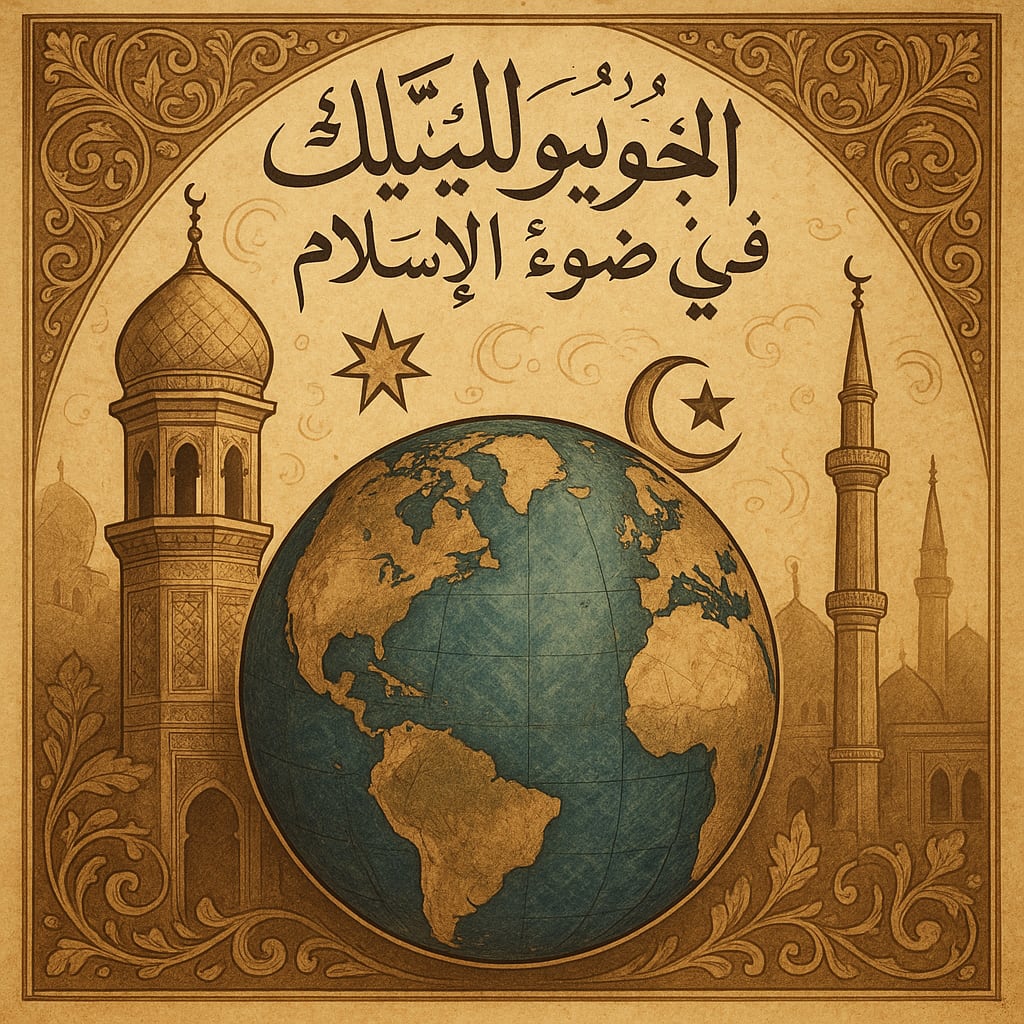
Geopolitics and Islam: A Thousand-Word Analytical Discussion
Geopolitics—also known as geopolitics—is a complex reality of the world system. It is a complex pattern of policies and relationships developed around the geography, wealth, military power, economy, and cultural influence of states, which directly affects the course of human life and civilization. But what does Islam say in this complex world? How did the Islamic perspective view or still view geopolitics? To find the answer to this question, we must go back to early Islam and the state philosophy of the Prophet Muhammad (peace be upon him), and integrate it with modern reality.
In the view of Islam, the world is not a neutral geographical place, but rather a laboratory where people live in the light of justice, fairness, and monotheism. When Islam chose the path of state-building, it was not just a system of governance, but a platform of justice. The state that the Prophet (peace be upon him) established through the state of Medina was the first Islamic form of geopolitics, where coexistence was built on the basis of alliances and agreements with non-Muslims, Jews and other ethnic groups.
But the term geopolitics as it is used today—such as the strategy of a strong state to control a weak state, or the competition to seize natural resources—is contrary to Islamic values. Islam does not approve of any imperialist perspective. Rather, Islam speaks of a monotheistic worldview, where the entire world is a gift from God and man is his caliph. This perspective bases geopolitics on justice, compassion and morality.
In history, we see that the Muslim world was once united through the caliphate system and a just international policy was in effect everywhere in their strategic regions such as the Byzantine border, the Persian border, North Africa, Andalusia, Central Asia. The Abbasid and Umayyad Caliphates established themselves as geopolitical powers not only through religious expansion, but also through knowledge, science, and economic prosperity. It is noteworthy that even though these caliphates used power, their perspective was ummah-based, which is different from modern nationalism or balance of power strategies.
When English, French, Dutch, and Spanish colonialism entered Muslim lands, a new type of geopolitics began—a hegemony that was secular, lucrative, and devoid of human values. At this time, the strategy of separating Islam from politics and limiting it to personal allegiance began. Muslim lands—such as the Middle East, the subcontinent, and North Africa—were fragmented by drawing artificial borders everywhere, fragmenting Muslim unity.
In modern geopolitics, powerful states such as the United States, Russia, China, and the European Union, mainly exert influence over Muslim states based on economics, military bases, resources (especially oil and gas), and strategic location. The conflicts in Afghanistan, Iraq, Syria, Libya, Yemen, etc. are not only driven by the suppression of ‘terrorism’, but also by geopolitical calculations and competition for influence. Islam proposes a righteous, moral and rational world governance instead of this competition.
In the Islamic view, geopolitics does not mean just the geography of states, but the establishment of a just balance in the world, where the abuse of power is prohibited. In Islam, the “ummah” is a strategic concept—it is not just a religious group, but a global political entity. The leadership of this ummah does not require only scholars, but also leadership that can play a moral role in the world order based on justice, foresight and ideals.
Modern Muslim states today have become divided, weak and competitive with each other. Organizations called the OIC or the Arab League have failed to play an effective role in geopolitics because they are morally unled, subservient to Western pressure, and divided by their own economic interests. Yet the central principle of Islamic geopolitics is ‘al-Ulfah’ or unity. The Quran states: “And hold fast to the rope of Allah and do not become divided among yourselves” (Surah Ale Imran: 103). This verse is not only spiritual, but also has political and geostrategic significance.
In the current context, the restoration of Muslim geopolitics requires a restructuring on three main pillars: one, intellectual thinking—so that the Muslim world understands its own history and philosophy. two, economic independence—so that it is not controlled by the Western world or international economic institutions. three, moral reform of the leadership—so that they can represent Islam in world politics in the light of truth and justice.
Islamic geopolitics is not a strategy of stubborn war or military conquest, but rather it is a philosophy that says: Let power, technology and strategy be on the side of justice; let borders be based on principles; and let international relations be in the light of justice. If the Muslim world can return to this principle, it will be able to declare its presence in world leadership not only politically but also morally.
Islam has raised geopolitics to a strange moral height. The geopolitics that is today obsessed with the game of interests, Islam takes it to a broad horizon of justice and monotheism - where the ultimate harmony of humanity, leadership and brotherhood lies. The revival of that Islamic geopolitics is the way to the liberation of the Muslim world of the future.
About the Creator
Keep reading
More stories from Abdul Barik and writers in Writers and other communities.
Islamic alternatives to taxation: Kharaj, Jizya and other revenue sources.
In the current world system, the main means of revenue collection is tax. But this tax system has given rise to a huge class disparity, unjust economic exploitation and unlimited state intervention. While the poor people have to be crushed under the millstone of income tax, value added tax (VAT), customs duty, etc., the rich get relief through various loopholes. Instead of this unstable and unjust system, Islam has given a model of a well-organized, fair and balanced revenue system, which is not based on taxes - but on kharaj, jizya, ushar, rikaz, etc.
By Abdul Barik9 months ago in Writers
It's Winter
Anne Bernays and Pamela Painter — What If? Writing Exercise for Fiction Writers prompts The Exercise —Write a scene involving two characters. Have the point-of-view character presume something entirely different about the situation from what the other character's overt behavior seems to imply. For example, a landlord comes to visit, and the tenant suspects that it isn't a visit but an inspection. Make up several situations in which one character can fantasize or project or suspect or even fear what another character is thinking. The Objective - To show how your characters can use their imaginations to interpret the behavior and dialogue of other characters.
By Denise E Lindquist17 days ago in Writers
Where Dreams Loved Me Back
chapter 1 Chapter One: The Quiet I Learned to Carry Matthew’s perspective, I don’t remember when life started feeling heavy. It wasn’t sudden — it was gradual, like carrying a bag that someone kept adding weight to until one day I realized I couldn’t put it down anymore.
By Anshu Giri3 days ago in Writers


Comments
There are no comments for this story
Be the first to respond and start the conversation.