
Five Modern Realities George Orwell Would Find Unbelievable
Exploring Contemporary Phenomena Through the Lens of Orwellian Insight

George Orwell, the prophetic author of 1984 and Animal Farm, warned the world about government overreach, propaganda, and the manipulation of truth. His works continue to be eerily relevant today, but some aspects of modern society might exceed even his most dystopian imaginings. If Orwell were to visit the 21st century, he would likely find several aspects of our world both fascinating and deeply troubling. Here are five modern realities that might leave him in shock.
1. The Voluntary Embrace of Digital Surveillance
In 1984, Orwell envisioned a world where government surveillance was an inescapable force, monitoring every citizen’s move. However, in our time, Orwell might be more astounded by how willingly people submit to surveillance. Instead of an authoritarian state forcing its way into homes, millions voluntarily share their personal lives on social media platforms, allowing corporations and governments to collect unprecedented amounts of data.
Companies like Google, Facebook, and Amazon track online activities, analyze search histories, and even listen to conversations through smart devices. People exchange privacy for convenience, often without realizing the extent of data mining and algorithmic profiling. Orwell’s Big Brother was a sinister government figure, but today’s version is an intricate web of AI-driven systems that operate in the background, shaping public opinion, personal choices, and even elections.
2. The Rise of Fake News and Misinformation
Orwell was deeply concerned with the manipulation of language and truth. In 1984, the Party controlled information through Newspeak and doublethink, ensuring that truth could be rewritten at will. Today, the concept of "fake news" has become a global problem, with misinformation spreading faster than facts.
The internet has made it possible for anyone to disseminate false narratives, from deepfake videos to conspiracy theories. Political groups, corporations, and even individuals use digital platforms to craft misleading stories, distorting public perception. The ease with which misinformation is accepted and amplified would likely be Orwell’s worst nightmare, confirming his fears about the fragility of truth.
3. The Power of Artificial Intelligence and Automation
Orwell’s time saw the early stages of mechanization, but the rapid advancement of artificial intelligence (AI) and automation would surely astound him. AI now writes articles, paints pictures, composes music, and even engages in human-like conversations.
The implications of AI-powered decision-making raise ethical concerns about privacy, employment, and control. Automation has replaced human workers in numerous industries, creating both efficiency and job displacement. Orwell would likely be fascinated by AI’s ability to manipulate information and emotions, making it a tool for both progress and deception.
4. The Simplification and Distortion of Language
Language was a major concern in 1984, where Orwell explored how limiting words could limit thought. In today's world, the transformation of language has taken new forms. Social media and instant messaging have led to the simplification of communication, with abbreviations, emojis, and memes replacing detailed discourse.
At the same time, political and corporate interests weaponize language to control narratives. Terms are redefined to fit agendas, and ideological battles often center around the meaning of words. Orwell would recognize these tactics as extensions of Newspeak, where controlling language means controlling thought.
5. The Globalization of Culture and Commerce
Orwell, who had strong opinions about imperialism, might view globalization with mixed feelings. The internet has connected the world in ways previously unimaginable, breaking down barriers and making cultures more accessible. Yet, this same interconnectedness has led to cultural homogenization, where powerful corporations dictate global trends, values, and even belief systems.
Local traditions struggle to survive against the dominance of multinational media, entertainment, and consumerism. Orwell might see this as a new form of cultural control—one not imposed by force, but by economic and digital influence.
Conclusion: Would Orwell Be Surprised or Vindicated?
Many aspects of modern society align with Orwell’s predictions, though some might have taken a different form than he expected. While 1984 portrayed a world where people were oppressed by external forces, today's reality often involves people willingly participating in systems of control and influence. Orwell’s warnings remain as relevant as ever, serving as a reminder to stay vigilant against the subtle and overt ways in which truth, privacy, and autonomy can be eroded in a digital age.
About the Creator
Keep reading
More stories from Pranshu verma and writers in Writers and other communities.
When the Road Gets Tough: Why You Should Keep Going Even When You Feel Like Giving Up
Life is a journey filled with highs and lows, triumphs and setbacks. There are moments when everything seems to align perfectly, and then there are times when the weight of the world feels unbearable. If you’re reading this, chances are you’re in one of those tough moments—feeling overwhelmed, exhausted, and on the verge of giving up. But before you throw in the towel, take a deep breath and remember this: you are stronger than you think, and this moment does not define your future.
By Pranshu vermaabout a year ago in Writers
Early March 2026: 4 Goals Accomplished
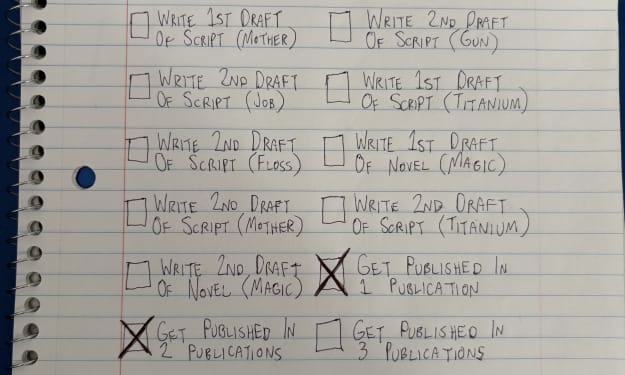
It's early March and I've now accomplished my 4th writing goal for the year of 2026. Before diving into the behind-the-scenes of it... why not tell you up front what that accomplishment was? I was published in a 2nd publication for this year. Published in Helix Literary Magazine out of Central Connecticut State University. You can read it for free right now!
By Stephen Kramer Avitabile6 days ago in Writers
What is the Difference?
I just thought of this article from the idea of my previously published drabble of future writing projects. What is the difference between old-school typewriting and keyboarding. In a keyboarding class do they still make the students use correct posture, fingers on homerow, how to figure margins and such beginning skills of beginning typists? Do they have Timed writings for speed and accuracy? How many of us who had Typing in school remember when having these one-minute, three-minute or five-minute writings to make sure of proper finger placement, proper posture with feet flat on the floor and the teacher walking up and down the aisle making sure.
By Mark Graham5 days ago in Writers


Comments
There are no comments for this story
Be the first to respond and start the conversation.