
Farah’s Silent Battle: A 17-Year-Old’s Journey Through Loss and Survival in Gaza
Between shattered dreams and fragile hope, Farah Mahmoud al-Kahlud embodies the resilience of Gaza’s youth amid devastation.

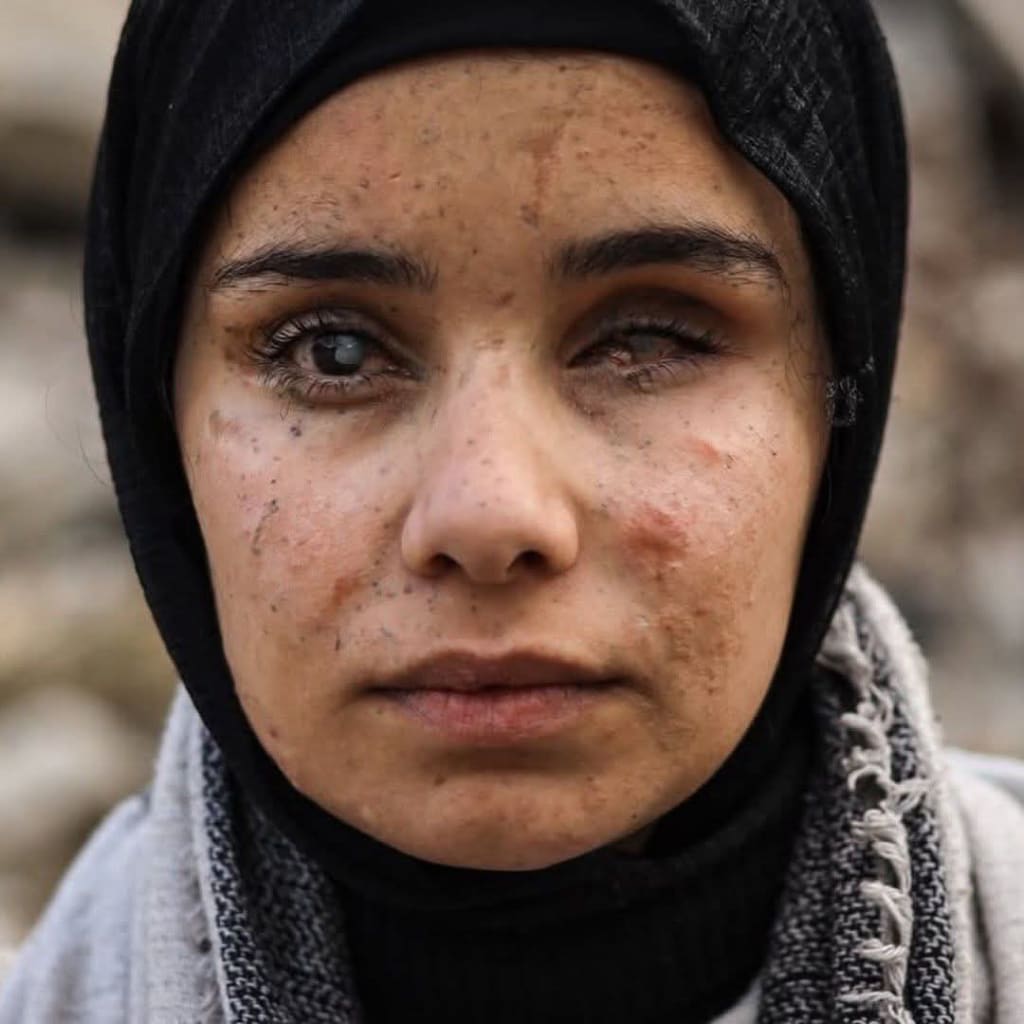
On January 19, 2026, in Gaza City, a young girl named Farah Mahmoud al-Kahlud stood before the world, showing the eye she had lost in a brutal attack on her home in Jabalia. At just 17 years old, Farah’s life has been irreversibly altered. In that single moment of violence, she lost not only her leg and her eye but also her parents—the pillars of her childhood and the guardians of her future. What remains is a teenager caught between unbearable grief, physical pain, and the uncertainty of survival in one of the harshest humanitarian crises of our time.
Farah’s story is not just about personal tragedy; it is a reflection of the broader suffering endured by thousands of Palestinians living under siege. Her injuries are severe: one leg amputated, complete blindness in one eye, and the other eye now at risk of permanent damage. Yet, despite her condition, she waits patiently for the borders to open, hoping for medical treatment that could save her remaining vision. This wait is agonizing, as every day without care increases the risk of losing her sight entirely.
The healthcare system in Gaza, already strained by years of blockade and repeated bombardments, offers little relief. Hospitals are overwhelmed, supplies are scarce, and specialized treatments are nearly impossible to access. For Farah, this means enduring constant pain with minimal medical support. Her struggle is compounded by the trauma of losing her parents, leaving her emotionally scarred and vulnerable in a world that seems indifferent to her suffering.
Still, Farah’s resilience shines through. Despite the devastation, she continues to fight for her dignity and survival. Her courage in showing the world her injuries is a powerful act of testimony. It is a reminder that behind every statistic of war casualties lies a human being—a child, a daughter, a dreamer—whose life has been torn apart.
Farah’s plight also highlights the broader humanitarian crisis in Gaza. Thousands of children live in fear, deprived of education, healthcare, and the simple joys of childhood. The blockade has created a reality where even basic necessities—food, clean water, electricity—are luxuries. For young survivors like Farah, the future is uncertain, shaped more by survival than by dreams.
Yet, amid the darkness, Farah holds onto hope. She dreams of receiving treatment for her remaining eye, of walking again with the help of prosthetics, and of rebuilding a life that honors the memory of her parents. Her story resonates deeply because it is not only about loss but also about the human spirit’s refusal to surrender. Farah represents the countless children of Gaza who, despite unimaginable suffering, continue to hope for a better tomorrow.
Her struggle calls for urgent international attention. The world must recognize the human cost of conflict and act to ensure that children like Farah are not forgotten. Access to medical care, humanitarian aid, and psychological support is not a privilege—it is a basic human right. Farah’s voice, though soft and burdened by pain, demands justice and compassion.
In the end, Farah’s journey is both heartbreaking and inspiring. She is a symbol of resilience, a reminder of the innocence lost in war, and a call to action for humanity. Her story forces us to confront uncomfortable truths: that wars are not fought in abstract numbers but in the lives of real people, and that every child deserves the chance to heal, to dream, and to live.
Farah Mahmoud al-Kahlud’s silent battle continues. As she waits for borders to open and treatment to arrive, she carries the weight of her losses with remarkable strength. Her courage is a testament to the resilience of Gaza’s youth—a generation that has known nothing but struggle, yet continues to hope against all odds.


About the Creator
Salman Writes
Writer of thoughts that make you think, feel, and smile. I share honest stories, social truths, and simple words with deep meaning. Welcome to the world of Salman Writes — where ideas come to life.
Keep reading
More stories from Salman Writes and writers in Writers and other communities.
The Room I Still Walk Into
I still walk into that room sometimes. Not with my body. With my mind. The real room no longer exists in the way it once did. The house changed owners. The walls were repainted. The furniture replaced. Someone else now opens that window without knowing how much weight it once held.
By Salman Writes8 days ago in Writers
Nicknames for Girlfriend
Nicknames for Girlfriend Finding the perfect nicknames for girlfriend can be both fun and meaningful, and I know my audience is always looking for ways to make their relationships extra special. I understand how important it is to choose a name that reflects love, playfulness, and intimacy, and I want to help you express your feelings in the cutest way possible.
By Ali Hassanabout 15 hours ago in Writers
Rage
Content Warning: Domestic Violence, Assault Rage D. A. Ratliff “Who did this?” My voice echoed through the house. All I wanted was a cup of tea, but one of the twins, running through the house like maniacs, knocked it over. My nerves tingled, and every muscle in my body felt coiled like a spring. Survival seemed out of reach.
By D. A. Ratliff7 days ago in Fiction



Comments
There are no comments for this story
Be the first to respond and start the conversation.