
Echoes for the Departed
He didn’t want to be found — just remembered.

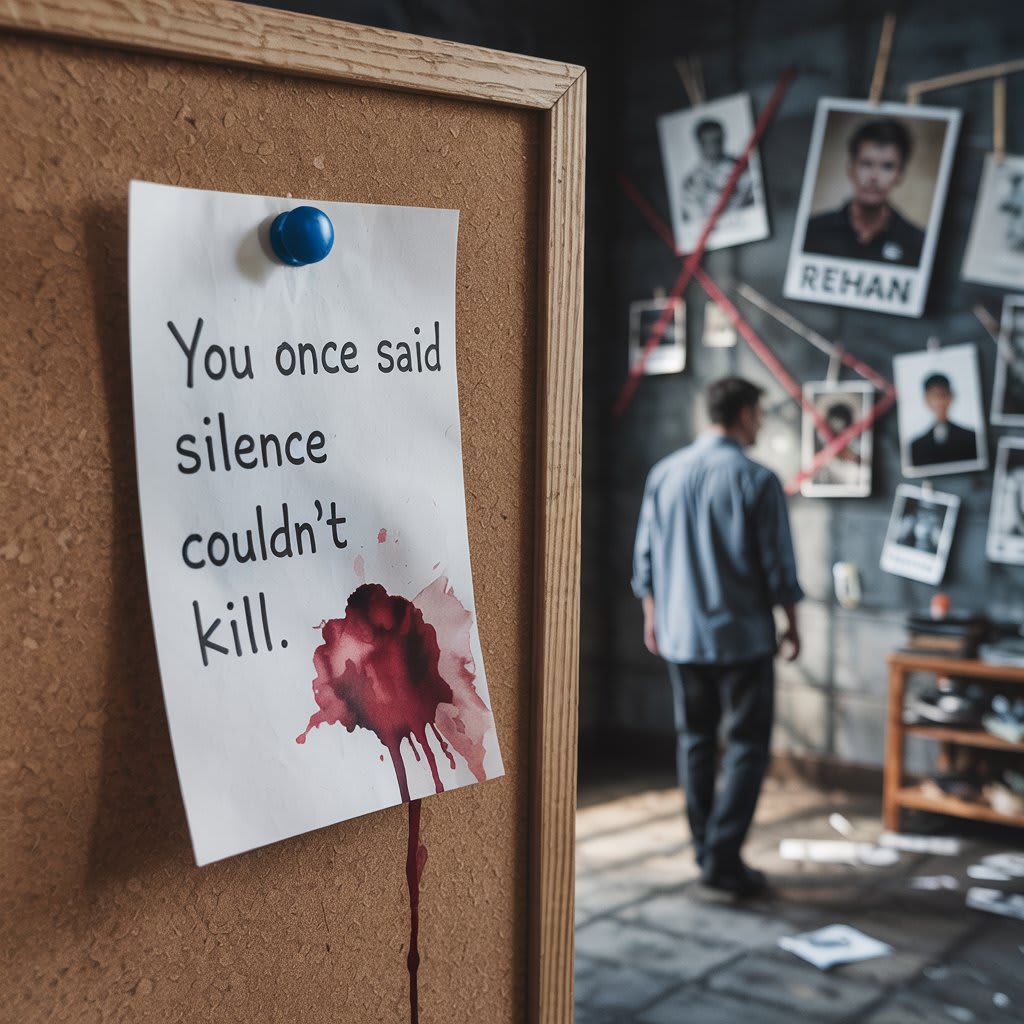
Detective Rehan Shah stood in the candlelit room, staring at the lifeless body of Professor Adil Murtaza. A respected academic, known for his work on memory and trauma. And now, the third victim in a series of killings that had the entire city gripped with fear.
As with the others, there was no sign of forced entry. No defensive wounds. Just a body laid out with unsettling care — and a handwritten note.
Rehan read it aloud:
“You said some memories should stay buried. I guess this one didn’t.”
Zara, his partner, stood beside him, arms crossed. “It’s like the killer isn’t talking to us. He’s talking to them. After they’re dead.”
Rehan nodded. “He wants them to hear him... even if it’s too late.”
Each of the three victims had one thing in common: they were influential in their own fields — a judge, a journalist, and now a professor. But beyond their careers, no connection was immediately clear. Each murder scene, however, included a note that hinted at a shared past.
The judge’s said: “You ruled over truth, but silence was your verdict.”
The journalist’s: “You printed lies, but forgot who bled for them.”
Rehan pinned the notes to a corkboard in his office, staring at the words until the lines blurred. They weren’t just messages. They were accusations. Emotional, bitter, personal.
It was as if the killer wasn’t seeking justice — he was seeking to be remembered.
Zara dug deeper. She found a long-forgotten case from twelve years ago involving a young boy named Sameer Raza, who had accused a group of respected adults of abuse and manipulation at an elite boarding school.
The case had been dismissed. The records were sealed. The boy had vanished. Forgotten.
Rehan whispered the name aloud. “Sameer...”
Could it be? Could Sameer be back?
Before he could say more, a fourth murder rocked the city. This time, it was a defense attorney — one who had worked on the dismissed case. The note beside his body was longer:
“You told them I was confused. You said I imagined it. But you knew. You all knew.”
The pieces began to fit. The killer was Sameer — or someone close to him — targeting the people who had betrayed him, silenced him, discredited him. And each message was written as if speaking directly to the victims, reminding them of what they did. A final reckoning they couldn’t escape, even in death.
Rehan and Zara went public with their theory, appealing to Sameer — if he was watching — to come forward. To talk.
Instead, Rehan received a note. This time, not left at a crime scene, but hand-delivered to his desk.
“You were at the academy once. You heard me. But you walked away.”
His hands trembled. A memory, long buried, surfaced.
He had met Sameer once, during a school visit. The boy had tried to speak to him. But Rehan, young and unsure, had brushed him off — assuming it was a student prank. He hadn’t remembered… until now.
The next morning, Zara was gone.
Her apartment door was unlocked. No signs of struggle. A note sat on her kitchen table:
“She tried to help you forget. That’s enough betrayal for one life.”
Rehan’s heart shattered. Not just from grief — but guilt. This wasn’t just a case anymore. It was a mirror. And he was part of the reflection.
He returned to the academy — now abandoned. In the old library, he found Sameer waiting.
Older now. Pale. Eyes heavy with years of pain.
“You came,” Sameer said.
“I should have come years ago,” Rehan replied quietly.
Sameer held out one last note. Rehan took it with shaking fingers.
“Forgiveness isn’t for the dead. It’s for the ones who failed to listen.”
“I’m sorry,” Rehan whispered.
Sameer nodded. “I believe you.”
And then he was gone.
He turned himself in that night.
At the trial, Rehan testified. About the case. The silence. His own cowardice. He lost his badge but found something far more important — truth.
Sameer was sentenced, but the world finally heard his story.
The notes had done what they were meant to: not to taunt, not to terrify — but to speak for the child who had been ignored, abandoned, forgotten.
And in the end, that voice — however late — was finally heard.
About the Creator
Keep reading
More stories from Muhammad Ali and writers in Writers and other communities.
The Village Without Yesterday
Deep in the folds of misty mountains, where roads turned to dirt and time seemed to slow, there lay a village called Nimara. The village was a curious place — not for its landscape, which was green and beautiful, nor for its people, who were kind and simple — but for something far stranger: no one in Nimara remembered yesterday.
By Muhammad Ali 9 months ago in Writers
It's Winter
Anne Bernays and Pamela Painter — What If? Writing Exercise for Fiction Writers prompts The Exercise —Write a scene involving two characters. Have the point-of-view character presume something entirely different about the situation from what the other character's overt behavior seems to imply. For example, a landlord comes to visit, and the tenant suspects that it isn't a visit but an inspection. Make up several situations in which one character can fantasize or project or suspect or even fear what another character is thinking. The Objective - To show how your characters can use their imaginations to interpret the behavior and dialogue of other characters.
By Denise E Lindquist22 days ago in Writers
Rachel Reviews: The Spiral Archive by Pieter Hendrik
It's difficult for me to know where to start with a review of this book as it was, for me, an entirely unique experience and one that I'll probably never have again. I don't want that to be interpreted as unenjoyable but it has left me scratching my head a little and ruminating on its content, its themes and its characters.
By Rachel Deeming6 days ago in BookClub



Comments
There are no comments for this story
Be the first to respond and start the conversation.