
Dialogue: A Formatting Guide
Addressing Common Dialogue Mistakes


I often see dialogue formatting mistakes and figured it might be prudent to have a separate Resource just for this issue. So, without further ado, here is a detailed guide to formatting dialogue.
Before getting into the weeds, I feel it’s best to talk about dialogue's purpose in a story. Like in a film, a character should only speak if their words drive the plot forward. This can mean that the dialogue characterizes the speaker, offers background information, “shows” rather than “tells,” like a break from heavy description or narration, and can communicate subtext between characters. If your dialogue or monologue (internal dialogue) does not serve the plot or characters, it would be better to use description or in some cases, skip it completely.
Please note that I will be mainly outlining the US conventions, but will specify if the UK deviates.
Now that that’s out of the way, how does one format dialogue?
Rule 1: Quotations
Double quotations: “blah blah” (“,”).
Single quotations: ‘blah blah’ (‘,’).
The US uses double quotations for dialogue and quoted excerpts from other sources. Single quotations are used for quotes within a quote.
Example: “I believe the headmaster said, 'not under any circumstances,' Sarah."
Note: The UK and other countries structure double and single quotation marks in the opposite way.
Direct vs. Indirect Dialogue
While direct dialogue is indicated by quotation marks, tags, and replies, indirect dialogue is conveyed through plain text description.
Example: Shirley told her mom she couldn’t go to the party.
In some cases, we run into an internal monologue, where the narrator’s inner voice comments on what other people might be saying, thinking, or doing. This can look like italicized thoughts and is another example of indirect dialogue, as no one else is witness to it.
Example 1: Something is off about Isabella today.
Example 2: Roger smiled at his wife and took a bite of dinner. Something is off about her today.
Example 3: Isabella kissed him on the cheek. Something’s off, he thought before he went downstairs.
Alternatively, your story could be in a deeper kind of first person perspective where the internal monologue wouldn’t need to be italicized.
Example: I’m starting to think the world is going crazy. First, I fail my vocab test, and now Isabella is happy all through dinner? What's going on?
Because quotations refer to the notion of “quoting” another source or speaker in a word-for-word manner, words that are not supposed to have been spoken by another person should not be used inside of quotation marks as though they’re dialogue. However, quotation marks can also be used to indicate ideas or subtext, like sarcasm, within paragraphs that are not themselves dialogue.
Example: Jeff said he was “busy,” then proceeded to lay down on the couch and turn on the TV.
Rule 2: Paragraph Breaks
When a new character speaks, a new paragraph is required, even if it’s only one word or an important sound. It should be easy to find new speakers by skimming down a page.
Normal paragraph break logic applies to dialogue. So, if a character is speaking for a long time and it’s natural to break to a new paragraph—do. The rule for quotations and paragraph breaks is that you do not include end quotes until the final sentence of a speaker’s dialogue. Simply add starting quotes to each paragraph break to indicate that the speaker is continuing.
For example:
“The quick brown fox jumped over the lazy dog. He kept running, afraid the dog would chase after him. However, the dog was so lazy, he didn’t notice the fox jumping over his back and kept sleeping.
“In other news, turtles are now riding skateboards to retaliate against their cat enemies. It’s unclear how advanced the reptiles have become, seeing as how their legs cannot reach the ground. A true mystery!”
As you can see, there are no ending quotation marks after “kept sleeping” but there are after “A true mystery!” This is because the speaker continued after the former but stopped speaking after the latter.
Rule 3: Punctuation & Capitalization
For details on dialogue tags, see Tip 4.
Punctuation
The basic rule for punctuating dialogue is to keep all spoken words and all related punctuation marks inside quotes. This applies to periods, commas, exclamation marks, question marks, dashes, ellipses, apostrophes. Semi-colons and colons both break this rule and go outside end-quotations.
Note: In the UK, there are different rules with regard to punctuation and dialogue. I've linked a helpful article here.
In some cases, a speaker might quote someone else in the form of a question. The question mark would be positioned outside the quotes, as the quote itself is unrelated to the question.
Example: "Did Daisy really say, 'I love you'?" asked Barb.
Here, the question mark is positioned outside the quoted speech, but still inside Barb's dialogue.
Capitalization
Capitalization is slightly more complicated.
- The first word is capitalized just like any sentence.
- If a tag is used before a line of dialogue, the first word inside the quotations is capitalized.
- If a tag is used after a line of dialogue, the first word of the tag is not capitalized.
- If a tag is used in the middle of a line of dialogue, the tag is not capitalized and the continuation of the dialogue is not capitalized.
- If dialogue continues after a dialogue tag ends in a period, the first word inside quotations is capitalized.
A good rule of thumb is to capitalize the first word following a period.
In Detail: Dashes & Ellipses
Dashes
Dashes have specific uses. In dialogue, the only specific rule to take note of is when to use the em dash, which breaks a sentence up. Because dialogue is people speaking, there will often be interruptions. Em dashes are used to indicate these.
Example:
“Yeah, mom was quite upset, she—”
“She was upset? What about me? I was there! I survived the crash! What’s she got to be—”
“Oh, get over yourself, Julia!”
For how to use hyphen or single dashes (-) and en dashes (–), see Merriam Webster’s article on the subject.
Ellipses
For pauses, a line of dialogue will use an ellipsis (“...”). These can be used in quick back-and-forth or simultaneous dialogue, like the em dash, or just once.
Example:
“Yeah, mom was quite upset. She…”
“She what? What did she say?”
“She…She was angry she wasn’t the first to know.”
Rule 4: Tags and Action Beats
Tags
A line of dialogue is “tagged” when there’s an indication of who said what. The phrase “he/she said” is the most common (and best), but a tag could also use other common verbs like "asked," or "exclaimed," depending on the context.
For two speakers, tags are not critical for readers to know who is speaking past the first few indicators; beyond two speakers, it is important to use tags frequently to clarify the speaker.
When switching between dialogue and plain text, remember the following rules:
- A tag that follows a statement in dialogue will use a comma instead of a period. Tags that follow this and other forms of punctuation will always be lowercase.
Example 1: “Please,” he said.
Example 2: “Please!” he cried.
2. If the tag precedes the dialogue, put a comma after the tag and a period at the end of the quote.
Example 1: He croaked, “Please.”
3. A tag can interrupt a line of dialogue by breaking it up in the middle of a thought or by falling between two independent clauses.
Example 1: “Please, sir,” he said, “help me.”
Example 2: “Please,” he said. “I need help.”
4. Interrupt a line of dialogue with a tag followed by an action beat.
Example: “Please,” said the man, his hands shaking. “I need help.”
Beats
Similar to, but not the same as a tag, is a beat. It’s formatted in plain text and is usually a descriptive statement or internal thought. If your character’s dialogue ends in a period but the character continues to act, behave, or think, you will use a beat to convey that.
Example 1: “I can’t believe this happened! Something’s wrong.” David threw back the rest of his soda and stormed off.
Example 2: “I can’t believe this!” David rubbed his temples. Jamie must have changed something.
Keep in mind that beats are often pinned onto dialogue tags, but can also be used without them. It depends on what your story needs at the moment as to which option you might use. Diverse dialogue is more interesting, so consider mixing it up every few lines or so.
Conclusion
If this guide left out any questions you might have about formatting dialogue, please leave them in the comments! I’ll edit this as needed.
About the Creator
Mackenzie Davis
Most stories are reverted to Drafts, but will keep up resources & posts that hold community significance. May drop in for tips or updates.
My love & gratitude to you all.
It's time to pivot.
Boycott ALL A.I. \ Copyright Mackenzie Davis
Keep reading
More stories from Mackenzie Davis and writers in Writers and other communities.
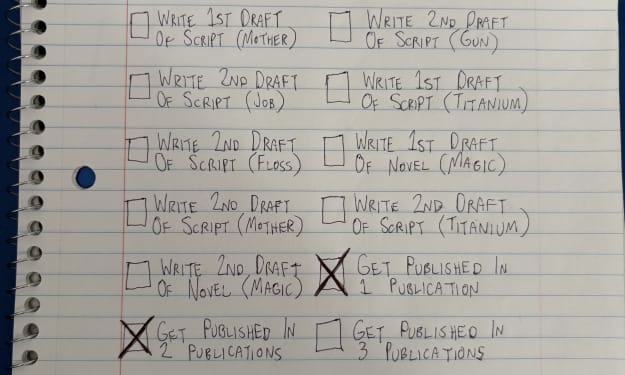
Early March 2026: 4 Goals Accomplished
It's early March and I've now accomplished my 4th writing goal for the year of 2026. Before diving into the behind-the-scenes of it... why not tell you up front what that accomplishment was? I was published in a 2nd publication for this year. Published in Helix Literary Magazine out of Central Connecticut State University. You can read it for free right now!
By Stephen Kramer Avitabile3 days ago in Writers
Should You Use Elementor for WordPress in 2026
Building a professional website used to require strong coding knowledge, design skills, and significant time. Over the past few years, page builders have transformed the way websites are created on WordPress. Among these tools, elementor has played a major role in making website creation easier for beginners, freelancers, and businesses. But the WordPress ecosystem continues to evolve rapidly. New tools, faster frameworks, and improved block editors are changing the landscape.
By Louis Specter4 days ago in Writers



Comments (7)
Thanks, Mackenzie. I believe that curly quotes are for use in fiction and straight quotes are for use in nonfiction. My favorite grammatical comedienne. https://www.youtube.com/watch?v=zEaqySLiAck
Great guide Mackenzie! I guess, for UK, a good pointer re punctuation, is: if it’s the writer’s punctuation, place outside quotes; if it’s the speaker’s, place inside. ’I don’t want’, she said, ‘any more trouble.’ She’d said earlier that she didn’t, ‘want any more trouble’. We’re a confusing nation I know 🫣
Omgggg, I'm so soooo glad you wrote this! I detected some of the mistakes I've made before. I'll be able to correct then from now on. Thank youuuu for sharing this with us!
Glad you compiled this! These tips for writers will enhance their confidence and their readers' experience. One red pencil moment for me--and please forgive me if I'm overstepping--in the subsection on direct versus indirect dialogue under rule 2, could you check the formatting of examples 2 and 3 to confirm that the italics showed up where you intended?
I believe I will share this with my students. Excellent guide, well-delineated. Thank you for doing this.
Very thorough! Definitely did not read this in a panic wondering what I've gotten wrong over the years (nothing that I can tell, thank goodness). A great resource for those who didn't read style guides or the irreplaceable rulebook Eats, Shoots & Leaves. Also, worth noting for punctuation that it's inverted in the UK and other places where they learn British English. At least when it comes to ending punctuation (the punctuation goes outside the dialogue tag): "I can't believe they format it like this".
Such a helpful guide!