
Brahmanical hegemony in India and its political-cultural impact.
ভারতে ব্রাহ্মণ্যবাদী আধিপত্য ও এর রাজনৈতিক-সাংস্কৃতিক প্রভাব।

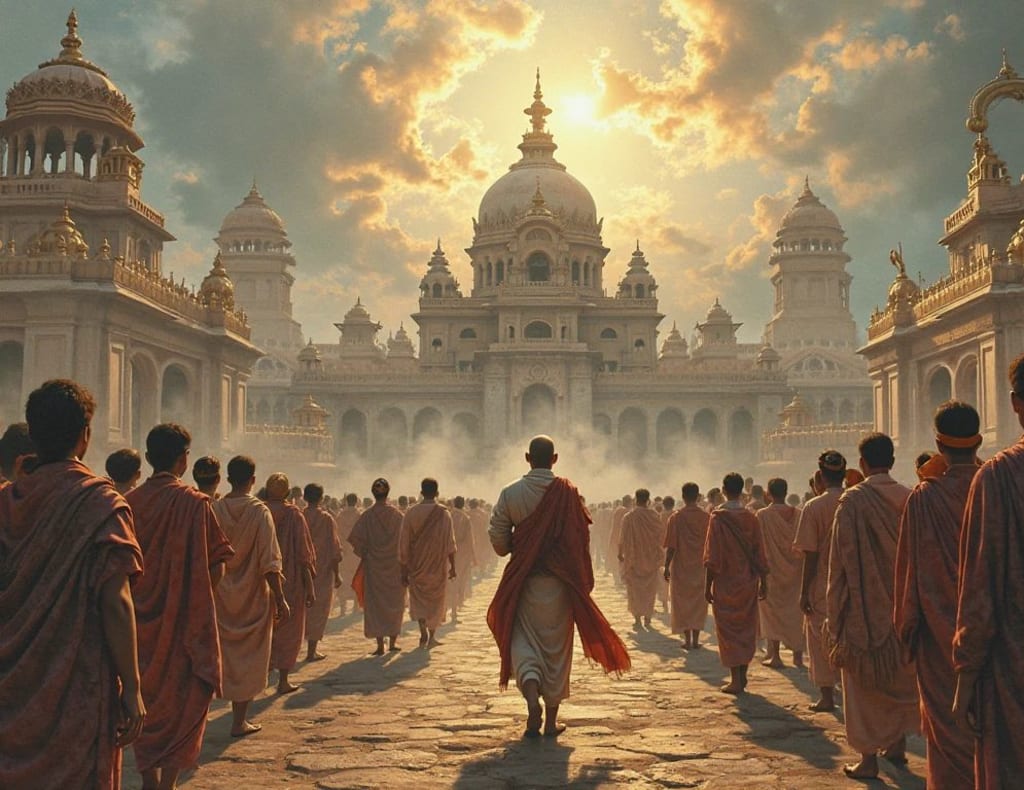
Brahmanical Hegemony in India and Its Political-Cultural Impact
In the history of India, Brahmanism is not just a cultural and religious ideology, but a deep political and social structure that has formed the basis of power, dominance and social distribution for many centuries. This ideology is basically a far-reaching plan to establish the superiority and authority of the Brahmin community, which is not limited to the system of religious worship but has influenced every level of people's personal life, politics, education, law, language and culture.
The foundation of Brahmanism in ancient India was laid through the caste system. In the Vedic era, society was divided into four castes—Brahmins, Kshatriyas, Vaishyas and Shudras. The main purpose of this division was to create a hierarchy in society where Brahmins would be the bearers of knowledge, responsible for the Acharya of worship, and the moral guide of society. In reality, they gradually became the real owners of power. Even the kings were guided by the advice of the Brahmins, who held the religious legitimacy of running the state.
Brahmanism was not limited to religious reforms. It took the form of a school of thought that organized logic, reason, theology and social principles with the aim of subordinating any other class or group. The Manusamhita, which is considered the ancient legal code of Hindu society, clearly states that the Shudras have no freedom, their religion is to pay unconditional allegiance to the Brahmins. There are even such terrible signs as if a Shudra listens to Vedic knowledge, his ears will have to be cut off.
This Brahminical dominance not only created a ruling class, but also recognized a kind of class division in the minds of the common people. It is a system where if a person is born into a lower class by birth, he will be imprisoned in that position for life. This idea has not only brought about social stagnation, but also established a brutal mental slavery.
When the British came to India, the Brahmin class was still in the social leadership. The British used this class for their own interests and created a powerful means of governance. By giving priority to Brahmins in higher education and providing opportunities at various levels of administration, they made this class their allies. As a result, the dominance of Brahmins expanded not only in religion, but also in the administrative and economic structures.
Even at the beginning of independent India, this dominance could not be completely broken. Although the caste system was banned in the constitution and some rights were given to the lower castes through the reservation policy, in reality Brahmin dominance persisted in various forms. Brahminism is still visible in India's education system, historical studies, literature, and even popular culture.
For example, Indian history textbooks have long been written solely around the Brahmin-Kshatriyas, ignoring the contributions of Buddhism, the Shudra rebellion, or Muslim rulers. Brahminists promote their own history as ‘eternal’ or eternal and label any alternative history as distortion or ‘from outside’.
In contemporary politics, this Brahminist hegemony has once again reared its head through Hindutva politics. Organizations like the BJP and the RSS actually want to make Brahminism a state ideology. With the slogan ‘one language, one culture, one religion’, they are busy planning to destroy the pluralistic and secular character of India and build a Brahmin-centric state system.
Another major impact of Brahmin hegemony has been on women. The Manusamhita completely denies women’s rights. It says, “A woman is never free—in childhood under her father, in youth under her husband, in old age under her son.” In this ideology, women are just objects of enjoyment, an element without social status. Even today, in many parts of India, women are not given any rights over their own bodies, choices or lives, which is actually a long shadow of the Brahminical ideology.
However, hope is rising through some emerging progressive movements. Dalit writers, women’s rights activists, tribal organizers and alternative historians are raising the voice of truth against Brahminism. A new generation is emerging in Indian society who want to build their identity not only on the basis of Brahmin-non-Brahmin, but on the basis of human justice and respect.
Ultimately, Brahminism is not a problem of a single community—it has destroyed the social and moral fabric of the entire India. Where a person’s destiny is determined by their birth, democracy is just a lip service. Brahminical supremacy is not just a historical mistake, it is a real threat to the present. Until there is a genuine, society-wide revolt against this ideology, India's independence will remain incomplete.
About the Creator
Keep reading
More stories from Abdul Barik and writers in Writers and other communities.
Islam spread by the sword - truth or propaganda myth?
The Allegation: “Islam Spread by the Sword”—Truth or Propaganda? --- A common complaint in the vast literature of history and religion is: “Islam spread by the sword, that is, by force and coercion.” This statement is not only made by ordinary atheists or Islamophobes, but also by many Western historians, media analysts, and even some well-known Muslim figures. This allegation attempts to portray Islam as a repressive, terrorist ideology, as if it were founded not on the basis of reason, heart, or humanity—but only on the basis of fear and bloodshed.
By Abdul Barik8 months ago in Writers
How to Hire a Virtual Assistant for Personal Organisation and Scheduling
If your calendar feels like a battlefield back-to-back meetings, personal errands, rescheduling, missed reminders you’re not alone. In 2025–2026, more professionals and founders are hiring a virtual assistant (VA) not for “extra help,” but to build a system that keeps life and work running smoothly.
By Michael Coplin5 days ago in Writers



Comments
There are no comments for this story
Be the first to respond and start the conversation.