
Book Reviews: What are they good for?
Answer: More than you might think

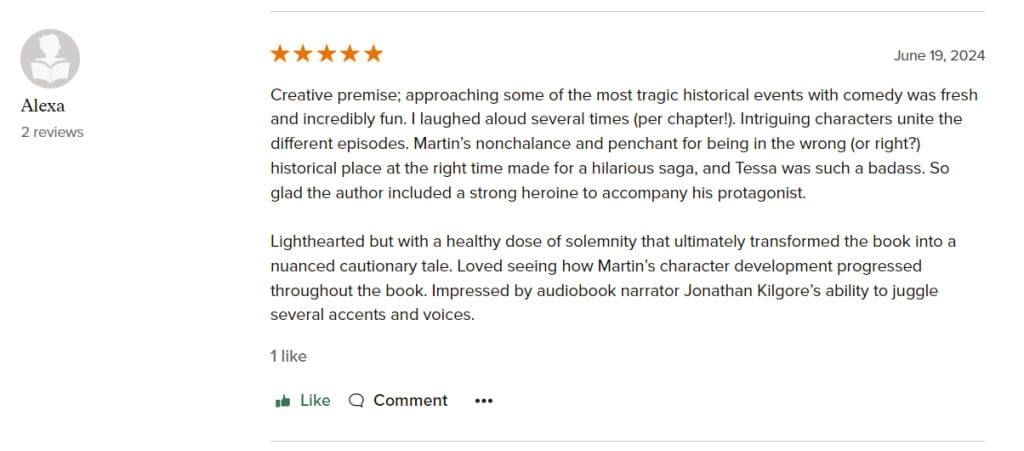
It’s a common refrain. Even big-time authors will ask:
If you enjoyed this book, please consider leaving a review.
Perhaps to the point that a regular reader has become a bit dulled to it all. After all, can my one review really matter when they already have hundreds or even thousands?
It’s a similar quandary when it’s time to vote in our elections in the US.
And much like the large-time author who already commands a massive audience, your vote might not matter as much when aggregated in the millions.
But in state and local elections where the constituency is much smaller, it can matter a whole lot.
For example: when I was first able to legally vote, a family friend was running for Attorney General for the Commonwealth of Virginia. Mark Herring won by less than a thousand votes.
I was one of those votes.
Think of book reviews the same way: your review might not tip the scales for the George R.R. Martins and Sarah J. Maas’s of the author world.
But for someone like me far, far down the ladder, it can have an outsized impact.
There are a lot of good things a review can do, but in the independent publishing world, they answer one question prevalent on a potential reader’s mind (to borrow a Pink Floyd lyric):
Is there anybody (reading this book) out there?
Independent publishing has lowered the barrier to entry for aspiring authors. In many ways, this is a positive.
Conversely, it is a negative.
Because, by lowering the barrier to entry, anyone can publish a book. A standard publishing house will screen manuscripts. They will then put that manuscript through an editorial process from high-level plot and character considerations to the fine detail of proofreading and line edits.
KDP and any other self-publishing service has no such guardrails. Which means there is nothing to stop you from publishing your first draft. Perhaps some readers can look past a few rough spots. But the majority have come to expect a certain standard. Not to mention, they’re investing money up front and time in the longer term to read your book.
Considerations such as the subjectivity of what makes “good” writing aside, nobody wants to read a book riddled with typos and spelling mistakes. Or a book that fails to deliver the big payoff at the end because the author clearly did not have a clear sense of direction.
So, what’s one hallmark that I, the independent author, actually put something out that meets most readers’ definitions of quality?
That little ratings count at the top of the book page, to start:
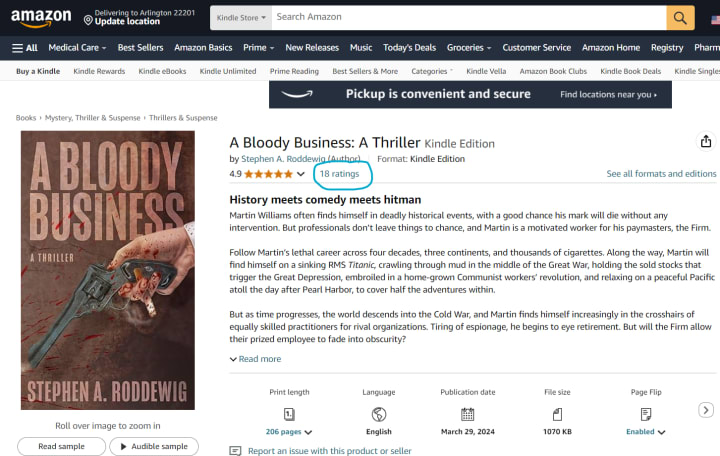
Because, if people invested the money and time to read it and then rate it (positively), then it’s more worthy of consideration than, say, a book with no ratings. You’d probably be a bit leery of that book, wouldn’t you?
Now, just because something doesn’t have ratings doesn’t necessarily mean that people aren’t buying and reading it.
But how’s the prospective reader to know that?
And why would the reader choose that book over a more “sure bet” that has clearly garnered attention and positive feedback? It’s not like there’s a shortage of books out there.
In summary: ratings are helpful because it’s how most readers will make the initial snap judgment: Pass or Consider.
And if we reach the Consider stage, then reviews play their part:
What do readers really think?
There’s a reason the review section is listed farther down the page on Amazon. They’re likely not what a prospective reader is interested in when first visiting the product page.


I will confess: I don’t often read reviews when making my own purchasing decisions. I’m more focused on the number of ratings and their total score (e.g. 4.5) then the actual thoughts behind them. And in the case of books, does the premise interest me? Am I drawn in by the description?
But for others, especially when viewing something with a lower rating count, I imagine reviews will play a bigger part.
What do other readers like? What do they dislike? What’s unique about this book? Why did they give it the rating they did?
The answers to these questions (and others) will likely be the final determinant in which way the reader goes with the Decide stage:
Sure
or
Not this time
Is this book really for me?
And while Not this time might feel like a loss, consider this:
On one end of the spectrum, we have those who like to sit down and watch mindless reality television for their evening entertainment. It doesn’t matter if it’s scripted or if none of it matters in their own lives.
On the other, we have those who will watch historical documentaries despite often knowing full well how it ends. No, the Germans do not conquer Stalingrad this time (or the last 30 times you’ve watched something about the battle), but isn’t it amazing how the Soviets turned the tide?
I imagine there’s incredibly scarce overlap between these camps, and that most view those in the opposing circle with disdain: why waste your time with that?
Point being, it’s impossible to please everyone. I will be forthright and say: those who hate history will probably not like my novel A Bloody Business. I didn’t write it to be a textbook. I certainly try and make it accessible to non-history lovers through action and humor. But there’s no denying the historical element.
Someone who reads Romance exclusively and watches the Bachelor will likely be less than satisfied.
On the one hand, if they bought the book and that was the end of it, it would still be a win. Who knows, maybe they end up loving it!
On the other hand, they buy the book, hate it, and take to the internet to let everyone know. Now I’m dealing with bad reviews. Maybe they even go the extra step to return the book. Now I’ve gotten reamed, and I don’t even have a royalty to show for it.
Rather than attempt to deceive someone who falls outside of my likely audience or otherwise roll the dice, I’d rather this person have all the information they need up front to make an informed decision.
Someone who would be a likely fan might still hate the book. But the odds are far lower than if I’m claiming A Bloody Business will woo fans of the Bachelor with its steamy romance scenes (of which there are none). With that kind of deliberate false advertising, I deserve every bad thing that comes my way.

Instead, I do my best to make it very clear:
A Bloody Business offers heaping servings of action, comedy, and history.
If you like one of those genres, you’ll probably like the book.
If you like all three, you’ll probably love it.
And if you don’t like any of those and/or detest one or more, then we both know your time and money is best spent elsewhere. And that’s okay.
More than okay, that’s great! You made an informed decision. The last thing I want is to waste your time or money when I myself am trying to maximize those.
Objection Handling
Despite all the positives listed here, despite the necessity of these metrics when folks are making the purchase decision, I know not everyone will be convinced.
And it’s pretty easy to think that your words don’t matter. After all, you’re not a literary critic. Why should someone care what an average reader has to think?
Let’s start there:
Why should someone care what an average reader has to think?
Simple: the majority of readers are also not literary critics. The way those people think and feel about books is on a whole different plane than us average folk. The critic searching for the deeper meaning might hate it. You, simply looking for a fun read to tune out the worries after a long day, might love it.
Your voice has meaning!
But I’m not Shakespeare. What if people judge my review for being too plain/too short?
Once again, not everyone needs the flowery language of classic literary reviews. Not everyone understands dressed up prose. Or, they may understand but not consider it meaningful.
And, yes, it can be a common assumption that a review must stretch on for pages and pages. But consider this: I have a review on A Bloody Business that is seven words long (including title).

And isn’t that a bit more digestible and memorable than a thousand-word review? A little can go a long way.
I already bought the book. Isn’t that enough?
You have already done much to support me with your purchase. Do not think for a second I am not grateful. And if that’s all you can do, then I thank you for doing more than most.
But if you really enjoyed it and want to see me write more, then all I’m asking is you do just a bit more to help make that possible. Independent publishing is not cheap (at least, not for someone like me who wants to provide a quality product for my readers). Helping attract more readers and build a following does much to make it financially viable to produce more books in the future.
And, hell, I want to know what you think!
Plus, rating a book is almost as powerful:
Can I just rate the book instead?
Yes, absolutely! Though some platforms like Amazon usually require a written review to accompany the rating. The one exception I’m aware of is when a reader has finished reading the e-book on Kindle and a prompt appears asking them to rate the book.
Still, Goodreads and Audible both will accept ratings without a review, and I’m sure there are others. Plus, not everyone is on Goodreads and not everyone listens to audiobooks, so a rating on these platforms is intensely valuable.
Summary: Review, and review often
To mirror the Get Out the Vote message my fellow Americans are being blitzed with at the moment: Go review!
…it’s not your constitutional duty, but it’s still a nice thing to do. Make your voice heard!
And while you should vote and/or review no matter the size of the constituency/readership, spare a special consideration for your local elections and/or small-time authors where your vote/review can have an outsized impact.
Man, I really pushed that metaphor as far as I could, didn’t I 😉
And know that while the Lee Childs of the author world likely don’t give a damn what you have to think (unless, for example, you’re a book critic for The New York Times), us independent authors certainly do.
We’re listening. And we’re incredibly grateful you took the time to share your thoughts.
About the Creator
Stephen A. Roddewig
Author of A Bloody Business and the Dick Winchester series. Proud member of the Horror Writers Association 🐦⬛
Also a reprint mercenary. And humorist. And road warrior. And Felix Salten devotee.
And a narcissist:
Keep reading
More stories from Stephen A. Roddewig and writers in Writers and other communities.
My Publishing Strategy
TLDR: Since publishing my first book 5 months ago, I’ve tried some promotions. Some worked, some didn’t. I’ve codified the best bits of strategy and advice below. But wrap it all in one giant “in my opinion/in my experience” asterisk.
By Stephen A. Roddewig2 years ago in Writers
Writing To Succeed
If you want to find something that will help readers find your writing, possibly expand your audience, and maybe even get you noticed for other things, then you’re not alone. But how can you get it done in a world full of want-to-be writers? Look less at what you’re writing now, and more at what other writers have used to boost their views and reads.
By The Man Behind The Mask8 days ago in Writers
What to Know About Spanish Book Translation in 2026
Maria took two years to write her first novel. When a Spanish-language publisher came calling, she faced an unforeseen hurdle: finding someone with the ability to translate her book without losing its voice. Three translators later, she learned that spanish book translation consists of so much more than converting English words into equivalents in Spanish.
By Hillshire Media2 days ago in Writers




Comments (3)
Love this Stephen!! Look forward to voting for you next campaign , I mean reviewing your book on amazon when I finish it!! 😂 Seriously though, so well said and such a great reminder!!
Couldn't agree more. I love getting a review!
I promise I will leave a scathing review targeted at the key bachelor watching demo.