
Blues Empress of Harlem
Zora's Blues: The Rise of a Jazz Queen


Chapter-1: The Girl with the Golden Voice
The summer air in New Orleans was thick with the scent of magnolias and the sound of brass horns. At sixteen, Zora Cunningham had already learned that the world was not kind to a Black girl with big dreams. The doors that opened for others remained shut for her. Employers saw her as just another pair of hands, not a talent waiting to bloom. Club owners waned a pretty face to entertain their guests, not a woman who demanded to be heard. Even in music, where voices were supposed to be free, she knew the best stages were reserved for those society deemed worthy. She spent her days hemming dresses in a small tailor shop and her nights sneaking into the juke joints of Basin Street, where the real magic happened.
"Sing for us baby girl!" old Mr. Dupree would say, tapping his cane on the wooden floor. And sing she did. Her voice, rich and smoky like the bourbon on the bartender's shelf, filed the air with a sorrow that made grown men weep and women press their hands to their hearts.
Mr. Dupree was a rarity in their world: a Black man who owned his own juke joint. Born the son of a freedman, he had spent years working on riverboats, saving every dollar until he could buy his own slice of freedom. When a white saloon owner lost everything in a bad gambling hand, Dupree swooped in and took over the place for pennies on the dollar. Against the odds, he built it into the most popular juke joint in New Orleans, a place where Black musicians could play without fear of being run out, and where the music of their people was celebrated, not stolen.
Dupree saw something in Zora that reminded him of himself, an unwillingness to bow to the world's expectations. "You got somethin' special, girl. Don't let no one take it from you," he'd tell her. His words stayed with her, long after she left Basin Street behind.
But New Orleans was not a place for a girl like her to rise. The stage she longed for was elsewhere, and when a traveling musician told her about the Harlem clubs, she knew she had to go.
*********************************************************
Chapter-2: TheSeamstress
One sweltering afternoon, Zora found herself lingering outside a department store, watching white women in lace gloves step through the grand doors without a second thought. She needed new fabric for a dress she had planned to sew, but the moment she entered, the clerk's gaze turned sharp.
"We don't serve your kind," the woman sneered, arms crossed tight over her apron. The sting of rejection was familiar, but it burned all the same.
Zora clenched her fists, refusing to give the woman the satisfaction of seeing her back down. "My money's as good as anyone else's" she said, but the clerk simply pointed to the door.
She left, head high, but that day, she made a vow: if the world wouldn't give her space, she would carve one out herself. That defiance would follow her, shaping the way she fought for her dreams.
It wasn't just stores that shut her out. A few months later, she and her best friend, Claudette, decided to attend a performance at a whites-only theater. They pooled their money for tickets, hoping to hear the famed jazz pianist Benny Goodman. But when they approached the door, the usher blocked their way.
"You best find the colored section round back, if they let you in at all," he muttered.
Claudette tugged at Zora's arm urging her to leave, but Zora wasn't one to walk away so easily. She spotted a small group of Black musicians tuning their instruments nearby. With a boldness that surprised even herself, she walked up to them and asked, "Why do we gotta wait for them to let us in when we got our own sound?"
That night, instead of standing in the shadows of a segregated venue, Zora and the musicians set up an open lot down the street. The music spilled into the night, drawing a crowd bigger than any inside that theater. Passersby swayed to the rhythm, some even dropping money into a bucket. The police eventually came, but by then, the message had already been sent: Black music didn't need anyone's approval to thrive. At just sixteen, Zora had already begun playing a role in the cultural and political shift of her time. She refused to let segregation, gender inequality or economic limitations stop her from claiming her place in the world. The stage was still far away, but her voice was already making waves.
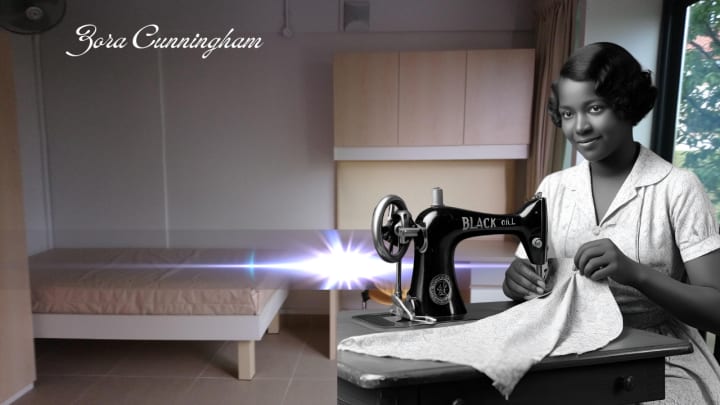
Back at home in her small dimly lit room, she stood in front of the small vanity. The golden glow of the evening lamp catching the sheen of the satin dress draped over her sewing table. She ran her fingers over the fabric—soft, luxurious, though slightly worn at the edges. It had once been a gown gifted to her by Miss Hattie, an older seamstress at the dress shop where Zora worked part-time. “Just needs a little love,” Miss Hattie had said with a knowing smile.
She had spent the last few nights stitching and shaping it into something new—something that fit not just her body but the woman she was becoming. A sleek, floor-length gown, its bias-cut design cascading down in smooth, elegant folds. The bodice hugged her frame just right, the sweetheart neckline accentuating the confidence she carried when she stepped onto the stage. At the back, a daring V-shape dipped low, just enough to hint at the glamour of the jazz divas she admired—women like Josephine Baker and Billie Holiday, who owned every room they entered.
Tomorrow, she would perform at Duprees Juke Joint and she had to look her absolute best. She put the simple pearl necklace to her neck, the tiny beads cool against her skin. They will go perfect with her gown. The shoes that she picked, a pair of strappy heels—scuffed, but polished to perfection—waited to be worn. They had carried her through every late-night dance, every hurried walk home beneath the streetlights, and tomorrow, they would carry her onto the stage once more.
She was almost finished making her gown, adjusting the beading she had carefully sewn along the neckline. The tiny embellishments caught the light as she moved it around, shimmering like the stars over a midnight sky. A lace shawl rested on the chair nearby, delicate yet sturdy, much like herself.
After finishing the dress, she tried on everything, pleasant with the reflection that she saw in the mirror. Tomorrow, the women are going to be holding their men tightly to them. The men will be drooling, hypnotized by her presence, traumatized by her voice. Zora made herself ready for bed. She could barely sleep from all the excitement she was feeling. But it was not long before she was in dreamland.
********************************
Chapter-3: QueenOfTheJukeJoint
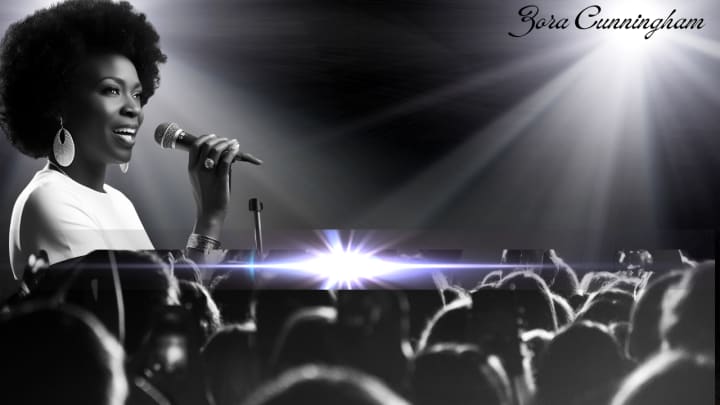
The warm, sticky air inside Mr. Dupree’s Juke Joint buzzed with energy. The scent of whiskey, sweat, and slow-cooked gumbo mixed with the sweet, smoky haze of cigars. Laughter and chatter filled the dimly lit room, but when Zora Cunningham stepped onto the small wooden stage, a hush settled over the crowd like the calm before a summer storm.
She was a vision in her sapphire-blue satin gown, the bias-cut fabric catching the glow of the low-hanging lanterns. The beading she had sewn by hand twinkled like stars, reflecting the anticipation in the eyes of the audience. She took her place at the microphone, one gloved hand resting on the cool metal stand, and let her gaze sweep over the sea of expectant faces—men in sharp suits, women with feathers in their hair, old-timers hunched over their drinks, waiting for the music to wash over them.
Behind her, the band was poised—trumpet, upright bass, and a slow-dragging piano that set the tone. Zora closed her eyes for just a moment, feeling the pulse of the room, the weight of the night. Then, she opened them and began to sing.
Her voice was syrup and smoke, rich and full, carrying the weight of stories untold. The notes curled through the air like wisps of steam rising from a river at dawn. The slow, honeyed blues of the first verse had couples swaying at their tables, fingers tracing the rims of half-empty glasses. But then—oh, then—she let loose.
The tempo picked up, the bass thumped steady as a heartbeat, and Zora threw herself into the song like a woman possessed. Her voice soared over the wailing trumpet, bending and stretching each note like taffy. She didn’t just sing—she testified. Her hips swayed, her hands lifted, fingers snapping in rhythm with the drum. She let out a soulful holler, the kind that made old men slap their knees and young women throw their heads back in laughter.
Mr. Dupree himself, standing behind the bar, whistled low and muttered, “That girl got the spirit in her tonight.”
By the time she hit the final note, the room was alive—stomping feet, clapping hands, voices shouting her name. The music had settled deep into their bones, and Zora, chest rising and falling with each breath, smiled wide. She wasn’t just a singer.
Tonight, she was the queen of the juke joint.

Chapter-4: Nothing In Life is Free!
It was time for Zora to make another gown. There was only so many ways to style the same dress. She found herself back in front of the department store that had the fabric she needed, the one that refused to serve her. This time, she walked into the store without hesitation. The older clerk who had turned her away was nowhere in sight. Instead, a younger cashier, a pale-skinned girl with auburn hair and kind eyes, stood behind the counter. The girl hesitated at first, then smiled. "You're her, aren't you? The girl that sang in the open lot last week?"
Zora lifted a brow. "That depends. You gonna tell me you don't sell to my kind too?"
The girl flushed. "No, no, I-I liked your voice. You were amazing. I don't care what my boss says. What do you need?"
Zora crossed her arms. "That fabric over there," she said pointing to the material she wanted. The girl nodded and quickly gathered the material Zora requested. As she rang up the sale, she leaned in. "Listen . . . I got a big brother who plays trumpet. He's real good, but he don't get a chance to play nowhere. Maybe we could meet? You know, behind Dupree's juke joint? Maybe he could play for you?"
Zora quickly pushed her money back into her purse. "Oh my," she said. "Would you look at that? I'm sure that I had the money for this before I left home today. Oh that's right! I switched purses. I have to go get . . ."
"No, no wait," the girl said. "Just take it."
"Are you sure?" Zora said. She wondered if the girl knew what she was doing because she was always taught that nothing in this world is for free.
"Yes. I am sure," the girl said. "Will you listen to my brother?" she asked holding out her hand. "Do we have a deal?"
"Eight o'clock," she said shaking her hand and grabbing the bag from the counter. "Don't be late!" she yelled over her shoulder as she rushed out the door. She had a gown to make.

Chapter- 5: The Budding Forbidden Romance
Zora Cunningham had never been in love before- not truly. She had danced with boys at juke joints, batted her lashes at handsome musicians and laughed at the sweet-talking fellas who thought a wink and a slick smile would win her heart. But none of that had ever stirred her the way Thomas McMillian did.
That night, behind Dupree's, the sound of a lone trumpet cut through the thick air. The girl's brother, Thomas was tall, dark-haired and handsome. He played the trumpet like the world had yet to hear him. Zora felt something stir deep in her chest, not just admiration, but something more dangerous.
Inside Duprees she watched him as he mingled with the crowd. His kind was not always welcomed here but for some reason the crowd loved Thomas McMillian. Maybe it was the horn. Maybe it was his southern charm. Maybe it was his smile and those dimples that melted their defenses faster than any hatred ever could.
He wasn't like the guys that she knew. He was a white boy, the son of a shopkeeper who sold fine linens and imported perfumes in the French Quarter. He had the kind of quiet charm that snuck up on you, soft-spoken but sharp-eyed, his voice carrying the lilt of old Southern wealth. He should have been just another face in the world, another person who never truly saw her. But Thomas saw her. And that was the problem. Zora knew better. A Black girl in 1930's New Orleans didn't fall for a white boy. She didn't steal glances when she walked past his father's shop, didn't linger when their eyes met by accident. She didn't let her heart race when he spoke her name, low and careful, like it was a secret he didn't want the world to hear. But she did.
At night, lying beneath the slow-churning fan in her tiny bedroom, she thought of his hands touching hers, sending a sweet shiver through her body. She thought of the ways his eyes softened when she laughed, how he always seemed to pause for just a second longer than he should when she was near. It was dangerous, foolish even, to let herself dream. Because dreams like this could break a girl.
She imagined what it would be like if the world were different. If she could walk beside him, touch his hand in the open air without fear. If she could love him freely, without the weight of knowing it could never last.
But this was the South in 1934, and love like that was a whispered thing, a dangerous thing. It could get a girl killed. It could ruin a man. So she swallowed it down, tucked it away beneath the music, the laughter, the life she had carved out for herself. But no matter how much she tried to bury it, the truth remained: She was falling for someone she could never have. And that kind of love was the cruelest of all.
The first time Zora heard Thomas play, it was like the Mississippi itself had found a voice- deep, winding and full of sorrow. His trumpet sang through the humid night, weaving through the sounds of the juke joint's laughter and clinking glasses like it had a purpose all on its own.
She leaned against the brick wall behind Dupree's, arms crossed as she listened. She could not deny his tall lean body, his skin paler than hers but tanned from the sun, his dark hair slicked back in a way that made him look like he'd just stepped off a city train. He played like a man who had something to prove, and Zora, for the first time in a long time, found herself intrigued.
When he finished, the small crowd that had gathered clapped politely. Zora didn't. She let the silence hang between them, waiting until his blue eyes met hers.
"You're good" she admitted. "But you don't know blues."
Thomas arched a brow. "That so?"
She nodded. "Blues ain't just notes on a page. It's a feelin'. It's what you play when you got nothin' left but a song." She stepped closer, her gaze never leaving his. "You ever had nothin', Thomas?"
Something flickered across his face, a shadow of a memory. He cleared his throat. "I've had enough."
"Not enough," Zora said simply turning toward the back entrance of the juke joint. "But maybe you'll learn."
The heat between them grew like an untamed fire- slow at first, simmering beneath glances and unsaid words. But the more time they spent together the harder it became to ignore the pull. The juke joint had its own rhythm, its own chaos. But within all that madness, Zora and Thomas found pockets of quiet-places where the world didn't watch so closely.
One night, when the music had faded and the last of the customers stumbled home, Thomas lingered outside with her. "You ever scared?" he asked.
She tilted her head to meet his glare. "Of what?"
"This," he said softly.
She let the word settle between them before answering. "You think I don't feel it every time I step outside my door?"
He stepped closer. "Then why don't you walk away?"
She trailed her fingers along the edge of his sleeve. "Because don't want to."
That night, at an abandoned church, she met him in secret. His hands were on her before she could take another breath-warm, firm pulling her in. His lips hovered over hers, waiting, waiting. She closed the space between them. And nothing else in the world mattered. That was how it began.

Chapter- 6: Smoke and Shadows
The world outside did not allow for them. But in the hidden corners of the night, away from prying eyes and judgmental whispers, Zora and Thomas found a universe where only they existed.
Their secret meetings stretched through the humid Louisiana nights, stolen moments behind the juke joint, whispered conversations in alleyways, fingers grazing when no one was looking. But it wasn’t enough.
One evening, after a particularly electrifying performance at Dupree’s, Thomas pulled Zora aside, breathless from the night’s energy. "Come with me," he said, his blue eyes dark with something dangerous and desperate.
"Where?" she asked.
"Away from all this. Just for a while."
She hesitated, but only for a second.
The weight of the world could wait.
They ended up at a run-down barn just outside the city limits, a place Thomas had stumbled upon in his restless wanderings. The wood smelled of age and rain, and the only light came from the slivers of moonlight cutting through the gaps in the walls.
Thomas laid his trumpet down gently, then turned to her.
"Zora," he murmured, stepping closer. "You know what happens if—when—they find out."
She swallowed, nodding.
"They won’t find out," she whispered, though they both knew better.
His fingers traced along her jaw, tilting her face toward his. "I don’t care," he said, voice thick with something more than lust—something deeper, something dangerous.
She let herself drown in it.
Their lips met, slow at first, tasting the danger, the forbidden fruit of their existence. But the slow burn did not last—the need was too great, the fire too consuming.
The barn held their secrets that night. The scent of old hay and sweat mixed with the deep sighs of two people who had found something no world, no rule, no hatred could erase.
But the night could not last forever.

Chapter 7: The Whispers Begin
They thought they were careful. But the South had eyes everywhere.
The first sign came in the form of silence. The kind of silence that feels like it’s listening. Watching. Waiting.
Zora had been in the small-town store a dozen times before without issue. Each time, the chime above the door rang out and Margaret, the younger cashier and Thomas’s sister, would greet her with a grin as wide as summer. But this time, when the chime rang, Margaret barely looked up. Her shoulders stiffened. Her smile never came.
Zora hesitated, then made her way to the counter, trying not to read too much into it. She picked up a tin of salve and a spool of thread, her movements casual, practiced.
"You need to be careful," Margaret murmured under her breath, barely moving her lips.
Zora froze, then tilted her head slightly. "What are you talking about?"
Margaret’s eyes didn’t meet hers. Instead, they flicked toward the older man in the corner aisle, then back to the register. Her hands trembled slightly as she rang up the items.
"People are talkin’, Zora."
Zora’s heart thumped once, hard. "Who?"
Margaret swallowed. "I don’t know for sure. But I heard my father say something over supper. Someone saw you two—maybe not together, but... close enough. Enough to start guessing."
Zora kept her face calm, her breath even. Her fingers curled around the edge of the counter. The hum of the ceiling fan above seemed louder than before. Time slowed, thickened.
"You didn’t say anything, did you?" she asked softly.
Margaret finally looked at her. There was fear in her eyes—but also loyalty. "Of course not. But Zora, it’s not just about what I say. It’s about what folks think they see."
Zora nodded slowly. She gathered her things, placed her coins on the counter, and offered a faint thank-you. As she turned to leave, Margaret added under her breath, "They’re watching now. Be smart."
The bell above the door rang again as Zora stepped out into the thick Southern heat. The sun felt different now. Less like light, more like a spotlight.
The whispers had begun.
And once they started, they rarely stopped.

Chapter-8: Caught in the Storm
The night it all came crashing down, the air smelled of rain, thick and heavy.
Zora was waiting behind Dupree’s, hidden in the shadows. Thomas was late, which was unusual.
Then she heard it—footsteps. But not his.
Three figures emerged from the darkness. White men, broad-shouldered, rough-faced.
"Well, well," one of them drawled. "If it ain’t the little songbird waitin’ for her white knight."
Zora felt her heart slam against her ribs. She stepped back, but they moved closer.
"Ain’t no place for mixin’, girl," another sneered. "Ain’t right."
She lifted her chin. "I don’t know what you’re talking about."
A hard grip clamped onto her wrist. "Don’t play dumb."
Then, like a ghost out of the night, Thomas was there.
"Let her go."
His voice was low, controlled—but there was a tremor in it, one that only Zora caught.
One of the men turned. "Boy, you sure got some nerve."
Thomas squared his shoulders. "She ain’t done nothing to you."
A slow smile spread across the man’s face. "That’s where you’re wrong."
The first blow came fast—Thomas barely had time to react before a fist connected with his jaw, sending him sprawling. Zora screamed, lunging forward, but rough hands grabbed her, yanking her back.
Thomas stumbled to his feet, wiping blood from his mouth. "Let her go."
The men laughed. "That ain’t how this works."
But before they could land another punch, a voice rang through the alley.
"What the hell y’all doin’?"
Old Mr. Dupree.
He stood at the edge of the alley, shotgun in hand, eyes burning with rage. "Y’all best think real hard ‘bout what happens next."
The men hesitated.
"You know damn well who I am," Dupree continued. "And you know damn well what happens if you start somethin’ you can’t finish."
The tension hung thick.
Finally, one of the men spat on the ground. "This ain’t over."
They turned and disappeared into the night.
Zora ran to Thomas, helping him up. His lip was split, his eye already bruising.
Dupree exhaled. "Y’all need to be smart. The South don’t take kindly to… this."
Zora’s hands trembled. "What do we do?"
Dupree looked at Thomas. "You got somewhere to go, son?"
Thomas hesitated. "I can leave. But I won’t go without her."
Zora sucked in a sharp breath.
The choice was hers.

Chapter 9: The Road to Freedom
The dim light from Dupree’s backroom lantern flickered against the walls, casting shadows that swayed like restless ghosts. Zora pressed a damp cloth to Thomas’s bruised cheek, her fingers trembling slightly. The fight he had gotten into earlier that evening—defending her honor, as he put it—had nearly cost him more than a busted lip and swollen knuckles.
"Don’t look at me like that," Thomas muttered, wincing as she dabbed at the cut on his lip.
"Like what?"
"Like I’m some fool."
Zora sighed and pulled away, wringing the cloth in her hands. "Because you are one."
Thomas smirked despite the pain. "Well, if I’m a fool, then I’m your fool."
She scoffed, trying to ignore the way her heart ached at his words. "That’s the problem, Thomas. You can’t be mine. Not here. Not now."
His expression darkened, and he reached for her hand, his calloused fingers lacing with hers. "Then let’s go," he whispered. "Let’s get on that train tomorrow night and never look back. Harlem. Chicago. Anywhere but here."
Zora pulled away as if burned. "You don’t know what you’re saying."
"The hell I don’t," he snapped, his frustration boiling over. "I know exactly what I’m saying. I love you, Zora. I’ve loved you since the first time I heard you sing behind this damn juke joint."
Zora’s breath hitched. She had dreamed of hearing those words, but now that they had been spoken, they felt like a noose tightening around her.
"Love ain’t enough, Thomas," she said softly, shaking her head. "Not for folks like us."
Thomas stood, pacing the small space, his hands in his hair. "Who says it ain’t?"
"The whole damn world!" she shot back. "Do you know what they’ll do to you if they catch you with me? If we run? Ain’t no city in this country that’ll let a white man and a Black woman live like they belong together. We won’t make it, Thomas. They’ll drag you back home in a pine box, and me…?" She trailed off, shaking her head.
His voice was raw with desperation. "Then let them come. Let them do whatever they want. I’d rather die with you than live another day pretending I don’t want you."
Zora clenched her fists, fighting the tears stinging her eyes. "And I’d rather you live."
Silence hung thick between them, heavier than the humid Louisiana night.
Thomas swallowed hard. "So you’re saying no."
Zora bit her lip so hard she tasted blood. She wasn’t saying no because she didn’t love him. She was saying no because she did.
"You belong here, Thomas," she whispered, her voice barely holding steady.
His eyes flashed with hurt. "And you don’t?"
She shook her head.
The train whistle howled in the distance, as if mocking them both.
"You gonna forget about me when you get up North?" His voice was hollow, but his gaze was searching, begging for a lie.
Zora exhaled shakily. "Never."
Thomas nodded, running a hand through his dark hair before looking away. "Then go, Zora." His voice was thick with emotion. "Go be the star you were meant to be."
She reached for him one last time, fingertips grazing his bruised cheek. He leaned into her touch, just for a moment, before she pulled away.
Zora turned, swallowing her sobs, and walked out the door.
The next night, she was on a train to New York.
She never looked back.
But she never stopped listening for his music in the wind.
The train to New York was long, and the city was cold when she arrived. Harlem was alive with jazz, poetry, and the rhythm of change. She took work as a seamstress by day, but by night, she prowled the speakeasies, waiting for her chance.
That chance came when the famed Savoy Ballroom held an open mic night. Stepping onto the stage in a dress she had sewn herself, Zora took a deep breath and let her soul spill into the microphone. The crowd fell silent, then erupted into applause. A man in the front row, a sharp-dressed music producer named Reuben Glass, approached her after the set.
"That voice of yours—it's got the spirit of the blues and the fire of jazz. You come see me tomorrow. We’re gonna make history."
Chapter 10: The Rise and the Cost
Zora’s career took off like a whirlwind. She recorded her first hit, Midnight Lament, and soon found herself on tour with Duke Ellington’s band. The money, the fame, the flashing lights—it was everything she had dreamed of. But it came at a price.
The industry was ruthless, especially for a Black woman. Labels took more than they gave, and club owners treated her like an exotic prize rather than an artist. She fought back, starting her own record label, Cunningham Records, in 1935—one of the first Black woman-owned labels in the country.
With success came enemies, and Zora soon found herself facing threats from men who wanted to control her. But she had survived too much to be silenced. With a pistol in her purse and her voice as her weapon, she kept singing.
New York had given Zora everything she ever wanted—fame, fortune, and a stage big enough to hold her dreams. But even with all that, she could never escape the shadow of what she left behind.
Thomas.
In the early days, she saw him everywhere. In the flicker of candlelight on the stage, in the way a stranger’s laugh carried across a crowded room, in the deep, longing notes of a trumpet floating through the city’s midnight air. She'd spin around, expecting to see him leaning against a lamppost, hat tilted low, watching her with0 those intense blue eyes. But it was always someone else.
Time passed. The pain dulled, but it never disappeared.
She became the darling of Harlem, her name lighting up club marquees, her records played in dance halls from New Orleans to Chicago. Reuben Glass had been true to his word—she was making history. Yet, no matter how many men tried to woo her, no matter how many arms she fell into late at night, she never found what she had with Thomas.
Then, one night at The Cotton Club, she saw him.
At first, she thought she was imagining it, like so many times before. But when the music stopped and the lights came up, he was still there, standing in the back, just beyond the glow of the chandeliers.
Zora’s heart pounded so hard she thought the whole room could hear it. She barely made it through the rest of the set. And by the time she got backstage, he was gone.
It wasn’t until weeks later that she learned the truth.
Thomas had become famous in his own right. No longer just a boy with a horn, he was now Jonathan Hale, the jazz world’s brightest star. Under his new name, he played in Paris, in London, in clubs where only the finest musicians were allowed to grace the stage. Critics called him a genius, the sound of a generation.
She called him a ghost.
Because that’s all he was to her now.
He showed up at a few of her performances over the years, always lingering in the shadows. Sometimes, she caught a glimpse of him just before the lights dimmed. Other times, she’d hear that unmistakable tone of his horn on a record, knowing he was out there somewhere, playing to the world but thinking of her.
And then there was the night she saw him with his wife.
She was beautiful. Blonde. The kind of woman the world approved of. She sat in the corner of the club, watching him with adoration, her gloved hand resting lightly on his arm. Thomas never looked Zora’s way, but she felt him there.
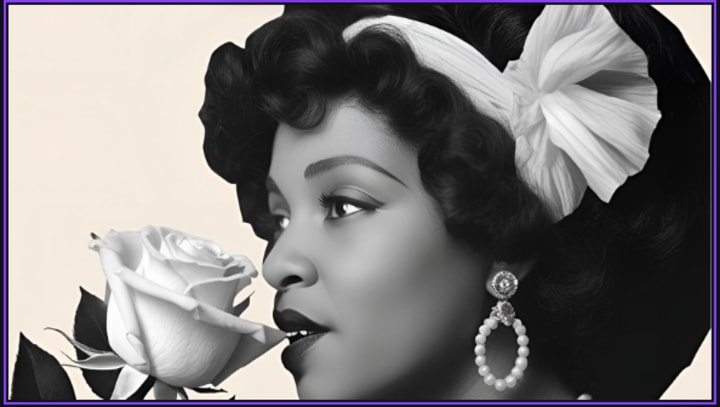
Later that night, after the club had emptied, she found a single white rose in her dressing room.
No note. No name.
But she knew.
And as she held the flower to her chest, breathing in its soft, sweet scent, she realized that some loves don’t fade. They simply exist—just out of reach, just beyond the light, forever playing in the background like a song that never truly ends.
About the Creator
BeeSparrow
I’m Bee Sparrow.
I write stories born from real life, sparked by imagination, and shaped with the help of AI. They’re short, soulful, and waiting for you. Your next favorite story might be one click away.
Keep reading
More stories from BeeSparrow and writers in Writers and other communities.
I Knew
**Introduction:** Sometimes, words written in the past carry even more meaning in the present. While going through my old writings, I rediscovered poetry I wrote back in 2010, during my mid-20s—a time of reflection, growth, and deep emotions. These pieces capture moments of love, struggle, and self-discovery, and I’m excited to share them with you.
By BeeSparrow12 months ago in Poets
Unofficial Challenge: Black History Celebration
Forward: February 28th, 10:53 PM, EST... The final hour of Black History Month, 2026. Hello fellow writers. I've had this challenge waiting in my drafts for most of the month. But I held off on publishing it, until now.
By Sam Spinelli7 days ago in Writers
Real men drink, right?
He has a problem. He’s felt it for years now, but he refuses to face it. He doesn’t want to admit it, to himself or to the people around him. All his heroes were the same. He likes to recall the scene where James Bond sits in a dusty pub in Latin America, a glass of whiskey in hand, his gaze fixed on a scorpion crawling across the bar. When he first fell for literature, it was Post Office and Women, which he read over and over again. Without those cans of beer and bottles of cheap whiskey, Bukowski’s work wouldn’t have been so raw, so honest. Even Vaclav Havel spent most of his nights in Prague bars; without that, he wouldn’t have been who he was. Those were the real men.
By George Roastabout 20 hours ago in Writers


Comments (1)
Thank you so much for being transparent about using AI 😊