
Artificial Intelligence in Cybersecurity: Revolutionizing Threat Detection and Response
As a cybersecurity expert & AI enthusiast, I explore how AI transforms threat detection & response, boosting defenses against cyber threat.


Introduction
As digital landscapes evolve, so do the threats that lurk within them. Cybersecurity has become an essential facet of our digital lives, protecting everything from personal data to national security. Traditional methods of cybersecurity are proving to be insufficient against sophisticated cyber-attacks. Enter Artificial Intelligence (AI) – a transformative technology that's redefining how we defend against cyber threats.
The Growing Need for AI in Cybersecurity
Cyber threats are becoming increasingly complex, with hackers employing advanced techniques to breach security systems. Traditional cybersecurity measures, which often rely on predefined rules and human intervention, struggle to keep pace with these dynamic threats. AI, with its ability to learn and adapt, offers a powerful solution.
The future of AI in cybersecurity looks promising, with ongoing advancements expected to enhance its capabilities further. Researchers are exploring new ways to improve AI algorithms, making them more robust and resilient against adversarial attacks. Collaboration between AI developers, cybersecurity experts, and policymakers will be crucial in addressing the challenges and ensuring that AI is used responsibly and effectively in the fight against cyber threats.
How AI Enhances Cybersecurity
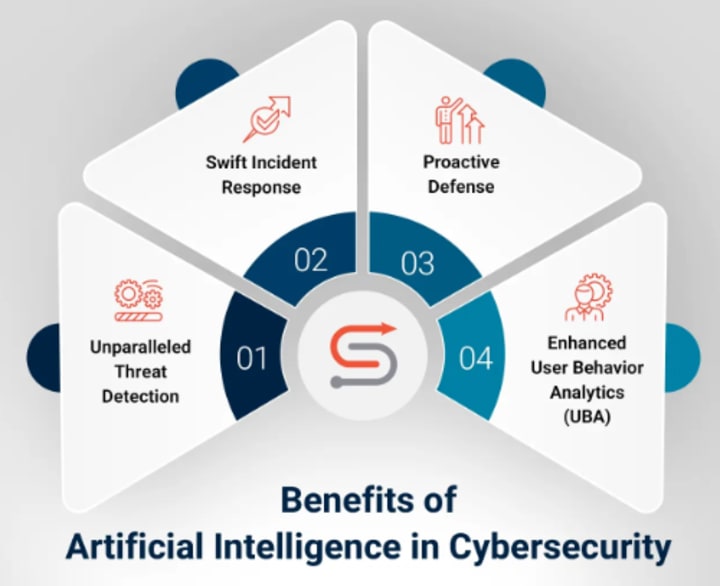
AI enhances cybersecurity in several ways, from threat detection and response to predictive analytics and user behavior analysis.
1. Threat Detection and Response
AI-powered systems can analyze vast amounts of data in real-time, identifying patterns and anomalies that may indicate a cyber-attack. Machine learning algorithms can be trained to recognize the signatures of known threats and detect new, previously unidentified threats. This capability allows for faster detection and response, significantly reducing the potential damage of an attack.
2. Predictive Analytics
Predictive analytics involves using historical data to predict future events. In cybersecurity, AI can analyze past cyber-attacks to predict potential future threats. This proactive approach enables organizations to strengthen their defenses before an attack occurs, rather than reacting after the fact.
3. User Behavior Analytics
AI can monitor user behavior to detect unusual activities that may indicate a security breach. By establishing a baseline of normal behavior, AI systems can identify deviations that suggest malicious intent. For example, if an employee who typically accesses files during business hours suddenly starts downloading large amounts of data at night, the AI system can flag this activity for further investigation.
4. Automated Incident Response
When a cyber threat is detected, AI systems can automate the response process, such as isolating affected systems, blocking malicious IP addresses, and alerting security personnel. This automation reduces the response time and minimizes the impact of the attack.

Real-World Applications of AI in Cybersecurity
1. Darktrace
Darktrace is a cybersecurity company that uses AI to detect and respond to cyber threats in real-time. Its technology, known as the "Enterprise Immune System," mimics the human immune system, learning to detect normal patterns of behavior within an organization and identifying deviations that may indicate a threat. Darktrace's AI continuously adapts to new threats, providing a dynamic defense mechanism.
2. IBM Watson for Cyber Security
IBM Watson leverages AI to analyze vast amounts of unstructured data, such as security blogs, research papers, and news articles, to provide insights into emerging threats. Watson's natural language processing capabilities allow it to understand and interpret human language, making it a valuable tool for threat intelligence and incident response.
3. Cylance
Cylance uses AI and machine learning to predict, prevent, and respond to cyber threats. Its AI-driven endpoint protection solution, CylancePROTECT, can block malware, ransomware, and other malicious files before they execute, reducing the risk of infection. Cylance's AI models are trained on millions of samples, enabling them to identify and stop threats with high accuracy.
Challenges and Future Prospects
While AI offers significant advantages in cybersecurity, it is not without challenges. One major concern is the potential for AI to be used by cybercriminals to develop more sophisticated attacks. Additionally, the reliance on AI systems raises questions about transparency and accountability, particularly in cases where AI decisions impact critical security operations.
The Road Ahead
The future of AI in cybersecurity looks promising, with ongoing advancements expected to enhance its capabilities further. Researchers are exploring new ways to improve AI algorithms, making them more robust and resilient against adversarial attacks. Collaboration between AI developers, cybersecurity experts, and policymakers will be crucial in addressing the challenges and ensuring that AI is used responsibly and effectively in the fight against cyber threats.
Conclusion
Artificial Intelligence is revolutionizing cybersecurity, offering new tools and techniques to detect, predict, and respond to cyber threats more effectively than ever before. As cyber-attacks become more sophisticated, the integration of AI into cybersecurity strategies will be essential in protecting our digital world. By harnessing the power of AI, we can build a more secure and resilient cyberspace, capable of defending against the ever-evolving landscape of cyber threats.
About the Creator
Maneesh Kumar
Tech enthusiast & content creator passionate about app development & API. I simplify complex tech concepts & share practical insights. Join me to explore new trends, learn innovative solutions & stay updated in the ever-evolving tech world.
Keep reading
More stories from writers in Writers and other communities.
Nine Souls for a Bloody Mary
If you think back to the autumn into winter challenges, you may remember that I found the villanelle challenge psychologically abusive and you may have accepted a free pass to my insanity show in one of these pieces. (Fuck you, Vocal, for that villanelle of regret challenge. I hope it was as torturous for the team to read them as it was for me, as it's only fair to reap what you sow. (Parentheses intentionally left open. Did it again.
By Harper Lewis5 days ago in Writers
Affection and Healing for Yourself
During the night of the last quarter moon, I gathered my ritual supplies. I carefully handled the chunk of black tourmaline that would protect me from your overall negative and narcissistic energy. I carefully walked the house with my stick of selenite in hand, asking the universe to cleanse our working space.
By Alisha Wilkins ✒️🦋🖋️7 days ago in Fiction




Comments
There are no comments for this story
Be the first to respond and start the conversation.