

Creating Amidst Collapse
In a blackout in Gaza City, Amina sits cross-legged on the floor, her phone’s dying flashlight casting a frail glow. She scribbles a poem on a torn napkin, her pen shaking as drones hum overhead. The words are jagged, about olive trees and blood-soaked earth, but they’re hers—proof she’s still here. Across the world, in a shelled-out building in Kharkiv, Dmytro paints a mural with scavenged house paint, a defiant sunflower blooming across cracked concrete. In Port-au-Prince, Jean records a song on a cracked phone, his voice raw, weaving Creole proverbs into a melody of rage and hope. These aren’t polished works destined for galleries or Spotify. They’re acts of survival, art born in the rubble of crisis zones, where creation is as vital as breath.
The Urge to Create
Why make art when the world is collapsing? It’s a question that haunts me as I read through contributions to Salt in the Wound, a zine collecting raw dispatches from artists in war zones, disaster areas, and places of upheaval. The pieces are unrefined—poems with uneven meter, sketches smudged by sweat, songs distorted by cheap mics. Yet they burn with urgency, each one a middle finger to oblivion. Art in these places isn’t a luxury; it’s a necessity, a way to claw meaning from chaos.
Psychologist Viktor Frankl, a Holocaust survivor, wrote that humans survive by finding purpose, even in suffering. For artists in crisis, creation is that purpose. It’s not about fame or beauty—it’s about asserting existence. “When I write, I’m telling the bombs I’m not gone,” Amina told me over a shaky WhatsApp call. Her poems, shared in Salt in the Wound, are fragments of memory: her grandmother’s hands, the smell of za’atar, a child’s shoe in the street. They’re not just words; they’re anchors keeping her from drowning in despair.
Art as Witness
In crisis zones, art is often the only witness. News reports fade, aid convoys leave, but a mural or a poem stays, etched into walls or memory. In Damascus, an anonymous artist known as “Shadow” paints stencils of children’s faces on bombed-out buildings. One contributor to Salt in the Wound described finding Shadow’s work during a rare ceasefire: a girl’s face, eyes wide, staring from a gutted wall. “It felt like she was watching us,” they wrote. “Like she was saying, ‘Don’t forget me.’”
Shadow’s stencils, like Amina’s poems, are acts of documentation. They record what power tries to erase—lives, stories, humanity. In Haiti, Jean’s songs do the same. His latest track, recorded in a makeshift studio during a gang lockdown, mixes field recordings of protests with lyrics about hunger and resilience. “I sing so my people aren’t just numbers on a screen,” he told me via email. His voice cracks in the recording, but it’s alive, carrying the weight of a community’s pain.
Art also bears witness to hope. In Kharkiv, Dmytro’s sunflower mural—painted during Russia’s 2024 offensive—became a local landmark. People left candles and notes at its base, turning it into a shrine of defiance. “I didn’t plan that,” Dmytro said in a Salt in the Wound interview. “I just needed to paint something that wasn’t death.” His hands were blistered from mixing paint with ash, but the sunflower’s yellow petals screamed life against the gray rubble.
The Cost of Creation
Creating in crisis comes at a cost. Materials are scarce—paint cans looted, paper burned for warmth, phones dead without chargers. Amina writes on whatever she finds: napkins, cardboard, the margins of old books. Dmytro scavenges paint from abandoned homes, mixing colors with rainwater. Jean records at night, when gunfire is quieter, draining his phone’s battery to capture a single take.
The emotional toll is heavier. Art forces artists to confront their pain, to dig into wounds that haven’t healed. Amina admitted she cries after writing, her poems reopening memories of loss. “But if I don’t write, I’ll explode,” she said. Dmytro paints through panic attacks, his brushstrokes erratic as sirens wail. Jean’s songs are laced with grief for friends killed in Port-au-Prince’s streets. Yet they keep creating, because stopping would mean surrendering.
There’s also the risk of being seen. In authoritarian regimes or war zones, art is dangerous. Shadow’s stencils in Damascus could earn them a prison cell or worse. Amina hides her poems, knowing they could be labeled subversive. Jean’s songs, shared on encrypted drives, have made him a target of local gangs. “I’m scared,” he confessed. “But silence is scarier.” Their art is an act of courage, a refusal to be erased.
Is Art Enough?
I keep circling back to the question: Is art enough? When survival hangs by a thread—when food is scarce, when bombs fall, when grief chokes—does a poem or a mural matter? The skeptic in me says no. Art doesn’t stop bullets or rebuild homes. It doesn’t feed the hungry or heal the wounded. Yet the voices in Salt in the Wound tell a different story. For Amina, Dmytro, Jean, and countless others, art is what keeps them human. It’s a lifeline, a way to resist dehumanization.
Art also ripples outward. Amina’s poems, smuggled out of Gaza, have been read at solidarity rallies in London and São Paulo. Dmytro’s mural inspired a Ukrainian diaspora artist to paint sunflowers in New York. Jean’s songs, shared on X, have sparked donations to Haitian mutual aid groups. These works don’t solve crises, but they amplify voices that power tries to silence. They remind the world that people in the rubble are more than victims—they’re creators, dreamers, fighters.
Philosopher Hannah Arendt wrote that storytelling is how we make sense of suffering. Art in crisis zones is storytelling at its rawest. It’s not about resolution; it’s about presence. A poem on a napkin, a mural on a wall, a song on a cracked phone—they say, “We’re here. We’re alive. We’re still making something.”
Creation as Survival
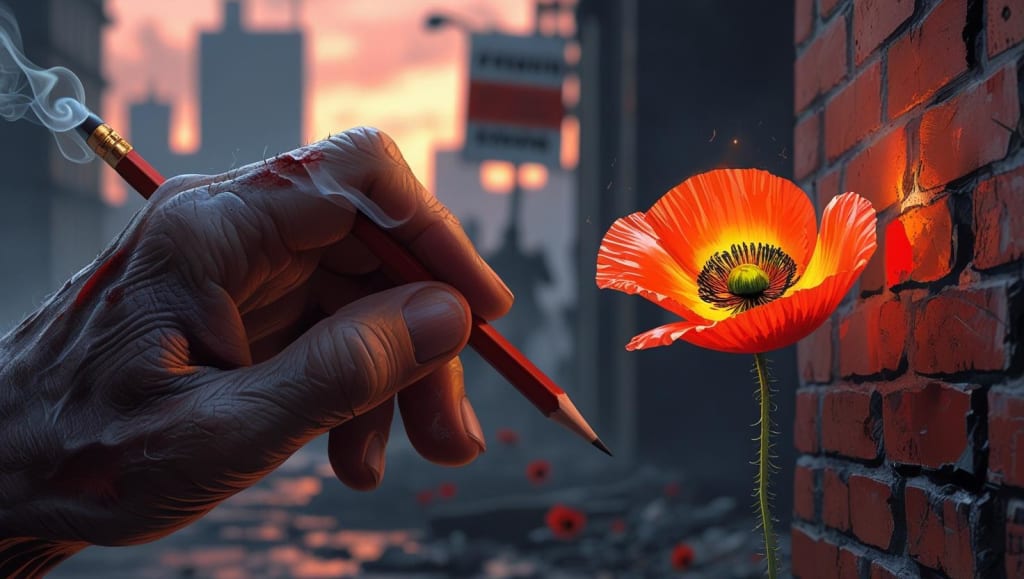
As I write this, I’m haunted by the image of Amina’s trembling hand, scribbling in the dark. Or Dmytro, painting as his city shakes. Or Jean, singing into a dying phone. Their art isn’t separate from survival—it is survival. To create amidst collapse is to refuse annihilation. It’s to plant a flower in the rubble, knowing it might not bloom but believing it could.
Salt in the Wound ends with a line from Amina’s poem: “We carve our names in ash, and the wind carries them home.” That’s what art in crisis does. It carves names, faces, stories into the ash of destruction. It carries them to us, demanding we listen, remember, act. Art may not be enough, but it’s something—a spark in the dark, a flower on a crumbling wall, a song that won’t die.
About the Creator
Shohel Rana
As a professional article writer for Vocal Media, I craft engaging, high-quality content tailored to diverse audiences. My expertise ensures well-researched, compelling articles that inform, inspire, and captivate readers effectively.
Keep reading
More stories from Shohel Rana and writers in Writers and other communities.
The Song That Won’t Die
How Bella Ciao Became a Global Cry for Freedom The air was thick with tension, the kind that hums before a storm. I stood in a crowd in Santiago last week, shoulder to shoulder with strangers, as a lone guitarist struck the opening chords of Bella Ciao. The melody cut through the chaos—tear gas lingering, banners waving, voices hoarse from chanting. Within seconds, the crowd joined in, their voices raw but resolute, singing in Spanish, Italian, or just humming the tune. It wasn’t just a song; it was a pulse, a shared heartbeat of defiance. How does a melody born in the rice fields of 19th-century Italy end up here, in Chile, in 2025, or in the streets of Gaza, Tehran, or Rojava? Bella Ciao is no ordinary song. It’s a living, breathing force, a global anthem of resistance that refuses to fade.
By Shohel Rana7 months ago in Writers
Published in Portrait of New England
My quest to find many publications with prestige to submit to has worked out even better than I thought. I was searching for more publications with more prestige in order to bolster my resume. I truly thought I'd try this for a year and not get published anywhere... maybe if I was lucky... in one of them. And I was OK with that... I was just going to try again the following year, and the year after that, and so on.
By Stephen Kramer Avitabile29 days ago in Writers
Silent Struggle
No one noticed the moment his life began to feel heavy. There was no single disaster, no dramatic fall. Everything happened slowly—quietly—like dust settling on furniture no one cared to clean. From the outside, his life looked normal. He woke up, went to work, smiled when needed, and returned home exhausted. But inside, a silent struggle was growing every single day. His name was Hamza. Hamza used to believe effort was always rewarded. As a child, he was told that if you worked hard, life would eventually open its doors for you. For a long time, he held onto that belief. He studied late into the night, sacrificed weekends, and stayed disciplined when others took shortcuts. But as years passed, reality felt cruelly different. People with less effort moved ahead. Opportunities passed him by. Promises turned into excuses. At work, Hamza was dependable—but invisible. When projects succeeded, others were praised. When mistakes happened, eyes quietly turned toward him. He never complained. He didn’t want to be seen as weak or ungrateful. Instead, he stayed silent. That silence slowly became his habit. At home, expectations followed him like a shadow. Everyone assumed he was “doing fine” because he never spoke about his struggles. Friends stopped asking how he was. Conversations became shallow. No one knew how many nights he lay awake staring at the ceiling, wondering if something was wrong with him. The hardest part wasn’t failure. It was feeling unseen. One night, after another exhausting day, Hamza sat alone in his room. The city outside was loud, full of people chasing dreams, celebrating small wins, living loudly. Inside his room, everything felt still. He picked up his phone and scrolled through social media. Success stories. Smiling faces. Motivational quotes. Each post felt like a reminder of how far behind he was. His chest tightened. A thought crept into his mind—soft, dangerous, and persistent. “Maybe I’m not meant for more.” That thought scared him. Not because it hurt—but because it felt believable. For the first time, Hamza considered giving up. Not dramatically. Not by quitting everything. Just… stopping the effort. Doing the bare minimum. Accepting an ordinary life without expectations. No one would notice anyway. But something held him back. It wasn’t hope. It wasn’t motivation. It was stubbornness. A quiet refusal to completely let go. The next morning, nothing changed externally. The same routine. The same people. The same silence. But inside Hamza made a small decision: “I’ll keep going—even if nothing changes.” He stopped waiting for encouragement. He stopped seeking validation. He focused only on improving himself, one small step at a time. He learned after work when others relaxed. He practiced skills no one asked him to learn. He failed quietly and corrected himself without announcing it. Some days, he felt strong. Most days, he felt tired. But he showed up anyway. Weeks turned into months. There were still no rewards. No applause. No sudden success. But something subtle was happening—something Hamza didn’t notice at first. He was becoming resilient. Things that once broke his confidence no longer shook him as much. Rejection still hurt, but it didn’t stop him. Criticism no longer crushed him; it taught him. Silence, once painful, became his training ground. One evening, a major issue arose at his workplace. A complicated problem that others avoided because failure would be visible. Managers were tense. Deadlines were tight. Blame was already being prepared. Hamza didn’t speak up immediately. He simply started working. He stayed late. He researched. He tested ideas. He made mistakes and fixed them. There were moments he doubted himself. Moments when fear whispered, “You’re not good enough for this.” But he answered back with action. Days later, the problem was solved—not perfectly, but effectively. This time, people noticed. Not with applause. Not with excitement. But with curiosity. “Who handled this?” “When did he learn that?” “Why didn’t we see this before?” Hamza didn’t feel proud in the way he expected. Instead, he felt calm. Grounded. Secure in a way that didn’t depend on others. When his manager finally called him in and acknowledged his work, Hamza thanked him politely. But inside, he knew the truth: This moment wasn’t built overnight. It was built during silent nights. Unseen effort. Unrecognized discipline. Life hadn’t ignored him. Life had been watching. Testing whether he would keep going without praise. Years later, Hamza looked back at the version of himself who almost quit. The man who felt invisible. The man who believed silence meant failure. He wished he could tell him one thing: “Your struggle wasn’t wasted. It was shaping you.” Not everyone’s journey is loud. Not every victory is celebrated. Some people are built quietly—strong enough to stand when others fall. If you are struggling silently today, know this: You are not behind. You are not invisible. You are not weak. You are being prepared. And one day, without warning, life will notice. Final Line (Powerful Ending): The strongest people are often the ones no one sees fighting—but they keep going anyway.
By Inayat khan4 days ago in Writers


Comments
There are no comments for this story
Be the first to respond and start the conversation.