
All That You Need to Know About Silk Sarees
Learn about silk sarees

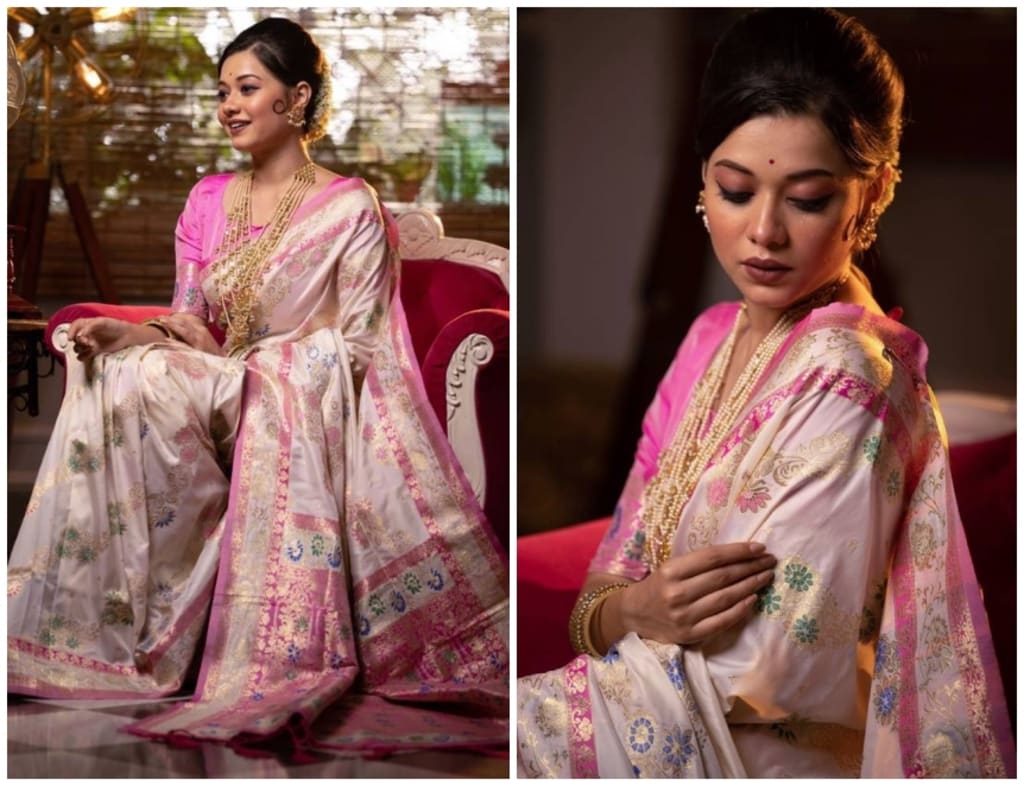
Every Indian wedding is an opportunity for the bride and bridegroom, as well as the attendees to display their fine clothes, gorge on delicious food and engage in boisterous revelry! Naturally, this is your chance to be the Queen of the Day too, via a gorgeous-looking silk saree, the bedazzling trappings that go with it and a poised stature! Do take your pick from the rich diversity of silk sarees available in different Indian states.
Eastern India
The handloom silk saree from West Bengal is an amazing blend of lightness, comfort, airiness and a wonderfully smooth texture! Backgrounds in diverse shades of blue, red and green are extremely popular. The embellishments are unique designs in brocade, dotted with charming motifs. The motifs may represent something from nature (flora and fauna) or the heavens (sun, moon and stars).
In the ordinary way, traditional Thangail and Dhania Khali styles of weaving are popular. The Jamdhani style comes into play for creating colourful motifs exhibiting floral or geometric patterns, with gold and cotton threads.

Assamese weavers are very fond of golden silk (Muga), Eri silk and Mulberry silk. They use multi-coloured threads or zari work, in order to design motifs (birds, animals, flowers, fruits, diamond-shapes, etc). Similarly, Meghalaya’s handloom weavers use Eri, Mulberry and Endi silk for creating durable silk sarees with superb textures. They create gloriously aesthetic patterns in chikan, gota, zardosi and ari with the aid of zari threads. Bandhini, batik, lehriya and block print sarees receive embellishments of pearls, kundans, beads, etc.
Western India
The Paithani saree from Aurangabad, Maharashtra dazzles the eye, with its luxurious display! It shines and shimmers, thanks to the golden zari threads that go into the decoration of the saree. The double colours of the garment prove to be even more fascinating to behold! However, the most attention-grabbing feature of this shimmering, pure silk garment is the jazzy peacock adorning the pallu!

Then again, Kota in Rajasthan refuses to be left behind in this aspect, going in for the production of exquisitely patterned silks! The weavers go in for fine count weaves, demonstrating their skill in creating something extraordinary out of the ordinary. Similarly, the weavers of Rajkot in Gujarat spin their historical tales into their silken offerings.
North India
The most popular saree from this region is the Banarasi silk saree, which has been in evidence from the days of royalty. The heavy saree with its excellent and luxurious zari work and traditional embellishments becomes the cynosure of all eyes at celebrations, formal parties and grand wedding ceremonies. The highlight of the garment is the pure gold threads that go into the creation of zari designs.

Move on to Madhya Pradesh, and you come across the Chanderi silk saree, renowned for its unique decorations, fine texture and sheer-looking appearance. It is able to carry off chikan, zari, gota, zardosi, ari, etc, patterns superbly well. It is also common to find zari brocades with embroidery dotting the length and breadth of the saree.
Not to be left behind, Jharkhand in Chhattisgarh produces a splendidly textured specimen exhibiting a deep golden colour. This is the wild silk/Tussar silk/Kosa silk/Vanya silk saree, which possesses eye-catching zari borders and unusual motifs. The tribals in Jharkhand’s forests use exotic batik and eco-friendly colours to hand paint thematic art designs on this fine silk yarn. The miniature decorations are sharply outlined and filled with intricate details.
South India
You should be able to see a marvellously glowing and elegant ‘pattu’ saree in evidence at every wedding, engagement and anniversary event! Created on a handloom, it is a bewitching combination of enchantingly rich thread work, charming motifs and unusual designs/prints. The big/medium-sized/small border of every saree is superbly brilliant, appearing in all manner of vivid hues! The embellishments may include mirror work, kundan work, chamki work, etc, while the embroidery may focus on gota, zardosi, ari, etc.
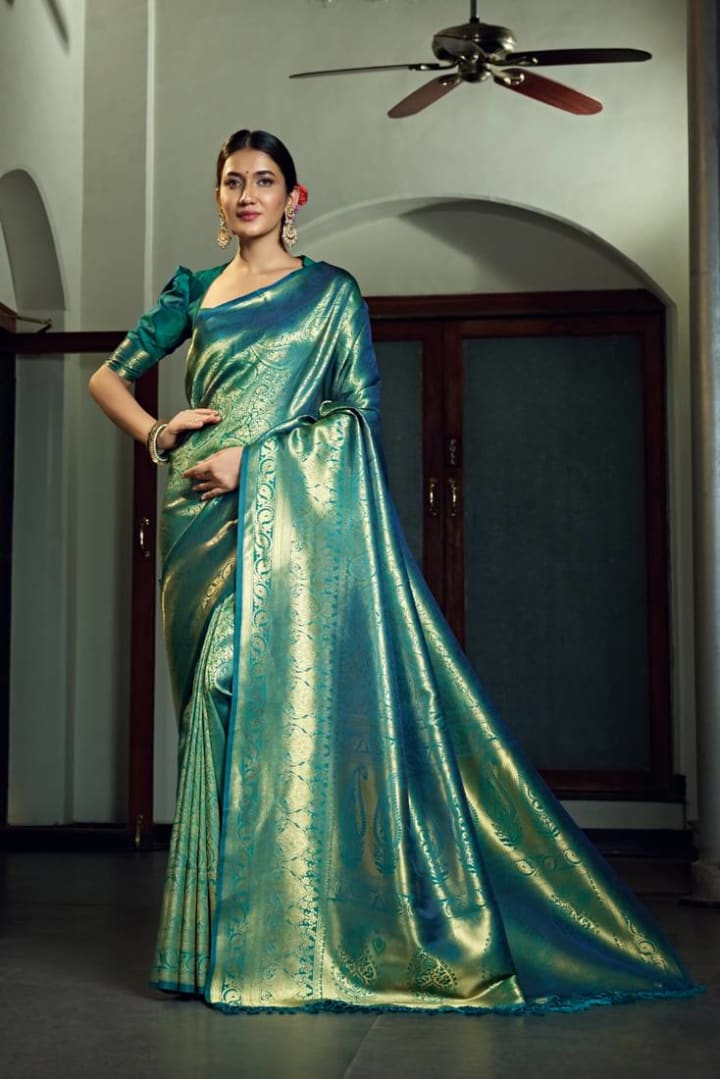
Amongst the South Indian collection, Kanjeevaram/Kanchipuram silks from Tamil Nadu are hot favourites! The body and border of each saree display sharply contrasting designs and colours. The themes include depictions of temples, scattered jasmine flowers enclosed within boundaries, parallel lines, etc. The pure silk base suffices to highlight different types of motifs beautifully! Created from silk zari threads dipped in liquid gold and silver, the motifs take the shape of animal figures (swan, lion, peacock, etc), fruits (mango, etc) or heavenly bodies (sun, moon, etc).
Similarly, Mysore silk sarees from Karnataka are highly renowned for their excellent quality. Bengaluru also produces its own brand of silk sarees. Other varieties from the South include Pochampally, Dharmavaram, Gadwal, Venkatgiri, Mangalgiri, Arani, Uppada, Coimbatore, Rasipuam and Narayanpet silks.
Summary
Obviously, Indians are fully in love with silk and silk sarees! Otherwise, such a vast variety of this traditional apparel would not be on display across the length and breadth of India.
About the Creator
Vaishali Mhaske
I am an IT engineer and an SEO executive who loves to travel, meet new people, shopping, and watch movies. Blogging is my passion, and I enjoy sharing all my experiences with those who need it.
Keep reading
More stories from Vaishali Mhaske and writers in Writers and other communities.
14 Indian Festivals That Are Worth To Gain The Bliss Of Life
The strength of India lies in the togetherness and oneness of many religions. Each one of us is happy in the dressing sense and loves the festivals as they are. There is some unconditional bond with the ethnic wear and celebrating Indian traditions. India is only the country who has diverse fashion styles and has remained to be immortal since ages. Many of us fashion trends are even now inspiring the western affluence. When we talk about festivals there are many of things that will inspire you to celebrate together and making the ethnic wear, the most counted thing to have in your wardrobe.
By Vaishali Mhaske9 months ago in Writers
The real South African life
Many people have these misguided opinions on South Africa. They don't know what SA truly is. I've heard people ask whether there are houses , do we get chased by lions- NO WE DON'T!! SA life is pretty much normal to some extent really.
By The real South African life4 days ago in Writers
📢 Raise Your Voice Thread: 01/08/2026
Our “Raise Your Voice Threads” are hosted most alternating Thursdays at 12PM ET to offer creators more avenues to uncover exceptional stories on Vocal. As we are continuously searching for fresh creators and inspiring stories, this thread provides an opportunity to exchange and discuss the stories that have moved and motivated us on Vocal.
By Raise Your Voice by Vocal5 days ago in Resources




Comments
There are no comments for this story
Be the first to respond and start the conversation.