
A real town called Raymond
Is there is a town called Raymond in California?


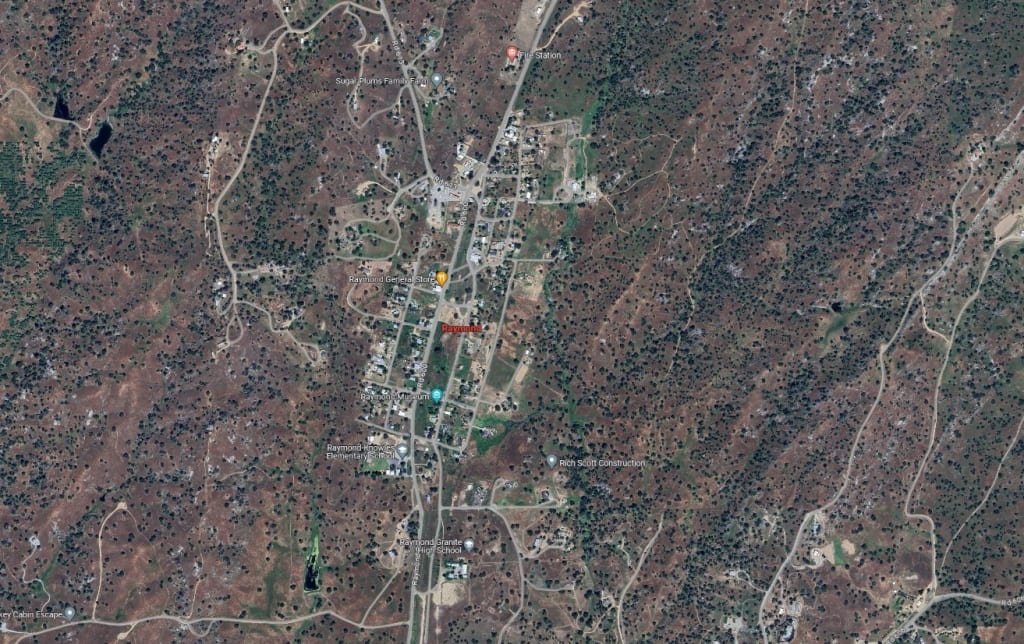
Quite a few people, having read my flash fiction story, "A Town called Raymond" have asked me whether there really is a town in California called Raymond and yes, there really is. I have mentioned in some of my articles that I like to use fact to give my fictional stories an authentic feel. Whether it is historical or scientific fact, or snippets from my own knowledge, experience or life story, truth can often enhance fiction, if you know how to use it.
As a practical exercise, I have therefore broken the short story "A Town called Raymond" into fact and fiction. I hope this illustration gives you some ideas about how you can do the same. Please remember when weaving fact into fiction, there are restrictions on how you can use some facts, particular if they would affect a person's privacy, breach their intellectual property or other rights. As a general rule, if a person mentioned (or identifiable) in your story died over 100 years ago, these rights will not apply. There is of course more to it than that and if you are not sure if you can use factual detail, then please don't.
Let's take another look at the story, then. All highlighted text is taken verbatim from the fictional short story: "A Town called Raymond".
The address written on the note said 153 Larkin Street. A street in San Francisco, between the Civic Centre and the Pioneer Monument. Or so I thought. San Francisco. City of earthquakes and Alcatraz, Dirty Harry and Chinatown. Cable Cars, barking sea lions, and the heart-stopping tall towers of the Golden Gate Bridge...
There is a Larkin Street in San Francisco and if you check Google Maps, as I did, you will see that it is, indeed, between the Civic Centre and the Pioneer Monument. I didn't chose the address, it was from a story prompt provided by the Writers Unite! Facebook group. I wondered if there was a real Larkin Street in California and turned out there was. The description of San Francisco is based on my own recollections of the city from long-past visits, and by reputation, and having seen the movies.
...I just couldn’t wait. 18 years old and the whole city awaited. A six-month stay before I started Uni. Six months away from Mum and Dad and my horrid sisters and brothers.
I often write in the first person and sometimes have to remind readers that if I write a fictional story, it is just that. By writing in the first person, it does not mean I am recounting my actual experience, other than the facts I have used to create the authentic feel I mentioned. Just to be clear, although I was once 18 years old (between 1977 and 1978) I did not take a trip on my own to California after leaving school, never went to university and would not describe my one sister and three brothers as "horrid." That is all made up as part of the story.
Turns out, it was not that 153 Larkin Street after all. It was 153 Larkin Street in a town called Raymond, somewhere else in California. Whoever heard of a town called Raymond? But there I was, in a beat-up old shack of a wooden house in the middle of nowhere. The most exciting thing in Raymond is the Raymond General Store.

I have visited Raymond, CA, however. During a vacation to California with my wife and, then, 5-month old daughter in 1994. I was driving our hired Buick (loved to drive this on the Californian highways) and we were heading someplace and came across Raymond along the way. Not surprisingly, the name of the town (which is my real name as well as the name I use for my published stories) made a big impression on me. I do a disservice to the town, however, by saying that the most exciting thing in Raymond is the general store. But remember, this is a fictional story and the narrator is an 18 year old boy excited to be on his first lone vacation and his first time in the state of California. I love California, have visited the state twice on business and once for the 1994 vacation. I loved visiting small, out-of-the-way places like Raymond in the sunshine state.
153 Larkin Street was badly in need of some paint. And it was my job to paint it. That was the deal. I stayed, rent free, if I painted the house.
All made up. The address came with the 2020 prompt picture:
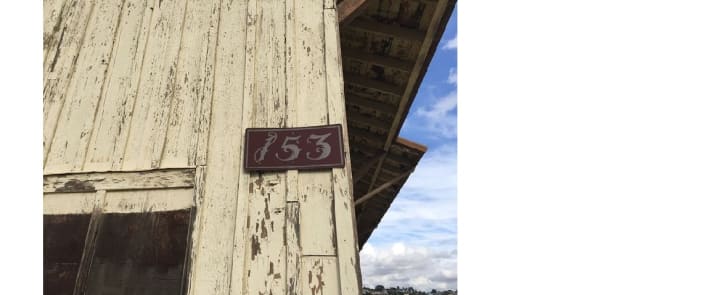
Should be obvious where the idea of having the MC paint the house came from. The full text prompt was:
The address written on the note said 153 Larkin Street.
I used the text prompt by first searching the address. I don't recall exactly how I proceeded, but I do remember looking up the address to see if it was really a place, hence the reference to the San Francisco location. All from Google maps. I often begin a story with research, whether name, place, time, historical or scientific detail. I don't overdo it. Just enough research to provide some factual snippets to help authenticate the story.
When I wrote the series of short stories "Tell tale crimson trail," for instance, I researched details about the firearms and vehicles used by police officers in my chosen location of Andover, Massachusetts. A town I have never visited, although I have been to Cambridge and Boston. To me, this kind of research and attention to detail is what makes a story believable. There is enough incidental detail about the setting to make the reader believe they are there, or at least have a picture of the place in their mind's eye, as they read the story.
This technique I have seen used very effectively by other creators on Vocal, particularly by my good friend Deborah Ratliff, D.A. Ratliff, in her Detective Boone stories. The following is an excellent example:
Deborah's Elijah Boone mysteries always make me feel I am in the place they are set. This is done, I think, by an effective inclusion of well-chosen small details. Take a look and let me know if you can see what I mean.
Now, let's forget the rain for a minute and get back to sunny California:
Funny thing was, I really got on well with the couple who lived there, Pam and Bob. Bob drove a cab and his wife, Pam, worked at the General Store. Weekends, they went gold prospecting out in the hills. Pitched a tent, cooked out, panned the mountain stream, and took back whatever shiny dust they found.
On one of my business trips to California, A cab driver (name unknown) collected me from my hotel to take me to a business meeting in San Jose. He told me about how he and his wife liked to camp out in the hills and pan for gold.
“Come with us,” said Pam. And I did, several times. Even wrote some poetry while I was there, as Pam and Bob waded in the stream and panned for gold.
This is of course the whole point of the story. A young man leaves home for the first time seeking the high life in San Francisco. Instead he finds a new kind of adult friendship and, perhaps, inner peace. It is a growing up, a right of passage, which is why I made his age 18.
I visited San Francisco, after I finished painting the house. But the two weeks I spent there, I wished I had stayed in the newly painted 153 Larkin Street, Raymond, CA, together with my newfound friends.
The story is ended with a measure of pathos, not unusual in my stories. Ironically, he got what he came for: some time exploring the big city, but in getting his wish, he finds it is something else he longs for. True friendship.
I hope you have found something useful in this explanation. If you liked reading this little tale of my namesake town, please consider taking a look at my equally little book:
About the Creator
Raymond G. Taylor
Author living in Kent, England. Writer of short stories and poems in a wide range of genres, forms and styles. A non-fiction writer for 40+ years. Subjects include art, history, science, business, law, and the human condition.
Keep reading
More stories from Raymond G. Taylor and writers in Writers and other communities.
Where do stories come from?
Ideas are funny things. They seem to pop out of nowhere, or sometimes come about as the result of a life event, seeing a film, reading a book, taking a walk in the woods. Sometimes they have a transitory existence, forgotten almost before they enter your consciousness. Sometimes they solidify, grow into a plan, a movement, a programme, philosophy, doctrine, religion. Let's not worry about all that though. We are writers and as writers we love to turn the best ideas into stories. But where to find them?
By Raymond G. Taylor2 years ago in Writers
Alone in the Jungle
The canopy is so dense that it suffocates all light. I am slashing through the dense boscage to get to the light, but I don’t know which way to go, or if I will ever get out of the forest. This jungle feels often filled with peril, and lonely. I came to this tangle of vines, underbrush, and unknown unfamiliar territory, with a dream, a goal, a determination. I planned and still plan to reach the end of the primeval and reach the inner sanctum of a place that is not easily traversed. I am a writer, and I want to write as a career.
By Alexandra Grant3 days ago in Writers


Comments (5)
Lovely.
I was one of those people who thought the story was real, I must admit. Congrats on the Top Story, Raymond!
Congratulations on Top Story. This was an interesting read.
Oh I never knew about the 100 years thingy. I'm soooo glad you wrote this to share with us all!
Good work and thanks for sharing your experiences in your writing.