
A Jewish Tale: Elizabeth Cooper’s Journey from Counterculture to Faith
How a Jewish Rebel Found Peace and Purpose in Faith

The search for truth, meaning, and purpose is a quest that spans time, culture, and faith. In her compelling memoir, A Jewish Tale: The Chronicles of a Jewish Rebel and How She was Conquered by the Prince of Peace, Elizabeth Cooper chronicles her spiritual journey, one that took her from the counterculture movement of the 1960s and ‘70s to an unexpected encounter with the God of Israel. This story is not just a tale of one woman's life, but an exploration of profound questions that many of us have asked at some point in our lives: Can you change society to make it more equitable for all? and Can you know God, and how would that relationship impact your life?
From Brooklyn to the Counterculture
Elizabeth Cooper’s story begins in Brooklyn, New York, where she was born in the aftermath of World War II. The daughter of Jewish immigrants, Elizabeth was raised in a traditional Jewish household, steeped in the rich heritage of her faith. Her early years were shaped by the strong values of her family, who emphasized education, culture, and a connection to their Jewish roots.
But like many young people growing up during the post-war era, Elizabeth began to feel the pull of the social and political changes that were sweeping across America. By the 1960s, the country was in the midst of a cultural revolution, and Elizabeth found herself questioning the established norms of the society she had grown up in.
In 1970, seeking answers to her growing sense of disillusionment with mainstream society, Elizabeth made a bold decision. She packed her bags and moved to the West Coast, where she became deeply involved in the counterculture movement that was flourishing in San Francisco’s Bay Area. Living in communes, surrounded by like-minded individuals who were questioning authority, exploring alternative lifestyles, and advocating for social change, Elizabeth became an active participant in a cultural moment that was defined by rebellion and idealism.
A Time of Questioning
The communes of the Bay Area in the 1970s were hubs of radical thought, artistic expression, and social experimentation. They were places where people gathered to live out their ideals of equality, peace, and community. But even within this environment, Elizabeth began to grapple with deeper, more personal questions. The counterculture was all about change – changing society, changing politics, and changing the way people lived their lives. But could these changes really create a more equitable world? And, more personally, could these external changes lead to true inner fulfillment?
As Elizabeth engaged with these larger societal questions, another, more spiritual question began to emerge in her mind: Can you know God? For a woman raised in the Jewish faith, this was not a new question. But in the midst of the social upheaval of the 1960s and ‘70s, and the exploration of alternative spiritual practices that were part of the counterculture, the question took on new significance.
Elizabeth’s journey became a spiritual one as she sought to understand the nature of God and how a relationship with Him might transform her life. It was during this time that she began to explore different spiritual traditions, philosophies, and ways of understanding the divine. But none of these seemed to provide the answers she was looking for.
An Encounter with the God of Israel
It was in the midst of this searching that Elizabeth had an encounter with the God of Israel – an encounter that was both unexpected and transformative. This moment became the turning point in her spiritual journey, leading her to a deeper understanding of her faith and her place in the world.
In A Jewish Tale, Elizabeth recounts how this encounter with God changed the trajectory of her life. It was not just a moment of spiritual awakening, but a profound realization that the answers she had been seeking could not be found in societal change or alternative spiritual practices. Instead, they were found in a personal relationship with the God of her ancestors, the God of Israel.
This realization led Elizabeth to embrace her Jewish faith in a new and deeper way. She came to see that her identity as a Jew was not just a cultural or historical fact, but a spiritual calling. And in this new understanding of her faith, she also encountered Jesus, the Prince of Peace, who she came to believe was the fulfillment of the promises made to her people.
A Jewish Rebel Conquered by Faith
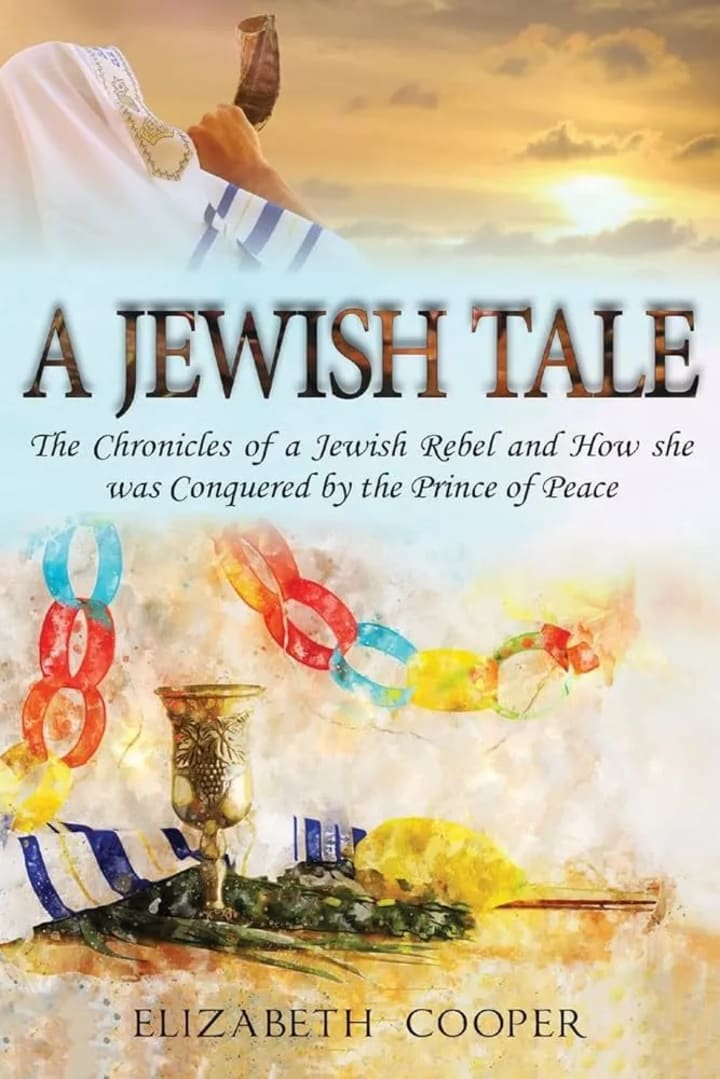
The Chronicles of a Jewish Rebel, as the subtitle of her book suggests, is the story of a woman who spent much of her life rebelling against the norms and expectations of society – and even of her faith. Elizabeth’s journey was one of questioning, challenging, and pushing back against the status quo. But ultimately, it was also a journey of surrender – not to society or its expectations, but to a relationship with God.
In her conversation with Kate Delaney on Authors Corner, Elizabeth discusses how her rebellion was not just a rebellion against societal norms, but also a rebellion against the spiritual truths she had been raised with. But through her quest for meaning, she came to realize that true freedom and fulfillment could only be found in embracing the faith of her ancestors and in a relationship with God.
A Tale for Our Times
Elizabeth Cooper’s A Jewish Tale is a story that resonates deeply with the times we live in. We, too, live in a world that is marked by social upheaval, political division, and a search for meaning. Like Elizabeth, many people today are questioning the structures and systems that have shaped their lives, and are searching for answers to the deeper questions of existence.
But what Elizabeth’s story reminds us is that the answers to these questions cannot be found solely in external change. While working for a more just and equitable society is important, true transformation begins within. It begins with asking the question: Can you know God? And it is in answering that question that we can find the peace, purpose, and fulfillment that we are all searching for.
Conclusion
Elizabeth Cooper’s journey from the counterculture to faith is a powerful testament to the human search for truth. In her memoir, A Jewish Tale, she invites us to join her on a quest for meaning that spans decades and crosses cultural and spiritual boundaries. It is a story of rebellion, questioning, and ultimately, surrender – not to society, but to a relationship with God.
As Elizabeth’s life shows, the journey of faith is not always a straight path. It is often marked by detours, doubts, and difficult questions. But it is also a journey that leads to profound transformation – not just of the individual, but of the world around them. For in seeking to know God, and in building a relationship with Him, we are not only changed ourselves, but we become agents of change in the world.
Elizabeth Cooper’s story is a reminder that the questions we ask about society, about faith, and about our place in the world are not new. They are questions that have been asked by generations before us, and they are questions that will continue to be asked by those who come after us. But in seeking the answers to these questions, we may find, as Elizabeth did, that the most unexpected answers are often the most transformative.
In her interview with Kate Delaney, Elizabeth offers us a glimpse into her journey and invites us to explore our own. Her story is a testament to the power of faith, and to the transformative impact that a relationship with God can have on our lives. A Jewish Tale is more than just a memoir – it is a guide for anyone seeking to understand the deeper questions of life, and a reminder that no matter where our journey takes us, God is always there, waiting to be found.
About the Creator
Keep reading
More stories from Angela Brown and writers in Writers and other communities.
Animal Compassion in 'Live Wise' with Scott C. Meischen
In a world where compassion often feels in short supply, stories that emphasize kindness and empathy can make a powerful impact, especially on young minds. That’s exactly what author Scott C. Meischen has done with his children’s book Live Wise, a touching story that introduces young readers to the importance of caring for animals and the world around them. Recently, Scott had the opportunity to discuss his work on the podcast Talking Books with JT Crowley, and their conversation not only explored the themes of his book but also delved into the real-life inspiration behind it.
By Angela Brownabout a year ago in Writers
Published in Portrait of New England
My quest to find many publications with prestige to submit to has worked out even better than I thought. I was searching for more publications with more prestige in order to bolster my resume. I truly thought I'd try this for a year and not get published anywhere... maybe if I was lucky... in one of them. And I was OK with that... I was just going to try again the following year, and the year after that, and so on.
By Stephen Kramer Avitabile27 days ago in Writers
How Students Can Check Scholarship Status Without Missing Updates
For millions of students worldwide, scholarships play a critical role in continuing education without financial strain. However, receiving a scholarship is only the first step. One of the most common challenges students face afterward is tracking their scholarship status accurately and on time. Missed updates, incomplete information, or misunderstanding the process can result in delayed payments or even disqualification.
By Abbasi Publisher6 days ago in Writers




Comments
There are no comments for this story
Be the first to respond and start the conversation.