
5 Kings Who Ruled the World: Leaders of Global Empires
"5 Legendary Kings Who Shaped Global Empires"

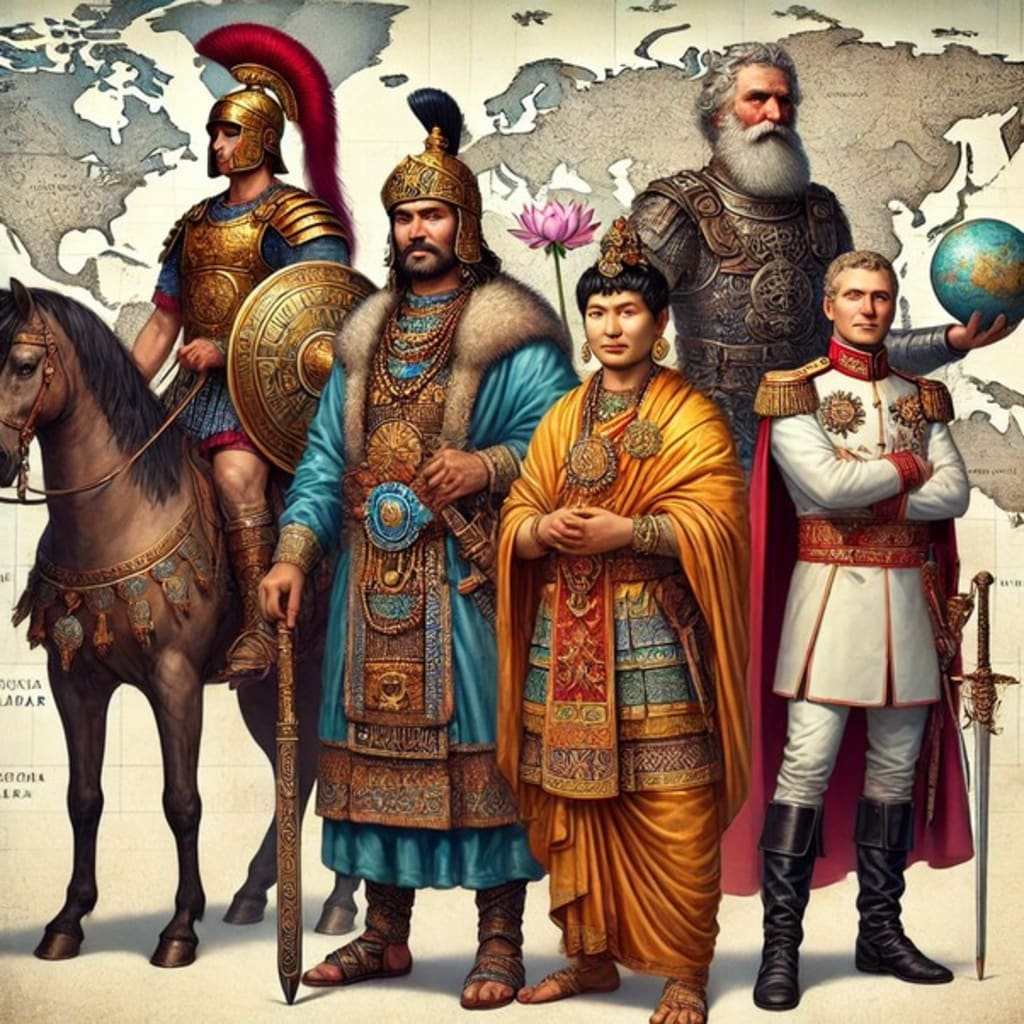
Throughout history, certain rulers have demonstrated extraordinary vision, military brilliance, and leadership skills to establish vast empires that changed the course of human civilization. These kings not only conquered lands but also created cultural, administrative, and political legacies that have shaped the world. Here are the stories of five legendary rulers who are remembered for their global influence and exceptional reigns.
1. Alexander the Great
Alexander the Great, born in 356 BCE, was the king of Macedonia and is often regarded as one of the greatest military commanders in history. By the time of his death at the age of 32, he had created one of the largest empires the ancient world had ever seen, stretching from Greece to India.
Alexander’s military campaigns were marked by strategic brilliance and audacious ambition. His conquests included the powerful Persian Empire, Egypt, and parts of Central Asia. Beyond warfare, Alexander played a pivotal role in spreading Greek culture and influence across his empire, fostering a blend of Greek and Eastern traditions known as Hellenistic culture. This cultural integration laid the groundwork for advancements in science, art, and philosophy that would endure for centuries.
2. Genghis Khan
Genghis Khan, born as Temüjin in 1162, founded the Mongol Empire, the largest contiguous land empire in history. From humble beginnings as the son of a tribal leader, Genghis Khan unified the Mongol tribes and launched a series of campaigns that brought regions as diverse as China, Central Asia, the Middle East, and parts of Europe under his rule.
Known for his innovative military tactics and exceptional leadership, Genghis Khan’s empire expanded rapidly, facilitated by efficient communication networks and governance systems. His policies promoted trade along the Silk Road, connecting East and West in unprecedented ways. Despite his reputation as a ruthless conqueror, Genghis Khan also established laws and systems that promoted stability and unity within his vast empire.
3. Ashoka the Great
Ashoka, one of ancient India’s most celebrated rulers, ascended to the throne of the Maurya Empire in the 3rd century BCE. His empire covered a vast area, including modern-day India, Pakistan, Afghanistan, and parts of Nepal and Bangladesh. While Ashoka initially expanded his empire through war, the bloody Kalinga War profoundly changed him.
After witnessing the horrors of war, Ashoka adopted Buddhism and became a champion of peace and nonviolence. He implemented policies rooted in compassion, justice, and religious tolerance. Ashoka’s edicts, inscribed on pillars and rocks across his empire, conveyed messages of moral governance and respect for all life. His reign is remembered as a golden age of cultural and spiritual development in India.
4. Julius Caesar
Julius Caesar, a towering figure in Roman history, transformed the Roman Republic into the foundation of the Roman Empire. Born in 100 BCE, Caesar was a brilliant general, statesman, and reformer. His military campaigns expanded Rome’s territories, including the conquest of Gaul (modern-day France), which solidified Rome’s dominance in Europe.
Caesar’s political acumen enabled him to consolidate power and implement significant reforms, such as reorganizing the Roman calendar into the Julian calendar. Although his dictatorship ended with his assassination in 44 BCE, Caesar’s impact endured. His leadership paved the way for the rise of the Roman Empire, influencing Western governance and culture for centuries.
5. Napoleon Bonaparte
Napoleon Bonaparte, born in 1769 on the island of Corsica, rose from obscurity to become one of history’s most influential leaders. As Emperor of France, Napoleon established an empire that spanned much of Europe during the early 19th century. His military campaigns, known as the Napoleonic Wars, reshaped the political landscape of Europ
Napoleon’s legacy extends beyond his military achievements. He introduced the Napoleonic Code, a comprehensive legal framework that influenced legal systems worldwide. His administrative reforms modernized governance in France and inspired similar changes across Europe. Despite his ultimate defeat at the Battle of Waterloo in 1815, Napoleon’s vision of unity and progress left an enduring mark on history.
The five kings—Alexander the Great, Genghis Khan, Ashoka the Great, Julius Caesar, and Napoleon Bonaparte—were not just conquerors; they were visionaries who shaped civilizations. Their reigns were marked by innovation, cultural integration, and transformative leadership. Their legacies continue to inspire and remind us of the enduring power of ambition and vision. As we study their
About the Creator
William Henry
Writing has been a hobby of mine for years, and I’m excited to share my work here! Besides writing, I’m passionate about dogs and love to travel.
I hope you enjoy my creative journey!
Keep reading
More stories from William Henry and writers in Writers and other communities.
Take a Fun, Have a Risk: The Thrill of Living Boldly
Life is an intricate dance between joy and uncertainty. Each moment holds the potential for celebration or challenge, yet so many of us live cautiously, afraid to step beyond our comfort zones. But what if we flipped the script? What if the essence of life was about embracing both fun and risk, recognizing that one amplifies the other?
By William Henryabout a year ago in Motivation



Comments (1)
Hey, just wanna let you know that this is more suitable to be posted in the FYI community 😊