
2025 BI Strategy Guide: Build a Data-Driven Roadmap
2025 BI Strategy Guide

Business Intelligence (BI) is no longer a luxury — it’s a necessity for organizations striving to stay competitive in today’s data-driven landscape. A well-structured Business Intelligence strategy aligns data analysis with business objectives, empowering organizations to make informed, agile decisions. This guide outlines the key components of a powerful BI strategy and how to implement it for sustainable growth and operational excellence.
What is a Business Intelligence Strategy?
A Business Intelligence strategy is a structured approach to collecting, managing, analyzing, and distributing data across an organization. It ensures that accurate and actionable insights are accessible to stakeholders to support data-driven decision-making.
Why a BI Strategy is Crucial to Business Success
Data-Driven Decision-Making: Aligns teams and leadership with quantifiable insights.
Operational Efficiency: Streamlines data workflows, reporting, and monitoring.
Risk Mitigation: Identifies anomalies and risk factors before they escalate.
Scalability: Supports future growth with flexible data infrastructure.
Competitive Advantage: Unveils market trends and consumer behavior before competitors.
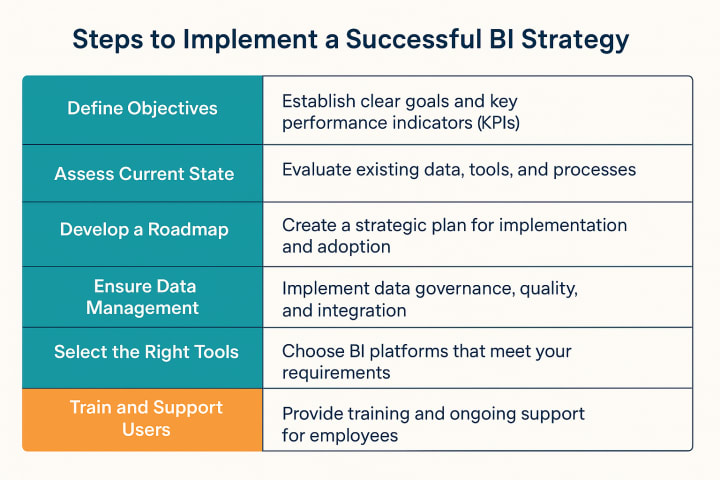
Core Components of a Robust Business Intelligence Strategy
1. Clear Business Goals and KPIs
Defining measurable objectives aligned with company strategy is foundational. Whether increasing sales, optimizing supply chain performance, or enhancing customer retention, the BI strategy must map directly to these goals.
2. Data Governance Framework
Data governance ensures data quality, consistency, and security. A robust framework includes:
Defined ownership and stewardship
Standardized data definitions
Access controls and compliance measures
Master data management (MDM)
3. Centralized Data Architecture
A modern data architecture consolidates data from multiple sources into a unified platform. This typically includes:
Data lakes or data warehouses
ETL/ELT pipelines for data transformation
Cloud or hybrid infrastructure
4. BI Tools and Platforms
Selecting the right BI tools depends on your organization’s size, complexity, and analytical needs. Key tools include:
Microsoft Power BI
Tableau
Qlik Sense
Looker
SAP BusinessObjects
5. Data Visualization and Reporting
Visual storytelling through dashboards and dynamic reports is essential for actionable insights. Effective BI strategies implement:
Real-time dashboards
Self-service reporting tools
Automated alerts and performance trackers
6. User Training and BI Adoption
Technology alone isn’t enough. BI success requires organizational adoption. Invest in:
User training programs
Center of Excellence (CoE) for BI
Role-based access and tailored user experiences
Real-World BI Strategy Use Cases
Financial Analytics
Track budgets, monitor revenue vs. forecasts, and optimize spending through interactive dashboards.
Sales and Marketing Optimization
Analyze customer journeys, campaign performance, and sales funnel metrics to improve conversion rates.
Supply Chain Monitoring
Monitor inventory levels, delivery times, and supplier performance in real-time.
HR and Workforce Analytics
Understand employee performance, turnover trends, and training impact on productivity.
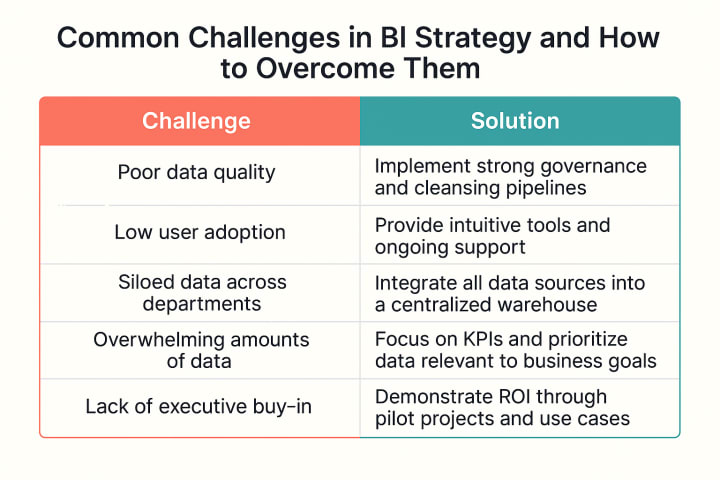
Key Metrics to Measure BI Strategy Success
User adoption rates
Dashboard and report usage frequency
Data accuracy and latency
Time to insight
Business outcomes improvement (revenue, cost savings)
Choosing the Right BI Partner
Look for a business intelligence consulting partner with:
Industry expertise
End-to-end implementation capabilities
Customizable training programs
Strong customer support
Proven track record with scalable solutions
Final Thoughts
An effective business intelligence strategy is a transformative asset that turns raw data into organizational intelligence. By aligning technology, people, and processes, companies can anticipate market shifts, optimize performance, and drive measurable growth.
About the Creator
Keep reading
More stories from Alisha Anna and writers in Writers and other communities.
Top Data Analytics Challenges and How to Overcome Them in 2025
In the rapidly evolving digital landscape, organizations are inundated with vast amounts of data. Effectively harnessing this data is crucial for informed decision-making and maintaining a competitive edge. However, the journey to becoming a data-driven enterprise is fraught with challenges. This article delves into the most pressing data analytics challenges anticipated in 2025 and offers strategic solutions to address them.
By Alisha Anna10 months ago in Writers



Comments
There are no comments for this story
Be the first to respond and start the conversation.