
Why Nobody Wants a Toyota Supercar.
It should have been a big hit, but for some reason there was no follow-up.

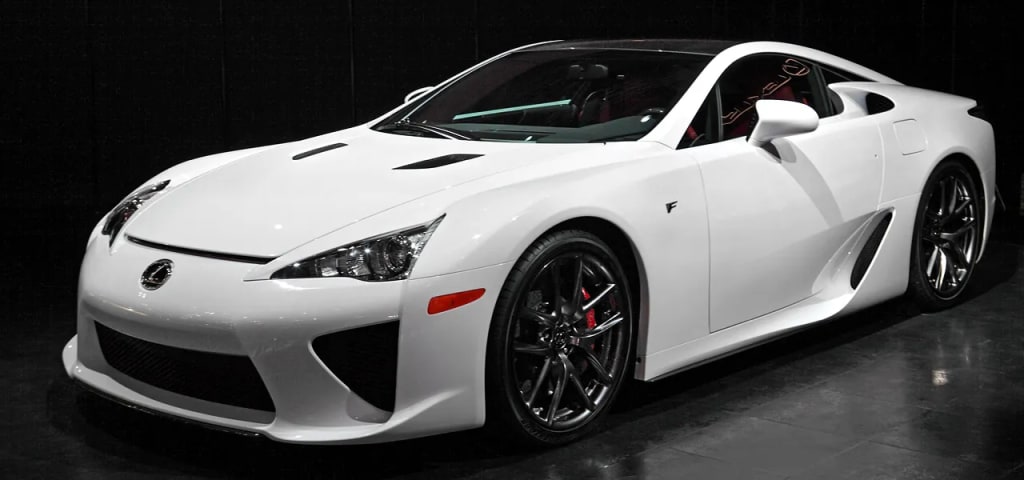
The world is strange sometimes; most of us can’t afford a supercar and sometimes we expect popular brands like Toyota to make an affordable and high-performance supercar but when they do, everyone doesn’t want to buy it; only a few want it.
Lexus, as a subsidiary of Toyota, released the LF-A a few years ago. On paper, this should be a car that will shake the world; how could it not? Toyota is a big manufacturer that we know and they are synonymous with quality so if they make a supercar, people will flock to buy it. That’s a pretty reasonable explanation.
The LFA, code-named TXS, started coming together around the year 2000. They got the first prototype ready in June 2003 and started testing it at the Nürburgring a few months later. Over the next ten years, they showed off a bunch of different concept cars at car shows. The first one was in January 2005, and they kept making tweaks and changes over the years. They finally unveiled the final version in October 2009, just in time for Lexus’s 20th birthday. They started making these cars in December 2010.
The LF-A is equipped with a brand-new engine, the 1LR-GUE, a 4.8-liter V10 that’s a powerhouse. It can accelerate from 0 to 60 miles per hour in a mere 3.6 seconds and has a top speed of over 200 miles per hour.
To make the LF-A even more impressive, it’s built using lightweight materials like carbon fiber, aluminum, titanium, and magnesium. This helps to keep the weight down, which is crucial for a sports car. And with its 560 horsepower, it’s definitely in the same league as other high-performance supercars.
At that time, the direct competitors of the LF-A were the Lamborghini Gallardo, which had already received its second facelift and the Ferrari 458 Italia. Basically, the idea was quite good, where Toyota made a supercar with their own hands. For the engine sound, they were assisted by Yamaha, who designed a special exhaust that could produce the sound of the V10 engine loudly and distinctively, where engineers described the sound of the engine as “the roar of an angel," a collaboration that we often see because Toyota and Yamaha have worked together several times in making engines, including the LF-A.
Toyota itself gave a quota of 500 units for the LF-A and strangely, it didn’t sell too well. Toyota still had new LF-A stock until 2020 and with a base price of around USD 375,000 and some examples reaching millions of USD now, it’s quite surprising why the LF-A didn’t sell well, even though I think there are some explanations.
The reason? Well, Toyota isn’t exactly known for making supercars. It’s like asking Ferrari to design a minivan. People just didn’t have faith in Toyota’s ability to create a truly high-performance, luxury vehicle. And the price tag didn’t help. For the same amount of money, you could get a classic Italian supercar or even a Nissan GT-R, which had similar power and a much lower price.
Some people even argue that the GT-R’s success actually hurt the LF-A. The GT-R proved that you could get incredible performance without the astronomical price of a traditional supercar. It was a more accessible option for many enthusiasts.
At that time the base price of the GTR was USD 81,000 and could increase to USD 90,000 if you opted for some optional parts. In terms of power, the VR38DETT on a GT-R was capable of producing 530–550 PS, which was close to the LF-A; though it did not use a V10 engine, if the power generated was almost the same, why bother choosing the expensive one?
For this, I think there will be controversy. The most important thing is that the GT-R cannot be included as a supercar because basically it is a Japanese sportscar but because the boundary between a supercar and a sportscar is still unclear, it can be said that for this matter, it seems we have to accept that the GT-R is a Japanese supercar; at least it has passed the 500 HP mark, which is sometimes used as a reference.
The same fate also happened to Honda with the NSX; they released the second generation NSX in 2017 but unfortunately they also stopped selling it in 2020. The main reason is that it doesn’t sell well and some feel the price is too expensive for a supercar from Honda. Once again, people still feel that Japanese brands should make common cars; most likely, people don’t want to buy Japanese supercars because of prestige and performance.
And I can understand that, for example, if in 2010 I had USD 400,000, those money would flow to Italian supercars. Maybe I wouldn’t look at Toyota because of prestige reasons and they haven’t been able to design a car as sexy as the Italian ones. Don’t get me wrong, the LF-A is good but there is still Japanese stiffness there; they haven’t got a design line that is flexible or sexy like the Italian supercars.
The point of all of that is the stigma. Toyota has not been able to shake off the stigma that they are a cheap car manufacturer and quite possibly people will not want to spend a lot of money on a Toyota. Lexus is the same because it is a fancy Toyota. Maybe Lexus’s durability is among the best but they have not been able to reach the high class in the automotive world.
Brand positioning is very important in this matter and most likely Toyota or Honda will not make other supercars; they will probably make some when they are ready and the public accepts them. For some time to come, it seems they will have to be satisfied with common cars, which are more profitable.
Does that mean the LF-A is bad? No, it just came at the wrong time. There will be a time when people can understand Toyota’s supercar.
About the Creator
Pinesthi Mukti Rizky Wibowo
Hi, my name is Eky and here I will write about automotive and other things, most of the writing will be taken from my personal Quora or Medium account. Most of my writing is curated from my Quora account which I have more than 4,000 answers
Keep reading
More stories from Pinesthi Mukti Rizky Wibowo and writers in Wheel and other communities.
The Surprising Advantages of 3-Cylinder Engines : Why 3-Cylinder Engines Are More Efficient Than You Think
You may have noticed—and if not, let me explain—engines are getting smaller and more efficient these days, and that trend looks like it’s here to stay. Gone are the days of massive engines in relatively small cars. So, what does that mean? We’re getting more economical engines, and right now, the trend is toward 3-cylinder setups—something engineers didn’t really consider seriously a while back. Sure, 3-cylinder engines existed before, and some were even kinda popular, but they never really caught on.
By Pinesthi Mukti Rizky Wibowo10 months ago in Wheel
Becca
"Everything is so... flat." Denille said stupidly as she looked around her new neighborhood. She looked around at the muted desert where even the smallest sign of life seemed to have given up. The plant life was shrubs that were half cooked by the heat and where there should have been a lawn, a mess of white rocks laid glistening in the sun. Even the sky looked stretched thin, like the sun had ironed it smooth. She’d moved from Riverside, where at least there were hills, but here in Barstow, everything felt baked and brittle.
By Sara Wilson7 days ago in Fiction




Comments
There are no comments for this story
Be the first to respond and start the conversation.