
Toyota Guide Mobi: 200kg Robot Solves Rural Delivery Crisis
34% of Japan Cargo Stranded by 2030—Autonomous Robots Answer
Japan stands four years away from a logistics disaster. By 2030, 34% of cargo demand will have no drivers to move it. That number lands harder when you realize Japan already faces a shortage of 240,000 truck drivers by 2027. The clock started ticking April 2024 when new overtime regulations took effect.
The math is brutal. The country has roughly 880,000 truck drivers today—the same number of people with the last name Kato. But Katos span all ages. Truck drivers don't. The average age hit 47.6 years in 2023, the highest on record. Workers in their 50s comprise 30.3% of the workforce. Those under 29 account for just 8.6%—half the all-industry average of 15.8%.
April 2024 brought new overtime caps under the Work Style Reform Act. Drivers now max out at 960 hours yearly, or 80 hours monthly. The rule aims to improve working conditions. It also slashes transport capacity by 14% immediately. Longer-distance cargo now takes longer to reach destinations or requires multiple drivers—both scenarios increase costs that get passed to consumers.
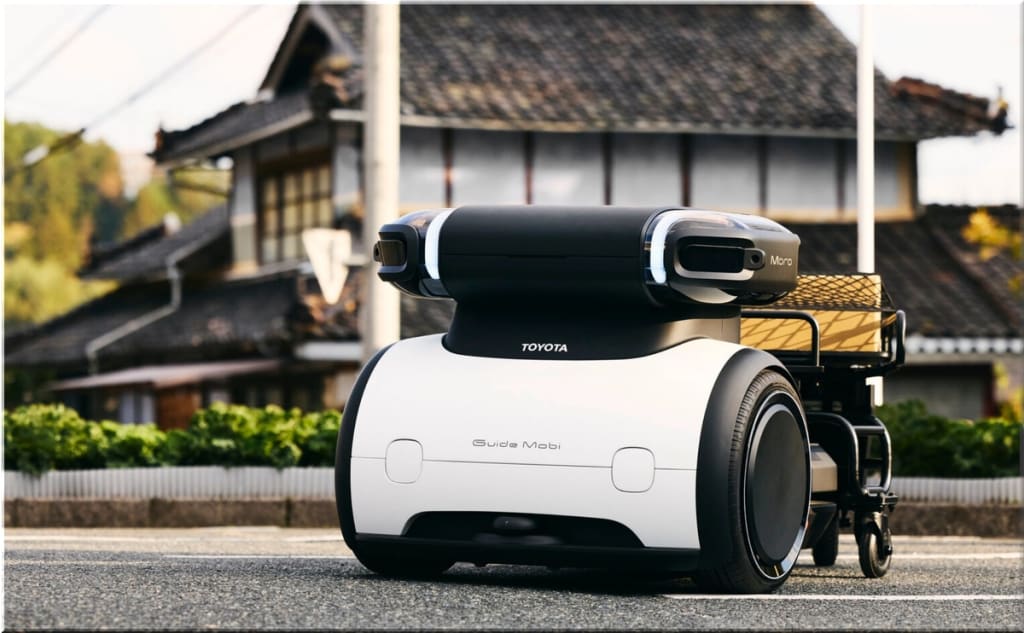
Toyota sees the problem differently. The automaker isn't waiting for policy fixes or immigration solutions. It's testing autonomous delivery robots in Sho, a mountain town of 10,900 residents in Okayama Prefecture where buses run three times daily, population density sits at 83 persons per square kilometer, and residents can't ride bicycles anymore.
The 2024 Problem Hits Rural Japan Hardest
More than 51% of Japan's 1,719 municipalities qualify as depopulated areas according to the Ministry of Internal Affairs and Communications. These aren't just statistics. They're communities where the local shop disappeared, walking 100 meters becomes a struggle, and handing in your driver's license means isolation.
The demographic crunch compounds fast. Between 1980 and 2020, 879 municipalities saw their female population aged 20-39 drop by half. A 2024 study by the Population Strategy Council identified 744 local governments where this critical demographic will decline 50% or more between 2020 and 2050. Former Minister Hiroya Masuda calls this "local extinction."
Key demographic indicators paint a dire picture:
- 29.1% of Japan's population exceeded age 65 by 2022
- Adult diaper sales surpassed baby diapers in 2014
- 896 municipalities faced extinction by 2040 in the original 2014 forecast
- 13.5% of houses sit vacant nationwide
- Life expectancy reached 85.22 years in Okayama Prefecture by 2020
Sho itself has lost population steadily since 1950, when it peaked at 14,317 residents. By 2022, that number fell to 10,900—a 23.9% decline over 72 years. The town sits in the Chugoku Mountains on terrain that's mostly hills and forests. It's said to be where the folklore hero Kintaro died at age 55.
Truck drivers earn significant income from overtime. The average driver worked 2,568 hours annually before the cap—about 214 hours monthly. New caps cut their wages substantially. The industry becomes less attractive to new workers. The shortage accelerates. The effective job openings-to-applicants ratio for truck drivers already sits at 2.68—roughly twice the all-industry average—highlighting chronic labor shortages.
Logistics companies face impossible choices. Revenue drops when drivers haul less cargo. Operational costs rise when overtime pay increases for hours beyond 60 monthly. Small operators—which make up 99% of Japan's 63,000 trucking companies—lack resources to adapt. Many face bankruptcy.
Toyota's Medium-Speed Robot Solves What Small Robots Can't
Other companies already deploy small, low-speed robots after Japan revised its Road Traffic Act in April 2023. These machines move at 6 km/h (3.7 mph) and carry 20 kg (44 lbs)—enough for a few grocery bags or small packages.
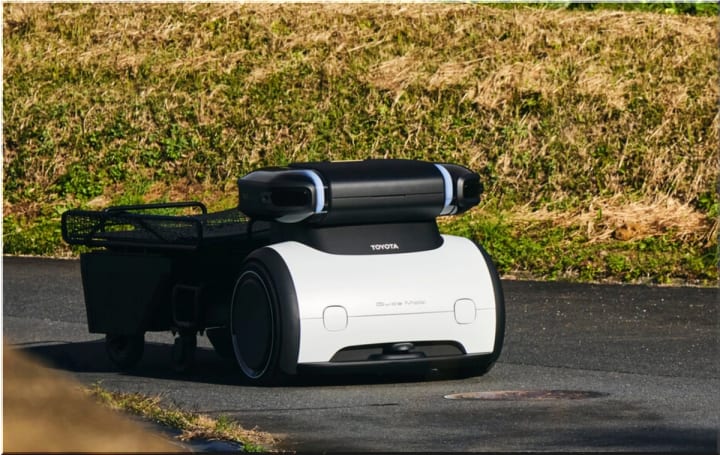
Toyota's Guide Mobi operates in a different weight class:
- Top speed: 15 km/h (9.3 mph), tested at 8 km/h (5 mph) for safety trials
- Load capacity: 200 kg (440 lbs)—10 times more than small robots
- Dimensions: 1,510 mm × 1,054 mm × 920 mm (59.4" × 41.5" × 36.2")
- Detachable cargo bed enabling multiple sequential tasks
- Operates in Toyota's Woven City test facility before public road deployment
The carrying capacity jump from 20 kg to 200 kg fundamentally changes use cases. A farmer can transport an entire harvest load to market—approximately eight standard crates of vegetables. A factory can move complete pallet loads of parts autonomously. Medical supply deliveries can include a week's worth of medications and equipment for homebound elderly patients.
Daisuke Sato, Assistant Manager in Toyota's Advanced Mobility System Development Division, explains the design philosophy with personal connection: "My own grandparents found shopping difficult in their later years. Being able to go and buy the things you want is a real source of joy. Despite the convenience gap between urban and regional areas, no one should be left behind."
The detachable bed creates operational flexibility competitors lack. While one farmer loads vegetables into a trailer, the Toyota Guide Mobi Autonomous Robot can drive elsewhere to pick up parts for a construction site or deliver groceries to an elderly resident. Community-wide sharing maximizes utilization rates. Higher operation time directly improves cost-effectiveness—the primary barrier to profitability in autonomous delivery business models.
Industry analysts project typical delivery robot costs range from $2,500 to $5,000 for small units. Medium-speed robots like Guide Mobi cost significantly more due to advanced sensor arrays and larger battery packs. However, the ROI calculation changes dramatically with 10x carrying capacity. A single Guide Mobi can replace multiple small robots operating the same route.
Mountain Testing Reveals Critical Design Flaws Lab Conditions Miss
Toyota refined Guide Mobi basics in Woven City, its 175-acre prototype smart city at the base of Mount Fuji in Susono City, Shizuoka Prefecture. The facility officially launched September 2025 after Phase 1 construction completed in January 2025. Woven City features three types of ground-level roads plus an underground network, multifunctional sensor poles, and coordinated traffic signal systems—a controlled environment perfect for initial development.
Public roads in Sho's mountainous terrain exposed problems lab testing and Woven City's planned layout missed completely.
Steep slopes triggered false positives. The robot's safety system misidentified hills as obstacles and executed emergency stops on inclines. Collision-prevention sensors sat low enough to detect a child lying on the ground—critical for safety—but the sensor angle needed recalibration for terrain variations common in rural areas.
The testing philosophy echoes Toyota's century-old manufacturing principle: roads build cars. Every trial in Sho's real-world conditions—narrow village paths, unpaved sections, agricultural access roads, extreme weather—improves the production version. Data accumulated through repeated public road trials provides evidence regulators need for approving medium-speed robot deployment nationwide by 2027.
Assistant Manager Sato emphasizes the stakes: "Autonomous transport is especially vital at night and in rainy weather. We want to keep improving sensor sensitivity and other aspects to help bring happiness to many people."
Night operation and heavy rain create the toughest technical challenges. Elderly residents who struggle with daytime shopping find evening trips impossible. But these scenarios demand the highest sensor precision. Water droplets scatter LIDAR returns. Darkness reduces camera effectiveness. Temperature variations affect ultrasonic sensors. Solving these edge cases separates viable products from prototypes.
The SORACAGO Tackles Last-Mile Delivery with Zero Human Interaction
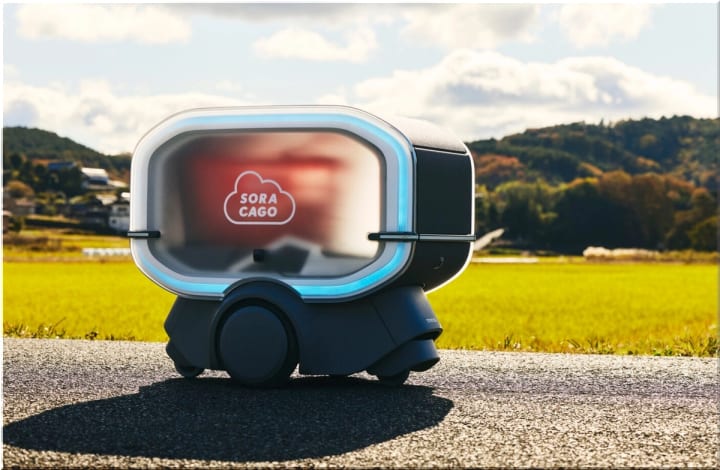
Toyota also tests a smaller robot called SORACAGO in Sho. It operates within the small, low-speed category (6 km/h maximum) already approved for public roads. The unit uses suspension technologies directly adapted from automotive engineering—specifically, damping systems that smooth out road irregularities to protect cargo.
But size and suspension aren't what differentiate SORACAGO from dozens of competing products flooding Japanese streets since the 2023 law change.
Masatoshi Kakutani, Assistant Manager in Advanced Mobility System Development, identified the breakthrough: seamless integration with secure parcel drop boxes.
Autonomous delivery means no waiting at home for the delivery window. No rushing to catch the driver. No rescheduling redeliveries—a massive cost burden in Japanese logistics. The robot delivers packages to weatherproof, locked drop boxes while residents sleep, work, or travel. Residents retrieve items on their schedule.
The approach draws inspiration from Toyota Production System philosophy—specifically the principle that people shouldn't just stand and watch machines work. Kakutani explains: "We drew inspiration from the idea that people should not just be left to watch over machines. The robot has been thoroughly lab-tested, and we also showcased the concept at the Osaka-Kansai Expo."
This automation level matters for business viability. Current last-mile delivery costs approximately $1.60 per mile with human drivers. ARK Investment Management research suggests autonomous delivery robots could drop that cost to $0.06 per mile—a 96% reduction. The primary remaining costs become hardware amortization, electricity (minimal for low-speed robots due to minimal air resistance), and remote operators managing edge cases.
Refrigerated transport development comes next. Kakutani notes: "The area where I live hasn't felt the effects of aging, but I was surprised to learn that even in such places there are many older people who rely on mobile vending. Even if the supermarket is just a kilometer away, walking the 2 km round trip is a tough ask for a senior person who has handed in their drivers license."
Temperature-controlled delivery opens entirely new revenue streams: fresh food, medications requiring cold chain integrity, meal kit services competing with Blue Apron and HelloFresh business models. For elderly residents, receiving fresh produce and prepared meals enables independent living longer. The social benefit translates to reduced healthcare costs and delayed nursing home admissions.
Business Model Remains Unproven Despite Acute Social Need
Tsutomu Takigami runs DonDon Market, a mobile vendor serving over 90% customers within the immediate area. Most are women over 60 who've surrendered drivers licenses. The business model barely breaks even. Takigami participates in Toyota's trials despite minimal profit potential.
His motivation isn't financial: "If we don't do something, people will no longer be able to shop. The question is, who's going to do it? So I volunteered. I feel embarrassed, so let's get the photo done quickly."
Takigami embodies the contradiction at the heart of autonomous delivery in depopulated areas. Technology solves logistics accessibility but erases human connection that elderly residents value most. He wants cameras installed on robots enabling video calls during deliveries—preserving the front-step conversations that define community bonds in villages like Sho.
The women waiting for DonDon Market enjoy everyday moments chatting with neighbors. Full automation eliminates those micro-interactions that combat isolation—already epidemic among Japan's aging population. Over 32% of elderly Japanese live alone. Social isolation correlates strongly with cognitive decline, depression, and premature mortality.
Japan's Ministry of Economy, Trade and Industry steers the project toward 2027 public rollout, timing that aligns precisely with the projected 240,000-driver shortage. The government goal extends beyond solving social challenges. Autonomous delivery robots should become a growth industry—creating manufacturing jobs, software engineering positions, remote operator roles, and maintenance technician careers while boosting GDP through efficiency gains.
But as Takigami noted with stark honesty, the business "hasn't even reached the starting line." No company has demonstrated profitable operation of medium-speed autonomous delivery robots in depopulated rural areas where customers are scattered and order density remains low. Urban pilots in Tokyo, Osaka, and Nagoya work because customer concentration justifies robot deployment. Sho presents the opposite scenario—maximum need, minimum economic viability.
Regulations Block Medium-Speed Robot Deployment Nationwide
Small, low-speed robots (maximum 6 km/h, 20 kg capacity) operate legally after the April 2023 Road Traffic Act revision. Companies deployed hundreds within months. Medium, mid-speed robots face regulatory vacuum. Very few cases exist of such vehicles testing on public roads anywhere in Japan.
The regulatory gap matters enormously. Small robots fundamentally cannot solve 34% of unmet cargo demand projected by 2030. They carry too little (20 kg versus the average parcel weight of 8-12 kg means 1-2 packages maximum), move too slowly (6 km/h versus pedestrian walking speed of 5 km/h offers minimal advantage), and cover limited range (typical battery life enables 3-5 km radius before recharging).
Medium-speed robots deliver 200 kg loads—approximately 16-25 standard packages—at speeds approaching urban traffic flow. They cover service radiuses of 10-15 kilometers, reaching customers in a timeframe competitive with human delivery. These specifications align with actual logistics requirements.
Testing medium-speed robots on public roads generates safety data, operational patterns, infrastructure needs, and edge case documentation that regulators require for nationwide approval. Toyota accumulates this evidence now so regulatory frameworks can catch up by the government's 2027 target date.
The Ministry of Economy, Trade and Industry actively promotes these trials because Japan faces dual crises: driver shortage and competitive disadvantage if foreign companies master autonomous delivery first. China deployed over 10,000 delivery robots in cities by 2023. American companies like Starship Technologies operate in 100+ cities globally. Japan's regulatory caution—normally prudent—risks creating dependency on foreign technology for domestic infrastructure.
Integrated Mobility Network Spans Multiple Robot Classes
Kakutani describes Toyota's development vision as "a mobility network that integrates parcel drop boxes as well as medium- and large-sized vehicles." This systems-thinking approach differentiates Toyota from competitors chasing single-product solutions.
No single robot size solves all logistics scenarios. Small robots (6 km/h, 20 kg) handle final delivery from drop boxes to individual homes on narrow pedestrian paths. Medium robots (15 km/h, 200 kg) move goods from distribution centers to neighborhood drop boxes and handle business-to-business deliveries. Large autonomous vehicles—Toyota's e-Palette platform—transport bulk cargo between cities and regional hubs.
The network requires sophisticated software orchestration. When should a large vehicle transfer cargo to medium robots? Which medium robot claims which delivery zone? How do small robots coordinate with drop box availability? These optimization problems demand AI-driven fleet management systems that balance cost, time, and customer satisfaction across hundreds of simultaneous movements.
Toyota tests this integrated approach within Woven City, where Phase 1 accommodates approximately 360 residents with plans to scale toward 2,000 residents across all phases. The facility earned LEED for Communities Platinum certification—Japan's first—recognizing environmentally conscious design. By 2026, Woven City opens to general public participation, generating diverse user data beyond Toyota employees and partner companies.
The three-type road system in Woven City enables controlled comparison of different mobility modes: dedicated vehicle lanes, shared pedestrian-mobility paths, and pedestrian-only routes. An underground road network allows testing unaffected by weather or temperature—critical for establishing baseline performance before deploying to Sho's harsh mountain conditions.
Automation Rush Extends Across Air, Ground, and Sea
Japan's driver crisis catalyzes automation investments across every transportation mode:
7-Eleven partnered with Suzuki Motor and robotics startup Lomby to test fully autonomous delivery robots in Tokyo's Minami-Osawa district—a hilly area with stairs that challenge robot navigation. The pilot serves 10,000 households, generating data on suburban terrain that differs sharply from flat urban cores.
Rakuten Drone completes ocean crossings to isolated islands where traditional delivery is prohibitively expensive. On Masaki Island (population 70, mostly over 65), residents order 5 kg of groceries via smartphone app, paper catalog, or phone call. The drone covers 5.5 kilometers in 15 minutes—a journey that requires hour-long ferry trips or helicopter charters for human delivery. Cost drops from hundreds of dollars per delivery to approximately $8-12.
Toyota Tsusho Corporation operates medication delivery drones to Goto Islands using the ACSL PF2-CAT3—Japan's first Level 4 autonomous drone authorized for flights over populated areas without visual observers. Level 4 represents the highest autonomy category, essential for commercial viability in remote regions where operator placement is impractical.
NTT (Japan's dominant telecommunications company) aims to deploy over 1,000 autonomous buses and cars by the 2030s. The company leverages its nationwide fiber optic infrastructure for vehicle-to-infrastructure communication, enabling real-time traffic optimization and predictive maintenance. NTT's scale transforms isolated autonomous vehicle pilots into cohesive regional networks.
Japan's Ministry of Land, Infrastructure, Transport and Tourism plans an automated cargo highway connecting Tokyo and Osaka—a 500-kilometer route handling Japan's densest freight corridor. Operating 24/7 with autonomous trucks in dedicated lanes, the system could transport 26% of goods currently moved by human drivers on that route. Construction timelines target 2030s completion, precisely when driver shortage peaks.
Four Years Determines Japan's Logistics Future
The timeline is fixed. Driver shortage hits 240,000 by 2027—just 12 months from now. Unmet cargo demand reaches 34% by 2030—less than one election cycle away. These aren't projections subject to revision. They're demographic certainties based on driver age distribution and retirement rates.
Technology development timelines rarely align with social need timelines. But Japan has no choice. The alternative scenarios range from bad to catastrophic: supermarkets empty in rural areas, elderly residents dying from medication access failures, farms abandoning crops because transport costs exceed crop value, factories relocating abroad because domestic logistics become unreliable.
Toyota's approach—test in harshest conditions, fix problems iteratively, deploy incrementally—mirrors how it revolutionized manufacturing through kaizen (continuous improvement). But automotive development typically spans 4-6 years from concept to production. Autonomous delivery robots face a 2027 regulatory deadline and 2030 social emergency with development that only began serious road testing in 2024-2025.
Assistant Manager Sato has young children in elementary school. He hopes they'll see Guide Mobi robots working while everyone sleeps or during heavy rain: "In the future, I hope they will see these robots going about their work while everyone is asleep, or in heavy rains, and think, My dad developed that."
That vision requires solving sensor sensitivity in extreme weather (typhoons, snowfall, fog), navigation accuracy on unmapped rural roads, operational efficiency sufficient for 12-18 month ROI that makes private sector deployment financially viable, and social acceptance from elderly residents who fear technology but desperately need its benefits.
The contradiction is painful. Tokyo residents enjoy Amazon Prime same-day delivery, automated convenience store checkouts, and ride-hailing apps with 2-minute wait times. Sho residents walk 2 kilometers for groceries, wait for buses that run three times daily, and face shop closures because no young people remain to staff them. The convenience gap between urban and rural Japan widens yearly.
When Technology Must Outrun Demographics
Autonomous delivery robots won't save every municipality among the 744 facing extinction by 2050. But for towns like Sho—where three daily buses and no bicycle-friendly infrastructure define mobility options—these machines represent the difference between community survival and forced relocation.
The economic pressure is relentless. Logistics companies raise freight rates to cover driver wage increases and reduced capacity. Retailers pass those costs to consumers. Prices rise faster in rural areas where delivery volumes can't offset per-unit costs. Elderly residents on fixed pensions cut spending. Businesses close. Young families leave. Population decline accelerates.
Toyota faces a deadline measured in months, not years. The 2024 problem arrived April 2024—logistics capacity already dropped 14%. The 2027 shortage of 240,000 drivers is locked in—those drivers don't exist in the talent pipeline. The 2030 cargo gap of 34% unmet demand is coming—unless autonomous systems scale rapidly.
The stakes extend beyond Japan. South Korea faces even faster population aging—median age 44.9 years in 2023 versus Japan's 48.7 years. Italy's population projected to shrink 28% by 2100. China's working-age population already declining since 2015. Germany's truck driver average age exceeds 50 years.
The question isn't whether Japan needs autonomous delivery robots. It's whether they'll arrive before the logistics system breaks completely—and whether other aging societies learn from Japan's crisis in time to prevent their own.
Toyota bets its robotics division on yes. The government stakes economic stability on successful deployment. Tsutomu Takigami and the elderly residents of Sho simply hope someone solves the problem before they can't buy groceries anymore.
The race against demographics has four years left. The robots are being tested in mountain villages. The regulations are being drafted. The business models remain unproven. And 240,000 missing truck drivers wait for no one.
About the Creator
Keep reading
More stories from Panorica Pan and writers in Wheel and other communities.
New 2026 Mazda CX-30 SUV: Prices, Engines, and Safety Tec
Mazda has released full details for the 2026 Mazda CX-30, its best-selling compact crossover designed for drivers who want efficiency, safety, and capability in a smaller footprint. The CX-30 sits between the Mazda3 hatchback and the larger CX-50, giving the automaker an important entry point in one of the most competitive vehicle categories in the U.S.
By Panorica Pan5 months ago in Wheel
Why I Trust Genuine Used BMW Parts
I didn’t start out trusting used BMW parts. Actually, I avoided them. For a long time, I believed what most people believe: new is safe, used is a risk, and genuine only matters if it comes in a sealed box with a BMW logo on it.
By MT Auto Parts – BMW Specialists from the UK4 days ago in Wheel
One Unchecked Box
"Republished" because it was the only way to add the embed for the newly recorded audio version of this story due to the Top Story badge. Plus it serves as a nice, informal announcement of the podcast's revival for another season (go subscribe!):
By Stephen A. Roddewig5 days ago in Fiction



Comments
There are no comments for this story
Be the first to respond and start the conversation.