
THE 4 STROKE ENGINE
The engine which changed the emission of vehicles

INTRODUCTION
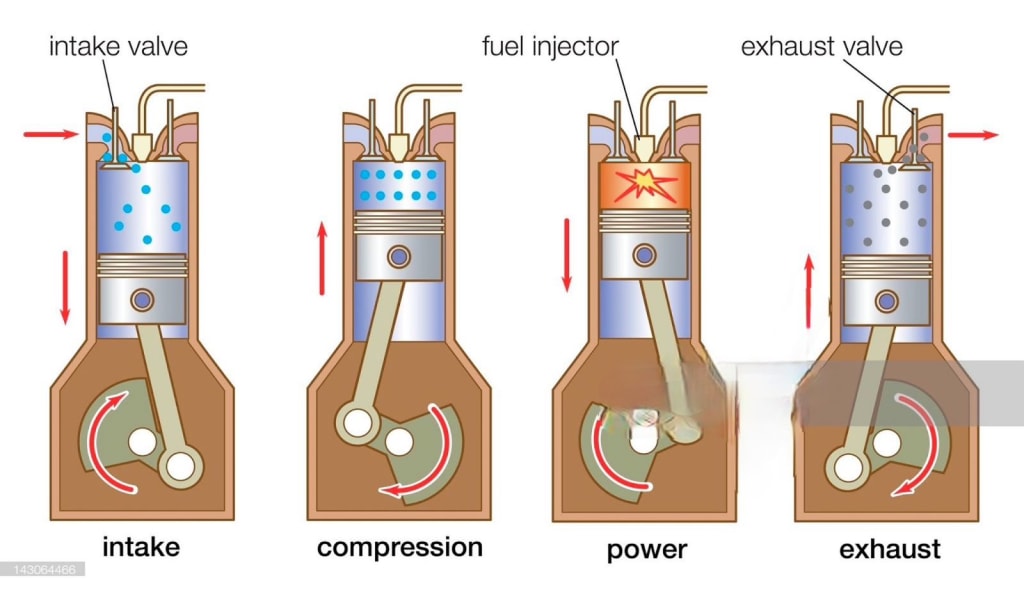
A 4-stroke engine is a type of internal combustion engine that is commonly used in automobiles, motorcycles, and other vehicles. It is called a 4-stroke engine because it requires four distinct strokes of the piston to complete one operating cycle. These four strokes are:
Intake stroke: During this stroke, the piston moves down, creating a vacuum in the cylinder. This allows a mixture of fuel and air to be drawn into the cylinder through the intake valve.
Compression stroke: Once the intake stroke is complete, the piston moves up, compressing the fuel and air mixture in the cylinder. This compression makes the mixture more volatile, which helps to increase the power output of the engine.
Power stroke: When the mixture is fully compressed, a spark from the spark plug ignites it, causing a rapid expansion of gases. This expansion pushes the piston down, generating power that is used to drive the vehicle's wheels.
Exhaust stroke: After the power stroke is complete, the piston moves up again, expelling the exhaust gases from the cylinder through the exhaust valve.
This process is repeated many times per second, with each cycle generating the power needed to keep the vehicle moving. Compared to 2-stroke engines, which complete the same cycle in only two strokes, 4-stroke engines are more efficient and produce less pollution.
------>ADVANTAGES OF 4 STROKE ENGINES
Greater Fuel Efficiency: 4-stroke engines are more fuel-efficient than their 2-stroke counterparts. This is because they burn fuel more cleanly and completely, resulting in fewer emissions and more efficient combustion.
Lower Emissions: 4-stroke engines produce lower levels of harmful emissions such as carbon monoxide, hydrocarbons, and particulate matter compared to 2-stroke engines. This makes them more environmentally friendly and better suited for use in urban areas.
Longer Lifespan: 4-stroke engines are built to last longer than 2-stroke engines. They have fewer moving parts, run at lower RPMs, and require less maintenance, resulting in a longer lifespan.
More Power: 4-stroke engines produce more power per unit of fuel than 2-stroke engines, making them ideal for high-performance applications such as racing.
Quieter Operation: 4-stroke engines produce less noise than 2-stroke engines, making them ideal for use in applications where noise levels need to be minimized.
Overall, 4-stroke engines are more efficient, produce fewer emissions, and have a longer lifespan than 2-stroke engines, making them a popular choice for a wide range of applications
----->DISADVANTAGES OF 4 STROKE ENGINES
Lower power-to-weight ratio: Compared to 2-stroke engines, 4-stroke engines are generally heavier for the same amount of power output. This means that they are not as suitable for applications where weight is a critical factor, such as in some types of racing or aviation.
Higher complexity: 4-stroke engines are more complex than 2-stroke engines, with more moving parts and additional systems such as the valvetrain and lubrication system. This can make them more expensive to manufacture and maintain.
Lower efficiency: Due to their more complex design and additional systems, 4-stroke engines tend to be less efficient than 2-stroke engines. This means that they may require more fuel to produce the same amount of power, which can be a disadvantage in applications where fuel economy is important.
Limited powerband: 4-stroke engines typically have a narrower powerband than 2-stroke engines, meaning that they may not produce as much power at high RPMs. This can be a disadvantage in applications where high power output is required, such as in racing or high-performance vehicles.
Slower acceleration: Due to their slower cycle of intake, compression, combustion, and exhaust, 4-stroke engines tend to have slower acceleration than 2-stroke engines. This can be a disadvantage in applications where quick acceleration is important, such as in some types of racing or high-performance vehicles
About the Creator
Yusuf Ibrahim Imaz
“Knowledge is of no value unless you put it into practice”
Dont just read apply it in your life .
A freshmen in sjec learning to write so i hope you like what i have in my aresnal
Keep reading
More stories from Yusuf Ibrahim Imaz and writers in Wheel and other communities.
RESTful API
RESTful API (Representational State Transfer) has become the preferred architectural style for building web services. It's based on a set of constraints that allow developers to create scalable, efficient, and maintainable APIs. In this article, we'll explore the principles of RESTful APIs, the benefits they offer, and some best practices for designing them.
By Yusuf Ibrahim Imaz3 years ago in Futurism
Top 10 Pickup Trucks Every Aussie Should Consider in 2026
Choosing the right pickup truck can make a huge difference in daily life, whether you’re hauling gear for work, towing a trailer, or exploring the Australian outback. With 2026 just around the corner, several models are standing out for their performance, reliability, and features. In this guide, we’ll cover the top 10 pickup trucks that every Aussie should consider this year, helping you to pick the right vehicle for your daily life and long-term plans.
By Alec Johnson8 days ago in Wheel


Comments
There are no comments for this story
Be the first to respond and start the conversation.