
Guide on How to Read a Tire Sidewall Marking
Understand how to read a tire sidewall marking like tire size, load capacity, speed rating, and more. A mobile tire shop helps make right decisions when buying tires.

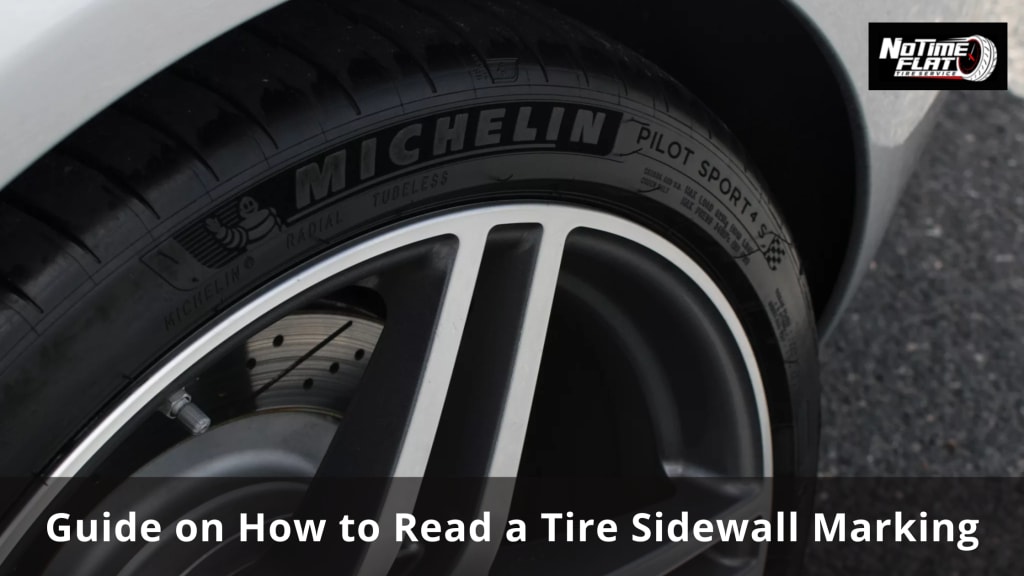
Your tire has a very useful feature—the sidewall marking. It contains important information like tire name, size, tube type, maximum load, and more. Learning how to read a tire sidewall marking will help you understand its purpose, dimensions, and capacity which enables you to make informed decisions when buying tires.
In this comprehensive guide, we'll explain everything you need to know about reading a tire sidewall. Whether you have passenger-car, light-truck, winter, or extreme-performance summer tires, mobile tire shop experts have all the knowledge to share.
Let's clear out the confusing numbers and letters on your tire's sidewall and gain valuable information about the tire sidewall marking system. By the end of the blog, you'll become a tire expert and make knowledgeable choices for your vehicle!
Understand The P-Metric Codes
If you've ever wondered how to read a tire sidewall if your tire is P-Metric, the answer is quite simple! So, how to read a tire sidewall code? Just check if the sidewall code starts with the letter "P."
The P-Metric system uses both metric and standard measurements to meet the requirements set by US-based standardized organizations. The system was established by American tire manufacturers in 1977 and has become the industry standard.
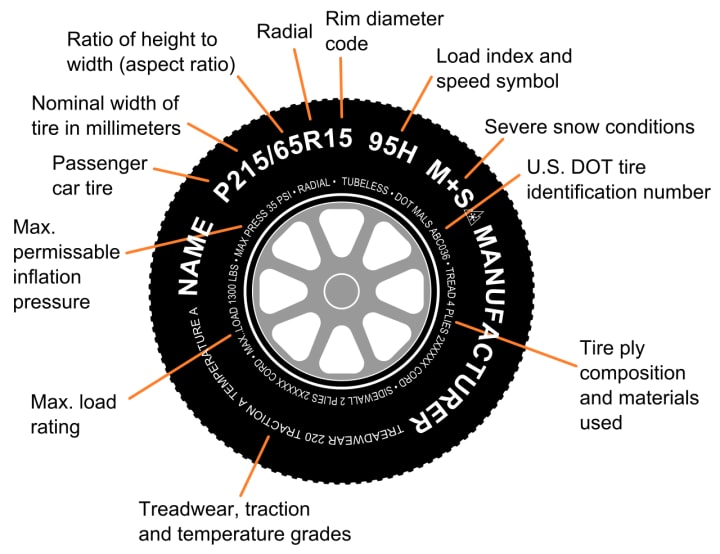
EXAMPLE: Look at a P-Metric sidewall code: P 215/65 R 15. Each character in the code holds valuable information about your tire's specifications.
The first character indicates the tire class: A "P" signifies a P-Metric passenger tire built to US standards. "LT" designates a light truck tire. Although not part of the P-Metric family, LT tires are also constructed to meet US standards.
If no letter is present, it indicates a passenger tire built to European standards, sometimes called Euro-Metric or Hard Metric tires.
After the tire class, you'll notice a number representing the section width. This measurement reveals the width of the tire from sidewall to sidewall in millimeters. The section width is typically three digits. For example, our tire has a section width of 215mm.
Next, the aspect ratio follows the section width. It dictates the sidewall height as a percentage of the section width. Look for the two-digit number after the slash to find the aspect ratio. In our example, the aspect ratio is 65 that means the sidewall height is 65% of the 215mm section width.
Following the aspect ratio, a letter specifies the tire's construction type:
"R" denotes radial construction, where the tire's plies run at a 90-degree angle that is to the centerline of the tread.
"D" represents diagonal bias construction, where the plies are positioned at angles lower than 90 degrees.
Lastly, the wheel diameter is the final figure in a P-Metric tire sidewall code. While the section width is given in metric units, the tire's rim diameter is expressed in inches. The measurement indicates the diameter of the wheel on which the tire can safely be mounted. Our example tire has a wheel diameter of 15 inches, which is suitable for a 15-inch wheel.
By understanding these P-Metric tire specifications, you'll know how to make right decisions when choosing the right tires for your vehicle from the inventory of commercial tire sales.
Know Your High Flotation Tire Codes
High flotation tire codes differ slightly from P-Metric tire codes, although they may look similar.
An example code is 35 × 12.50 R 17/E.
- High flotation codes start with the tire's total diameter, measuring its height in inches. The diameter is a two-digit number. For instance, our tire has a diameter of 35 inches.
- Next, you'll find the tire's width, given in inches: The tire width is a three- or four-digit number with a decimal point. In our example, it is 12.50 inches.
- Similar to P-Metric tires, a letter represents the tire's construction: "R" denotes radial construction, where the tire's plies run 90 degrees to the tread's centerline.
- "D" indicates diagonal bias construction, with plies at angles lower than 90 degrees.
- After the tire construction, the wheel diameter is mentioned, indicating the fitting diameter: Our example tire has a wheel diameter of 17 inches, fitting only a 17-inch wheel.
While not all high flotation tires are light truck tires, those that provide a load range indicate their capacity to hold air and carry weight. The load range is typically represented by letters like C, D, or E. Knowing these high-flotation tire specifications will help you make informed decisions when choosing the right tires for your vehicle.
When looking at your tire codes, it's important to understand that they contain more than just the tire dimensions. Other markings on the sidewall provide additional information about the tire's characteristics. Let's explore these markings and what they mean.
The Other Tire Sidewall Markings
So, how to read a tire sidewall marking system other than P-Metric and high flotation tire codes? Here's how:
1. Load Index and Speed Ratings
After the size code, you will find characters representing the tire's load index and speed rating. The load index, expressed as a number, indicates how much weight your tire can carry at different inflation pressures. Refer to a load index chart to determine your tire's precise load-carrying capacity.
For example, let's take a tire with the code P 205/65 R 16 92H. This tire has a load range of 92, corresponding to a carrying capacity of 1389 lbs at 36 psi.
The speed rating is specifically indicated by a letter, representing the maximum speed the tire can safely reach and maintain. It's important to note that these ratings are determined in controlled lab settings. It's advisable to follow the stated speed limit while driving. In our example, the tire has an "H" speed rating, indicating a safe speed of up to 130 mph.
2. US DOT and Safety Standard Markings
Certain details on your tire sidewall are legally required. The Department of Transportation (DOT) and safety markings provide information about where and when the tires were made and their compliance with federal regulations. The DOT and safety markings appear in alphanumeric codes, such as DOT CC9L XYZ1016.
The DOT designation assures that the tire meets or exceeds the U.S. Department of Transportation's safety requirements for on-road use. Tires without this designation are not legal for street use.
The plant code, represented by two letters after "DOT," identifies the tire's manufacturer and site of creation. Following the plant code, two characters express the tire size in a manufacturer-determined code. The next three characters represent brand characteristics intended for the manufacturer's internal use.
How to read a tire sidewall date? After the brand characteristics, four numbers indicate the tire's creation date. The first two numbers represent the week of manufacture, while the last two digits indicate the year. Combining these numbers provides a precise idea of when the tire was made. For example, a tire with the code XYZ1016 was manufactured in the 10th week of 2016.
3. Treadwear, Traction, and Temperature Markings
The DOT requires all tires to display their performance grades under the Uniform Tire Quality Grade (UTQG) system. These grades should only be used to compare tires from the same brand. The UTQG markings are written out, as in TREADWEAR 520 TRACTION A TEMPERATURE A.
The treadwear grade indicates a tire's wear resistance compared to a control tire with a rating of 100. In our example, the tire's 520 treadwear rating suggests it should last a little over five times longer than the control tire.
The traction grade ranks a tire's ability to stop on wet surfaces in controlled conditions, ranging from AA (highest) to C (lowest). Our example tire has an A traction grade, indicating very good but not superior stopping power on wet surfaces.
The temperature grade measures a tire's ability to dissipate heat and resist temperature buildup, with grades of A, B, and C. Our example tire has the highest temperature grade, an A.
4. Maximum Load Capacity and Inflation Pressure
Your tire sidewall also displays the tire's maximum load limit and inflation pressure. These specs, such as MAX LOAD 635 kg (1400 lbs) AT 300 kPa (44 psi) MAX PRESS, are explicitly mentioned.
The maximum load capacity, similar to the load index, identifies the tire's load carrying capacity when inflated to its maximum air pressure. The maximum air pressure is the tire's maximum inflation pressure and should not be exceeded. Standard and extra load tires meet their maximum load capacity at 36 and 42 PSI, respectively, and maintain that load up to the tire's maximum operating pressure. In our example, the tire has a maximum pressure of 44 psi and a carrying capacity of 1400 lbs.
Remember that these maximum load and air pressure limits apply to the tire, not your vehicle. Always consult your owner's manual for your vehicle's recommended cold inflation pressure.
5. Ply Construction
Your tire sidewall also provides information about its construction. This information is usually presented in a clear format, such as "PLIES: SIDEWALL POLYESTER 1, TREAD POLYESTER 1 + STEEL 2." These details indicate the materials used in the tire's plies and the quantity of each type of ply.
6. Rotation Direction
Finally, some tires are designed to be installed in a specific way. In such cases, look to the sidewall for instructions regarding the tire's correct position.
Understanding these other sidewall markings can provide valuable insights into your tire's age, construction, performance attributes, and more.
Get Expert Help for Knowing Your Tires Well!
By now, you must have the basic knowledge of how to read a tire sidewall marking system. It's important to know whether you have directional or asymmetrical tires to confirm the tire tread patterns. Directional tires have a specific rotation direction indicated by arrows on the sidewall, while asymmetrical tires have different tread patterns on the inside and outside halves. Some tires can be directional and asymmetrical, with clear indications for rotation and the outward side.
If you're not sure about your tire tread patterns, reach out to experts who can provide guidance. If you need new wheels and rims, contact a mobile tire shop offering a wide selection of aftermarket wheels and rims at unbeatable prices and top-notch tire installation service for your convenience.
About the Creator
No Time Flat
Top-notch tire services and quality tires at No Time Flat in Jenison, MI. Whether you need tire installations, repairs, or maintenance, we've got you covered.
Keep reading
More stories from No Time Flat and writers in Wheel and other communities.
Wheel Alignment vs. Wheel Balancing: What You Need to Know
Just like a well-oiled machine, the parts of your car need to work together efficiently. But when your wheels are out of sync, it can cause trouble. Incorrect wheel alignment and wheel balancing can damage your suspension and tires, leading to bumpy rides and costly repairs. That's where the best wheel alignment services or the ideal tire balancing services are considered. So, wheel alignment vs balancing, which one do you need? Keep reading the blog post to know the basics and how often wheel alignment and balancing are required. You'll enjoy a smoother and safer ride by getting your wheels aligned and balanced. No more uneven tire wear, say yes to a longer-lasting and more comfortable journey. Be ready to hit the road confidently and leave those wheel woes behind!
By No Time Flat2 years ago in Wheel
Self-Driving Cars
If you watched the 2004 Will Smith film ‘I Robot’, you’ll know that a minor plot point is that cars in this future are, by default, self-driving. They can still be driven manually, but this is considered a risky choice which only Smith’s character chooses to do, due to being a fan of such ‘retro’ choices. When his car is wrecked during an attack late in the film, his boss assumes that he crashed due to driving manually (the one time in the film he actually wasn’t). At the time of the film’s release, self-driving cars must have seemed hugely futuristic to help to sell the future setting.
By Joe Morganabout 4 hours ago in Wheel
Why Elon Musk Keeps Cutting Tesla Prices And What It Means For The Future Of EVs
The discounts keep coming, the stock keeps shaking, and the EV future suddenly feels a lot less predictable I remember the first time I realized Tesla had quietly dropped the price of a car I’d been obsessively speccing out.
By abualyaanart6 days ago in Wheel



Comments
There are no comments for this story
Be the first to respond and start the conversation.