
### Understanding the Free Air Law in the USA: A Guide to Accessing Free Tire Inflation
The **Free Air Law** in the United States addresses an essential aspect of vehicle maintenance: proper tire inflation. While not uniformly applied across all states, this law ensures that drivers have access to free air for their tires in certain circumstances, particularly at gas stations. Proper tire inflation is not just a matter of convenience; it is a critical safety measure that also improves fuel efficiency and extends the lifespan of tires. Here’s a detailed overview of how this law works and its significance.
---
### **The Free Air Law: What Is It?**
The Free Air Law mandates that specific businesses, especially service stations, provide free air for tire inflation. However, this regulation is not federal; instead, its application depends on state or local laws. Some states enforce it more rigorously than others, with California leading the way in implementing specific legal requirements.
---
### **California’s Free Air Law**
California has one of the most explicit Free Air Laws in the United States. Under Section 13651 of the California Business and Professions Code, service stations must provide free air and water to customers who purchase gasoline. Here are the main stipulations:
1. **Customer Purchase Requirement**:
Free air and water must be provided to customers who buy fuel at the service station.
2. **Availability**:
The equipment must be operational and accessible during the station’s business hours.
3. **Compliance**:
Stations are required to display signage informing customers of their rights to free air and water.
California’s law is a consumer-friendly initiative that emphasizes safety and accessibility, ensuring that drivers can easily maintain their vehicles.
---
### **Free Air Laws in Other States**
While California stands out, other states may not have such specific legal requirements. However, many gas stations across the country voluntarily provide free air for customer convenience. The absence of a state-mandated law does not mean free air is unavailable; rather, it depends on the policies of individual businesses or local ordinances.
Some municipalities or states may encourage, but not require, free air provision as part of consumer protection efforts. In other places, service stations may charge for air but occasionally offer complimentary access with a purchase.
---
### **Why Free Air Access Matters**
Free air for tire inflation is more than just a customer service perk; it plays a vital role in road safety and environmental sustainability:
1. **Safety**:
Properly inflated tires ensure better vehicle handling, reduce the risk of blowouts, and improve braking efficiency.
2. **Fuel Efficiency**:
Underinflated tires increase rolling resistance, which leads to higher fuel consumption. Proper inflation can save drivers money on fuel over time.
3. **Tire Longevity**:
Overinflated or underinflated tires wear unevenly, shortening their lifespan and leading to higher replacement costs.
4. **Environmental Impact**:
Improved fuel efficiency through proper tire inflation reduces greenhouse gas emissions, contributing to environmental conservation.
---
### **Finding Free Air: Tools and Resources**
If you're looking for places to inflate your tires without paying, several resources can help:
1. **Websites and Apps**:
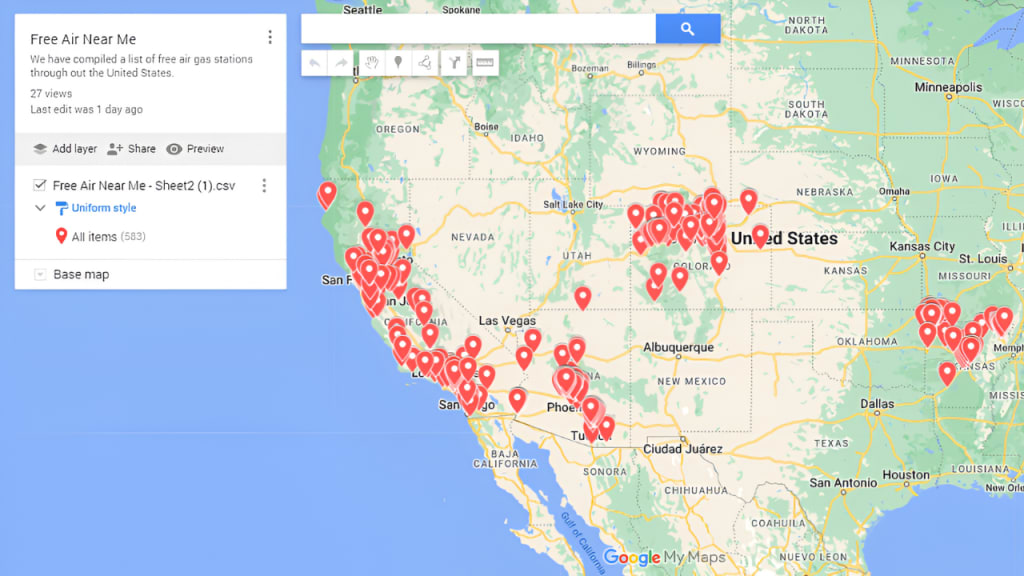
Tools like **Getfreeair.com** and similar platforms allow users to search for nearby locations offering free air for tires.
2. **Gas Station Chains**:
Some chains, such as Sheetz, Wawa, and QuikTrip, are known for providing free air as part of their customer service.
3. **Local Directories**:
Check local business listings or community forums, which often provide information on stations offering free air.
4. **Membership Benefits**:
Some roadside assistance programs, such as AAA, may include tire inflation services as part of their membership benefits.
---
### **Challenges with Free Air Access**
Despite its importance, accessing free air isn’t always straightforward. Challenges include:
- **Non-functional Equipment**: Stations may have air pumps that are out of order or poorly maintained.
- **Limited Availability**: In states without explicit Free Air Laws, fewer stations may offer this service for free.
- **Customer Restrictions**: Some stations only provide free air to paying customers, requiring a minimum purchase of gasoline or other services.
These challenges highlight the need for more consistent regulations across states to ensure wider access to free air.
---
### **Advocacy for Nationwide Free Air Laws**
The benefits of free air access suggest that broader implementation of Free Air Laws could be a worthwhile initiative. Nationwide legislation could:
- Standardize requirements across all states.
- Ensure air pumps are operational and well-maintained.
- Promote public awareness about the importance of tire maintenance.
Such measures would enhance road safety, reduce fuel consumption, and support environmental goals on a larger scale.
---
### **Conclusion**
The Free Air Law is a valuable initiative that underscores the importance of tire maintenance for safety and efficiency. While California leads with its explicit legal requirements, other states rely on voluntary efforts by businesses to provide free air. Tools like websites, apps, and community resources make it easier for drivers to locate free air stations, but challenges remain in ensuring consistent access.
Advocating for nationwide regulations could make this service universally accessible, benefiting drivers, the economy, and the environment. Until then, knowing your rights and resources can help you take advantage of free air services wherever they are available.
About the Creator
Keep reading
More stories from Eugene Harrod and writers in Wheel and other communities.
Genetic Factors Contributing to Early-Onset Hair Baldness in Teenagers
I. Introduction A. Background Information Hair growth is a complex biological process that involves cycles of growth, rest, and shedding. While hair loss is commonly associated with aging, early-onset hair baldness is increasingly observed among teenagers. This condition can lead to significant emotional distress during a critical period of identity formation. Understanding the underlying causes, particularly the genetic factors contributing to this condition, is essential for developing effective prevention and treatment strategies.
By Eugene Harrodabout a year ago in Humans
You Won't Believe How Easy it is to Get 100,000 Miles Between Brake Jobs
Most drivers are destroying their brakes prematurely — and it has nothing to do with speed. As a Master Mechanic for 25 years, I’ve seen every driving style imaginable. And nothing reveals a driver’s habits faster than how often they need brake work.
By Jack Martin2 days ago in Wheel
The Volkswagen T1 Camper Van Decanter Whiskey Bottle
Get it on : https://apparelabyssbrand.com/product/volkswagen-t1-camper-van-decanter-whiskey-bottle/ The Ultimate Blend of Nostalgia and Spirits: The Volkswagen T1 Camper Van Whiskey DecanterFor decades, the Volkswagen T1 Camper Van—affectionately known as the "Bus" or the "Bulli"—has been a global symbol of freedom, adventure, and the "Van Life" spirit. Today, that iconic silhouette has found a new home: not on the open road, but on the top shelf of the world’s most stylish home bars. The Volkswagen T1 Camper Van Whiskey Decanter is a stunning piece of functional art that captures the heart of 1960s counter-culture and pours it into a glass of premium bourbon or scotch.A Design That Drives ConversationAt first glance, these decanters are a masterclass in detail.
By gia ton hanh5 days ago in Wheel
Affection and Healing for Yourself
During the night of the last quarter moon, I gathered my ritual supplies. I carefully handled the chunk of black tourmaline that would protect me from your overall negative and narcissistic energy. I carefully walked the house with my stick of selenite in hand, asking the universe to cleanse our working space.
By Alisha Wilkins ✒️🦋🖋️4 days ago in Fiction




Comments
There are no comments for this story
Be the first to respond and start the conversation.