
Who are Hadzabe?
Learn about one of the few remaining hunter gather communities in the world.


When you talk about cultural experience in Africa especially in Tanzania, most people think about the Maasai. But there is another tribe with amazing and wonderful culture that is found in Tanzania.
In this article, we are going to see about the Hadzabe (or Hadza) people found around Lake Eyasi in northern Tanzania, on the edge of the Serengeti and south of Ngorongoro. Hadzabe people are among of the very few communities who are true hunter-gatherer remain on the Earth. They have a unique way of life that has remain unchanged for almost a millenia.
In this article we will see more about their land, their language, daily habits, belief systems, social structures, and how one if wants to go, might respectfully visit their community for cultural exposure.
Origins, and their Language
The Hadzabe are often referred to as one of the ancient human lineages remaining today on Earth. Their language known as Hadzane (or simply Hadza), is special and unique and it is not part of any larger language family in Africa like bantu. Their language is a completely language isolate meaning, and it employs click sounds among its phonetic components. Their language is oral-only, cannot be written and there is no writing system for the Hadzabe language. Therefore, the Hadzabe preserve their history and wisdom not by writing, but through stories, songs, and direct teaching.
They identify themselves simply by the word "Hadza", and this word simply means “human being.”
Division of Roles: Men Hunt, Women Gather
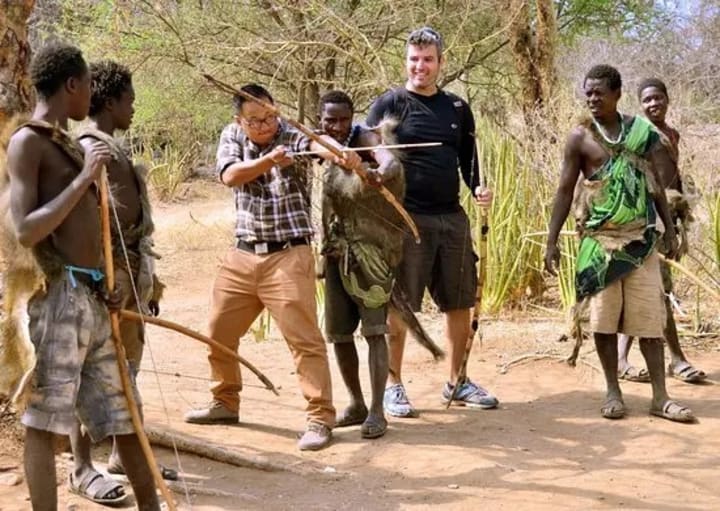
The Hadzabe live by dividing most of their work by task, not status. Men always go on hunting: tracking antelope, warthogs, baboons, birds, and other small to mid-size game. Their tools for hunting and gathering are handmade bows and arrows, often tipped with poison derived from local shrubs. For them, hunting often requires to be very patient, have good tracking skills, and deep knowledge.

Women on the other hand, harvest wild plants, tubers (roots), berries, baobab fruit, greens, and medicinal herbs. They also often gather honey, sometimes working in groups and children tend to accompany them, learning the ways of the community. In some cases, a male may accompany the women into the bush to provide safety or assistance.

During the rainy season, Hadzabe diet consist more of plant foods, fruit, tubers, honey, greens, and also meat. In the dry season, and since there is little vegetable around, they focus more on flesh from animals that mostly gather more at waterholes.
For Hadzabe, honey is extremely valued, not only for its flavor and calories but also for its energy provision value. Their food is consumed while it is fresh since they do not have ways of storing food for a long time. Whatever is hunted or gathered is shared together with the whole group.
Shelter and Culture
The Hadzabe live a nomadic or semi nomadic life. They relocate from place to place following water sources, seasonal growth of plants, or animal migrations.
Their shelters are simple and temporary in nature, they are constructed from tree branches, grass, and leaves. The Hadzabe own very few permanent possessions, as they move between places. they always carry their tools such as arrows, digging sticks or fire-making tools.
Their knowledge of plants, animals, medicinal herbs, and fire-making usually is taught and passed from generation to generation. They also use the lunar cycle (phases of the moon) to determine time and seasons rather than fixed calendars.
Beliefs and Values
Unlike many other societies, the Hadzabe do not have temples, priests, or centralized religious authority. Their beliefs are animistic, they believe in the spirits and ancestors who are reflected in trees, natural features, and wildlife. To them a creator figure is sometimes named Haine or Gkochu who is being told in their stories.
To them, death is accepted as part of life’s cycles. Burials are often simple in such a way that some bodies may be placed in caves or shallow graves. The community may mark a death with a ritual, kill an animal, and share a feast.
Social Harmony
One of the most striking features of Hadzabe society is its egalitarian ethos. This means that in this society all people are considered equal in worth, rights, and status, and should be treated as such. There is no chief, no formal leadership, and resource sharing among the community is strong. Major decisions such as where to move camp next are done by the community, often through discussion, consensus, or simply mutual agreement.
Conflict resolution can be flexible: if a person is in tension with others, they may simply move to a different camp. Age and ability here gives one respect, but distinctions of power or status are minimal.
In this kind of system, equality is seen and lived daily, it shapes social interactions, gender roles, and resource distribution. Survival is collective as the community.
Planning Your Visit
If you plan to see the cultures of Africa and you are drawn to witnessing culture in close contact, you may try to visit the Hadzabe. And this can be one of the best travel experiences you can ever have. But it must be done carefully.
First of all, you have to connect with a trusted local guide or operator. The Hadzabe rarely speak English or any other foreign language, and many do not speak Swahili fluently. Therefor you must find a guide who has existing relationships with the community who will help to ensure that your visit is welcomed and non-disruptive.
A trip to visit the Hadzabe often includes the following activities:
- Early morning walks with hunters
- Accompanying women and children as they do their duties
- Learning their traditional fire-making
- Archery demonstrations (trying with handmade bow & arrow)
- Exploring their bush dwellings and their cooking methods
- Listening to their songs and dances.
- Hearing their oral stories and cultural history.
Best Time to visit
The dry season (June–October) is generally the best time to visit the Hadzabe, the roads are passable (for walk with hunters), and daylight for movement is more reliable. Because these areas of Hadzabe are remote and there is no good infrastructure minimal, expect to have basic accommodations. Be prepared for walks on uneven trails, heat during daytime, dust, and possibly limited water or sanitation facilities. But what you get is the real authenticity of one of the few hunters and gathers cultures.
When visiting, try to follow a few simple rules:
- Seek local consent first
- Observe more than you request from the locals
- Avoid gift culture distortions (e.g., giving cash or items indiscriminately)
- Do not overstay so as to avoid fatigue or disruption
- Respect their rhythms and routines

Walking among the Hadzabe is not just a simple safari, it is like a pilgrimage to the places and life of which our forefathers lived long long time ago.
About the Creator
Jaynevy Tours
Jaynevy Tours offers personalized Tanzanian safaris to Serengeti, Ngorongoro Crater, and Zanzibar. Expert guides and unique experiences for all.
Keep reading
More stories from Jaynevy Tours and writers in Wander and other communities.
Wheelchair accessible wildlife Safari.
A safari in Africa is one of the most satisfying ways to see wild animals, beautiful landscapes, and nature up close. But sometimes, a person may be using wheelchair but wants to go for a safari. Everyone deserves to experience nature and wildlife up close, regardless of whether they have physical ability or not.
By Jaynevy Tours6 months ago in Wander
10 Reasons to Choose a Beach Villa with Private Pool
A beach holiday is about more than warm sand and gentle surf. When you choose a beach villa with a private pool, you unlock a level of comfort, privacy, and personalised experience that simply cannot be matched by standard hotel rooms. But what makes a private-pool villa genuinely worth it — beyond the glossy photos?
By Island Life Maldives3 days ago in Wander
This Is What I Do When People Throw Rocks At Me
Rocks have been thrown at me for a greater part of my life. Some have been small and missed hitting me. When people don't get a reaction from me, they throw bigger rocks with a better aim. Many have been hurled at me with precision over the years. For a long time, I thought my only options were to dodge them or be crushed by them.
By Margaret Minnicks5 days ago in Confessions




Comments
There are no comments for this story
Be the first to respond and start the conversation.