
Unusual Names For Towns
Places in Alaska with the oddest names


When traveling people usually go to known places such as perhaps Fairbanks or the capital, Juneau Alaska. It may be more interesting to go to unknown places such as Deadhorse, Alaska. Now I don’t know if this town has ever had anything to do with a dead horse but I do know that it is an unincorporated town in North Slope Borough in Alaska. The town is located near the Arctic Ocean. It mainly has facilities for the workers and companies that operate at Prudhoe Bay oil fields and companies that have facilities at Deadhorse also service the Trans-Alaska Pipeline System (TAPS).
Deadhorse can be reached from Fairbanks if driving by taking the Dalton Highway or if flying there is the Deadhorse Airport. There are between 25 and 50 residents that call this town, home and there are limited accommodations for tourists. Unfortunately, no alcoholic beverages are sold in Deadhorse and there is a humorous slogan for the town that says “All that far and still no bar.”
Ice Road Truckers which is a reality television series on the History Channel featured Deadhorse in its third season. The show dramatizes trucking on the Dalton Highway and shows truckers who transport equipment to the oil companies in and around the Prudhoe Bay area.
In order to have housing for the personnel, provide support for drilling operations and transport oil to the Alaskan pipeline the Prudhoe Bay area in Alaska was developed. There are disputes as to how Deadhorse came by its name but one theory is that it came from the “Dead Horse Haulers” trucking company which operated here in the late 1960s and 1970s.
There are tour buses that take tourists from Fairbanks to Deadhorse. It’s a journey that takes 2 days and there is an overnight stop at Coldfoot. In the summer months, visitors can get to the Arctic Ocean and can experience the midnight sun due to the fact that Deadhorse is located above the Arctic Circle. The phenomena of the polar night when the night lasts more than 24 hours occurs in the winter.
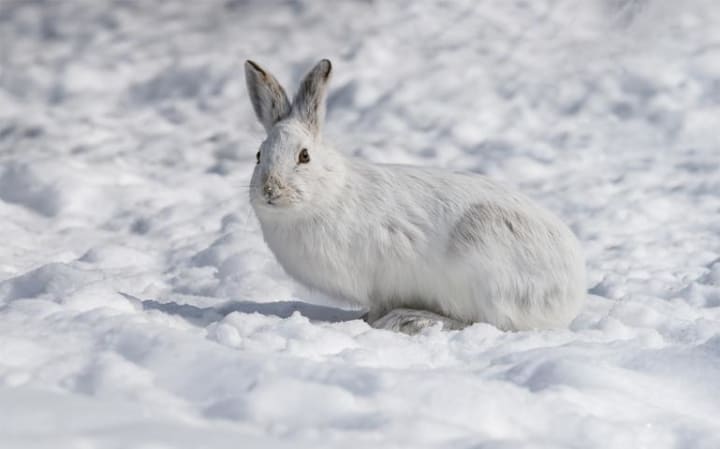
If one wants to communicate with nature and wildlife this is the place to go. There are large herds of caribou and over 200 bird and waterfowl species. These include geese, swans, seagulls and eagles. Among the wildlife, residents are the arctic fox, arctic ground squirrels, grizzly bears, polar bears, musk oxen and arctic hares.

Alright, let's move on to Coldfoot the town where there is an overnight stay for tourists going to Deadhorse. Coldfoot is a census-designated place (CDP) in the Yukon-Koyukuk Census Area and as of the year, 2000 had 13 residents. It serves mostly as a truck stop on the Dalton Highway from Fairbanks to Prudhoe Bay.
Coldfoot has a restaurant and some overnight accommodations which are converted pipeline construction camp quarters. There is a small visitor center that operates during the summer. Dick Mackey (Iditarod champion) founded the Coldfoot truck stop and began his business by selling hamburgers out of a converted school bus. Later on, truckers helped build the existing truck stop and café.
Coldfoot was originally a mining camp that was called State Creek and arrived at its present name when prospectors who were going up the Koyukuk River got “cold feet” and turned around in about 1900. In 1902 one could say that Coldfoot was booming since it had two roadhouses, two stores, seven saloons and a gambling house. Even a post office was operating from 1902 to 1912 and later reopened in 1984.
As with Deadhorse, there is a Coldfoot Airport and the town was also featured on the Canadian reality show Ice Road Truckers in their third and fourth seasons.
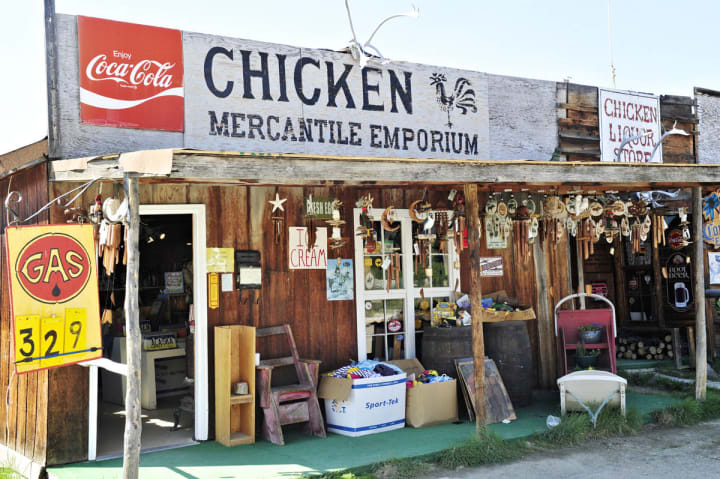
Chicken, did anyone mention chicken? Chicken, Alaska that is. It is also a census-designated place (CDP) located in the Southeast Fairbanks Census Area. The community was founded during the gold rush days and is one of the few surviving gold rush towns in Alaska. According to the 2010 census, there are seven residents in Chicken.
Those who came to prospect for gold settled the town of Chicken in the late 1800s and a post office was established in 1902. There were ptarmigan in the area (the Rock Ptarmigan is a medium-sized game bird in the grouse family. In Europe it is simply known as Ptarmigan and colloquially as Snow Chicken or Partridge in North America) and it was thought to call the town in this name but because there was a dispute as to how it is spelled the town became Chicken. A part of Chicken that has buildings from the early 1900s and the F.E. Company Dredge No. 4 (Pedro Dredge) are listed on the National Register of Historic Places.
The town is an outpost for the 40 Mile mining district and there are still active gold mines in the area. Chicken can boast that it has one important former inhabitant. Anne Hobbs Purdy a teacher and co-author of the book “Tisha” (with Robert Specht, Bantam Books) lived here for one year in the late 1920s teaching the local children. The book tells about her life in the Alaskan wilderness – the difficulties of living in a close-set community, prejudices against natives and the harsh winter.
The only way to get to Chicken is by flying and landing on its small airstrip or by driving along Alaska Route 5, the Taylor Highway.
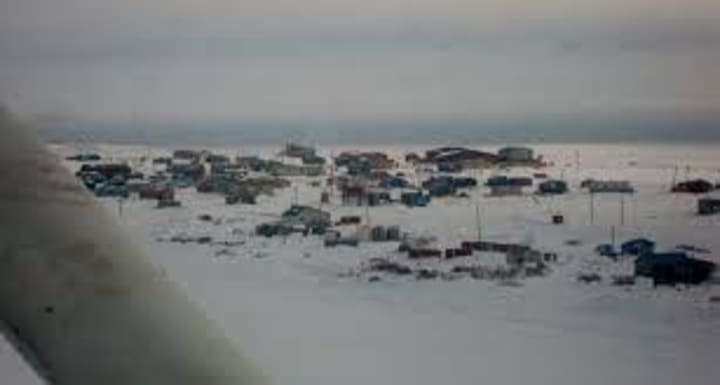
Let’s move on to Eek, Alaska. This town is in the Bethel Census Area and amazingly enough at the 2000 census, it had 280 residents. Eek has an airport. There was a second airport on the east side but it is now the site of a cellular transmission tower. Sometimes private aircraft do use this airport. One can get access to the Eek River from the town dock. The river feeds into the Kuskokwim and people can get to the neighboring villages by boat. In the winter many residents of Eek travel by snow machine and there are trails between the villages in the area.
About the Creator
Rasma Raisters
My passions are writing and creating poetry. I write for several sites online and have four themed blogs on Wordpress. Please follow me on Twitter.
Keep reading
More stories from Rasma Raisters and writers in Wander and other communities.
The Beauty of Nature in Italy
Asinara National Park is located on Asinara the second largest island in Sardinia. It is an amazing paradise with lots of untouched beaches and the water is crystal clear and sparkling. As lovely as this sounds this island was once known as ”Devil’s Island”. This was due to the fact that at one time it was a quarantine camp during WWI and became a high-security prison in the 1970s and 1980s.
By Rasma Raisters5 years ago in Wander
Worth the Wait: Puerto Viejo, Costa Rica
Beach bumming in a small Caribbean beach town sounded like a perfect way to end our 6-month trip through Mexico and Central America. Or so we thought. The foul, fishy stench of rotten seaweed hit our nostrils as we stepped from the cramped bus and looked out at a rather depressing, empty, and underwhelming black sand beach. It was pouring with rain, and we had to quickly fish out our ponchos. We thought, this couldn’t be it, could it?
By Sh*t Happens - Lost Girl Travel8 days ago in Wander
What Hidden Costs Should You Know in Armenia Tour Packages?
Booking Armenia Tour Packages is one of the easiest ways to explore this beautiful Caucasus destination. Many travel packages include hotels, transfers, and sightseeing tours, making travel convenient and organized. However, travelers should also be aware that some hidden costs may not always be included in the initial price.
By Viacation Tourism3 days ago in Wander
Hottest in the Office
Dear Rafi, You’re very distracting to work around. For the first second I saw you the other day, I thought you were some type of executive. It took a moment to realize no, you were just the new guy, dressed up for the job he wants. Be still, my heart.
By Gabriel Shames4 days ago in Pride


Comments
There are no comments for this story
Be the first to respond and start the conversation.