
Tower Bridge vs London Bridge
London's Iconic Crossings


Most people confuse London Bridge with Tower Bridge. “Did an American tycoon buy London Bridge thinking it was the grand Tower Bridge? Spoiler: he didn’t, but the truth is just as wild.”
We've all done it, especially as children. I must have been 4 or 5 when my parents said we were going out over Tower Bridge. I requested we go over the London Bridge instead because it is my favourite. Thankfully, my parents were patient in correcting my misconception.

Both bridges are essential to the thriving City economy and hopefully will continue to do so for generations to come. There's been a rumour swirling around that an American bought the wrong bridge.
Let me tell you a bit about both Bridges
Tower Bridge
Iconic Design: Completed in 1894, Tower Bridge is a Victorian suspension and bascule bridge with two neo-Gothic towers, instantly recognisable as a London landmark.
Bascule Mechanism: Its central span lifts for tall ships, still functioning today with around 800 lifts yearly, controlled by modern hydraulics.
Location: Spans the Thames between the Tower of London and Southwark, linking central London to the South Bank.

Construction: Built from 1886 to 1894, designed by Sir Horace Jones and engineered by Sir John Wolfe Barry, using over 11,000 tonnes of steel.
Tourist Attraction: Hosts the Tower Bridge Exhibition, where visitors can explore the Victorian engine rooms and walk across high-level glass walkways.
Cultural Symbol: Often featured in films and media (e.g., Sherlock Holmes, 2009), though frequently mistaken for London Bridge by tourists.
Colour Scheme: Painted red, white, and blue since 1977 for Queen Elizabeth II’s Silver Jubilee, enhancing its striking appearance.
Traffic: Handles over 40,000 vehicles and pedestrians daily, with a 20 mph speed limit to preserve its structure.
Engineering Marvel: Combines a drawbridge with suspension elements, a unique design for its era, balancing practicality and beauty.
Historical Moments: Notable for events like the 1952 incident when a double-decker bus “jumped” the gap as the bridge began to lift.
I've been behind the scenes and it was mind blowing experience. To read more about it, click on the following Link https://tabbylondon.com/blog/f/two-bridge-lifts-and-one-forever-memory
London Bridge
Historical Legacy: London Bridge dates back to Roman times (c. 50 AD), with multiple iterations; the current bridge opened in 1973.
Modern Design: A functional concrete box-girder bridge, designed by Mott, Hay, and Anderson, prioritising utility over ornamentation.
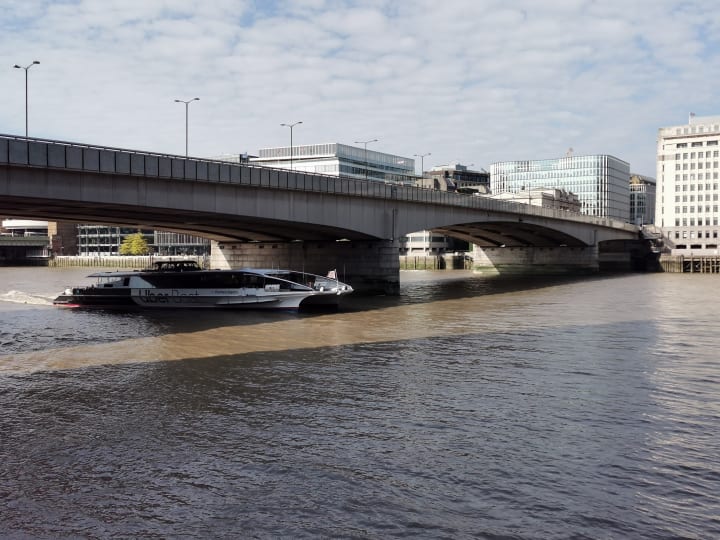
Location: Connects the City of London to Southwark, just upstream from Tower Bridge, near London Bridge Station.
Multiple Versions: The name “London Bridge” refers to successive bridges on the site, including a 19th-century version sold to Arizona in 1968.
Myth Clarification: Often confused with the ornate Tower Bridge, but it’s far plainer, leading to frequent tourist mix-ups.
Transport Hub: Adjacent to London Bridge Station, a major rail and Underground hub, making it a vital commuter link.
Reconstruction History: The 1973 bridge replaced a stone-arched version (1831–1967), which was dismantled and rebuilt in Lake Havasu City, USA.
Traffic Flow: Carries heavy road traffic and pedestrians, designed for efficiency with no lifting mechanism.

Cultural References: Immortalised in the nursery rhyme “London Bridge Is Falling Down,” tied to its long, storied history.
Resilience: Survived historical events like the Great Fire of London (1666) and modern challenges, including a 2017 terrorist attack.


London Bridge Was Sold in 1968
In 1968, American entrepreneur Robert P. McCulloch purchased the 19th-century London Bridge for $2.46 million (£1.02 million at the time) from the City of London. McCulloch, an oil tycoon and chainsaw manufacturer, was developing Lake Havasu City, Arizona, a planned community in the desert. He bought the bridge to attract tourists and boost property sales, as the remote location struggled to draw residents.
The bridge, designed by John Rennie and opened in 1831, was sinking into the Thames due to heavy modern traffic, prompting its sale and replacement with the current concrete structure, opened in 1973 by Queen Elizabeth II.
McCulloch had the bridge’s 10,276 exterior granite blocks numbered, dismantled, and shipped through the Panama Canal to California, then trucked to Arizona. Reconstructed over a man-made channel in Lake Havasu City, the bridge was completed in 1971, with a grand opening featuring fireworks, skydivers, and a visit from London’s Lord Mayor. It became Arizona’s second-biggest tourist attraction after the Grand Canyon, drawing nearly two million visitors by 1975.
Parting Comments
It might be 160 years old, but twenty one thousand vehicles go over Tower Bridge each day and Forty thousand people cross the Bridge. That in itself is a huge achievement.
Both Bridges have been part of millions of Londoner's lives. We grew up with them in the backgound. It is also a familiar icon to billions around the world.
Have you been across either Bridge? If yes, what's your experience?
If you enjoyed reading this article and want to support my work, you can now buy me a coffee ☕️.
https://www.buymeacoffee.com/TabbyLondon
Thank you for your attention.
Best wishes
Tabby
About the Creator
Tabby London
The London I've been discovering is usually off the well-beaten track.I love the nooks and crannies and walking along the streets steeped in centuries worth of history. I'm fond of Zone 1 because that's where it all began centuries ago.
Keep reading
More stories from Tabby London and writers in Wander and other communities.
Another Historical Remnant
The first time I went to Westminster Hall was on a school trip as a Secondary School student (High School for my international friends). When you’re 14, you don’t care much for history, well, I didn’t. However, that’s all changed. These days, I can’t get enough of it.
By Tabby London8 months ago in Wander
Worth the Wait: Puerto Viejo, Costa Rica
Beach bumming in a small Caribbean beach town sounded like a perfect way to end our 6-month trip through Mexico and Central America. Or so we thought. The foul, fishy stench of rotten seaweed hit our nostrils as we stepped from the cramped bus and looked out at a rather depressing, empty, and underwhelming black sand beach. It was pouring with rain, and we had to quickly fish out our ponchos. We thought, this couldn’t be it, could it?
By Sh*t Happens - Lost Girl Travel5 days ago in Wander
A Fear for Travelers Escaping the Gulf: Are Flights Safe?
As tensions rise across the Persian Gulf region, thousands of travelers are increasingly asking a troubling question: are flights leaving the Gulf still safe? Airlines, aviation authorities, and governments have all moved to reassure passengers, but recent geopolitical developments have heightened anxieties among those attempting to leave the region or pass through its busy airspace. The Gulf has long been one of the most important aviation crossroads in the world. Major hubs such as Dubai International Airport, Hamad International Airport, and King Khalid International Airport connect Europe, Asia, and Africa through a dense network of international flights. Every day, hundreds of aircraft pass through regional airspace carrying business travelers, tourists, migrant workers, and cargo. However, the recent escalation of military tensions involving Iran and its regional rivals has raised concerns about aviation safety. Missile launches, drone activity, and military operations in nearby areas have made some passengers uneasy about flying through the region. Several governments have issued travel advisories urging airlines to review flight paths and exercise caution when operating near potential conflict zones. Despite these concerns, aviation experts stress that commercial aviation remains one of the most heavily monitored and regulated industries in the world. Airspace safety is continuously assessed by international bodies such as the International Civil Aviation Organization, as well as national aviation authorities that issue warnings and restrictions when necessary. In recent weeks, some airlines have slightly adjusted flight routes to avoid certain areas where military activity has increased. These adjustments can involve flying at different altitudes or diverting aircraft around particular air corridors. While such changes may add extra travel time, they are designed to maintain maximum safety for passengers and crew. Airlines based in the Gulf—including Emirates, Qatar Airways, and Etihad Airways—have emphasized that they are closely monitoring developments in coordination with aviation authorities. Company representatives say flight routes are reviewed constantly using real-time intelligence and airspace risk assessments. Aviation safety experts note that modern aircraft are equipped with sophisticated navigation systems that allow them to avoid restricted zones quickly. Additionally, pilots receive constant updates from air traffic controllers and global aviation monitoring networks. If conditions change during a flight, routes can be altered immediately. Still, the psychological impact of regional instability should not be underestimated. Travelers waiting at airports across the Gulf have described a sense of uncertainty, particularly those leaving areas closer to potential conflict zones. Social media images showing crowded departure halls and long lines at ticket counters reflect a growing urgency among some residents and visitors hoping to leave the region temporarily. For many passengers, the fear is rooted in memories of past aviation incidents linked to geopolitical conflict. Experts point to tragedies in previous decades where civilian aircraft were caught in dangerous airspace. These events led to stricter international regulations and more sophisticated monitoring systems designed to prevent similar situations. Governments across the region have also sought to reassure travelers. Officials stress that airports remain secure and that aviation authorities are working closely with international partners to maintain safe air routes. Security checks and surveillance at major airports have been increased, and contingency plans are in place should the situation worsen. Meanwhile, airlines continue to operate the majority of scheduled flights without interruption. Aviation analysts note that completely shutting down Gulf airspace would have enormous global economic consequences, given the region’s role as a central hub for long-distance travel and cargo transport. Ultimately, experts say the key factor is constant monitoring and rapid response to emerging risks. Aviation authorities around the world maintain detailed systems for assessing conflict zones, allowing airlines to adjust operations long before flights approach dangerous areas. For now, flights across the Gulf continue to operate under heightened awareness but with robust safety protocols in place. While regional tensions have understandably created anxiety among travelers, industry professionals insist that the global aviation system is designed precisely to manage such risks. For passengers boarding planes in the Gulf today, the journey may carry a heightened sense of uncertainty. Yet according to aviation experts and regulators, the safety measures protecting commercial flights remain among the most comprehensive of any form of transportation in the world. ✈️
By Fiaz Ahmed 5 days ago in Wander


Comments
There are no comments for this story
Be the first to respond and start the conversation.