
The Whisper of the Cuckoos
The route of the eight cuckoo clocks of Córdoba


For more than six years now, I’ve had the great privilege of visiting the beautiful mountain ranges of Córdoba — one of Argentina’s many stunning regions. Along winding roads, picturesque villages, and fresh mountain air, nature blends with history and the traditions of the hills. Every corner invites you to discover a different story.

And among so many stories and questions born from these landscapes, my “Dora the Explorer” mind began to wonder: why are there so many cuckoo clocks in the Córdoba hills?
Across the mountains, there are more than seven cuckoo clocks that have become true tourist icons. The most famous is the one in Villa Carlos Paz, inaugurated in 1958 and located on Boulevard Sarmiento. It is the oldest and most recognized cuckoo clock in Argentina, built by two German immigrants, Kurt and Federico Carli, together with engineer Adolfo Krumm. Its mechanism was brought directly from Germany. At the time, it was considered the largest cuckoo clock in the world, and it remains one of Córdoba’s enduring symbols. Every half hour, the bird comes out to sing, always surrounded by tourists with cameras in hand.
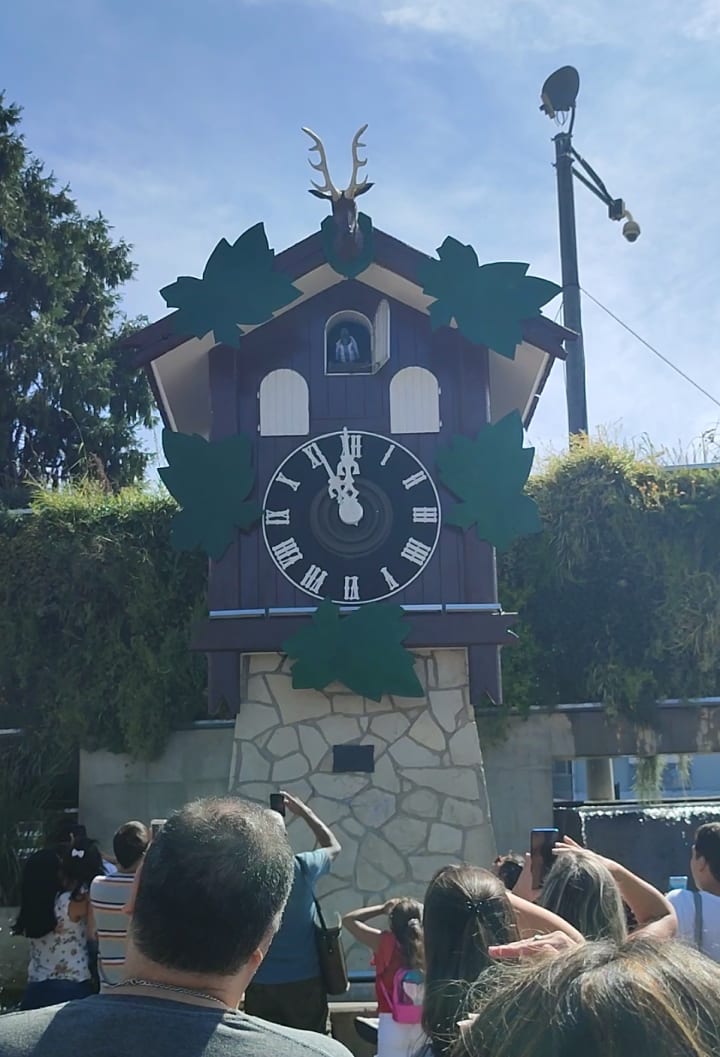
Another notable clock is found in La Falda, the heart of the Punilla Valley. Located at Diagonal San Martín 28, it was donated in 1958 by watchmaker Federico Clapier, and since then it has become a local emblem.
Other lesser-known cuckoo clocks are scattered throughout the mountain valleys — some smaller, some installed in town squares, others on façades or in shops. For example, the one in La Cumbrecita, newer than the others, fits perfectly with the alpine-style houses of the area. In Río Cuarto, the clock was recently restored, recovering its song after years of silence. In Villa General Belgrano, it has long accompanied festivals and traditional markets. In Capilla del Monte, it stands near the famous mount Uritorco, while those in Santa Rosa de Calamuchita and Los Reartes have a more handcrafted look.
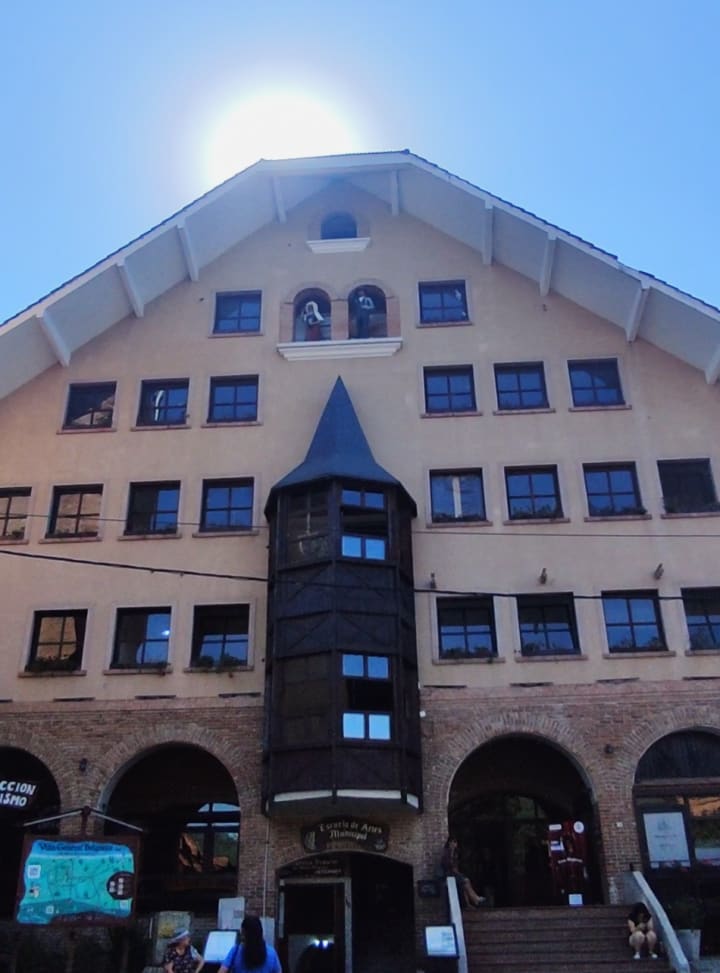
Together, they form what is known as “La Ruta de los Ocho Cucús Serranos” — The Route of the Eight Mountain Cuckoos — a charming journey that blends craftsmanship and history.
In this part of the country, the cuckoos are part of a special tradition: giant cuckoo clocks inspired by the classic models from Germany’s Black Forest, but adapted with local mountain charm. They were created as a tribute to the European roots of the immigrants who settled in the hills in the early 20th century. Many of these settlers came from Germany, Switzerland, and Austria, and they recreated the landscapes of their homeland — steep roofs, wooden houses, and, of course, the classic cuckoo clock.
Behind these cheerful clocks lies a fascinating story that begins in the forests of southwestern Germany, in the Black Forest (Schwarzwald) region — famous for its mountains, dense woods… and cuckoo clocks! It all began in the 18th century, around 1730, in the state of Baden-Württemberg. Winters were long and harsh, and when the farmers couldn’t work the land, they spent their time carving wood at home. Over time, their skill led them to create clock mechanisms using local wood and simple metal parts — giving birth to a tradition that still marks the hours with its characteristic “cuckoo” song.
It is said that the first cuckoo clock was designed by Franz Anton Ketterer, a clockmaker from Schönwald, around 1738. Ketterer sought a natural and original way to mark time. Inspired by the real cuckoos that sang in the forests around him, he created a system of bellows and pipes that imitated their sound — cu-cu. And so, the famous cuckoo call that replaced the traditional chime was born.
The first clocks were simple, but by the mid-19th century, artisans began decorating them with motifs from the Black Forest — oak leaves, deer, squirrels, and alpine cottages. The most popular design became the “Bahnhäusle”, or train station house, created in 1850 by architect Friedrich Eisenlohr. Its design was reminiscent of small Bavarian train stations and perfectly matched the rustic style of the forest.
Each clock is hand-carved, and authentic pieces bear the seal “Made in Black Forest – Germany”. The cuckoo has deep cultural symbolism — representing the passing of time and the living spirit of the forest. In towns such as Triberg, Titisee-Neustadt, and Furtwangen, cuckoo clocks remain a major tourist attraction, even with entire museums dedicated to them.
But why are there so many cuckoo clocks in the Córdoba hills?
In the mid-19th century (especially between 1850 and 1880), during Argentina’s wave of European immigration, many settlers arrived to populate scarcely inhabited regions and work in agriculture, livestock, and forestry. The hills of Córdoba were particularly attractive thanks to their temperate climate, fertile valleys, and abundant land — ideal for creating self-sufficient colonies similar to the villages of their homeland. The nearby rivers and forests also encouraged carpentry and woodworking, allowing many European crafts and traditions to endure.
European immigrants left their countries for various reasons — economic hardship, social tension, and political change. For instance, Germans from the Black Forest and Bavaria, and Swiss from cantons like Valais, faced overpopulation, poor soil, and harsh winters. Many sought better opportunities abroad. Meanwhile, Italians (from both north and south) fled poverty, unemployment, and agricultural crises worsened by Italy’s unification. Spaniards, particularly from Galicia and Asturias, escaped land scarcity and extreme poverty. All shared a common dream: to build a better life, own land, and achieve stability in a country that encouraged European immigration.
After World War II, starting in 1945, a new wave of Germans arrived in the Córdoba hills — this time fleeing the devastation of war and political persecution. Between 1946 and 1955, many settled in places with existing German presence, such as Villa General Belgrano, Colonia Tirolesa, and nearby towns, reinforcing the region’s cultural heritage. They sought to rebuild their lives in a peaceful environment that reminded them of their homeland — with mountains, forests, and a mild climate.
Thus, looking at the mountain cuckoo clocks is also an invitation to travel through history — a story shaped by waves of immigration. Visiting them means not only exploring these beautiful towns but also walking through the legacy of the immigrants who became part of Argentina’s soul.
The mountain cuckoo clocks form a kind of open-air museum, where time is marked by the call of the cuckoo and the curious gaze and leisurely pace of visitors. The Route of the Eight Cuckoos is not just a tourist itinerary: it is a journey through the memory of immigrants, woodcraft, and mountain life. For those who wish to experience it firsthand, spending a few days in the hills is the perfect way to immerse yourself in this enchanting tradition.
About the Creator
Tati Asencio
I enjoy writing. I love sharing stories that live in the streets and in people. Some move you, others surprise you; but all come from the soul.
Thanks for joining me on this journey.
Keep reading
More stories from Tati Asencio and writers in Wander and other communities.
Among Tin and Shared Dreams: Life in the "Conventillos" of La Boca
I was born in Buenos Aires, but I have been living in Turin, Italy, for six years. Today I can say, with my heart in my hand, that I know what it means to be an immigrant: the obstacles, the sadness, the joys… and, of course, the dreams that live in the soul.
By Tati Asencio5 months ago in Wander
Worth the Wait: Puerto Viejo, Costa Rica
Beach bumming in a small Caribbean beach town sounded like a perfect way to end our 6-month trip through Mexico and Central America. Or so we thought. The foul, fishy stench of rotten seaweed hit our nostrils as we stepped from the cramped bus and looked out at a rather depressing, empty, and underwhelming black sand beach. It was pouring with rain, and we had to quickly fish out our ponchos. We thought, this couldn’t be it, could it?
By Sh*t Happens - Lost Girl Travel8 days ago in Wander
What Hidden Costs Should You Know in Armenia Tour Packages?
Booking Armenia Tour Packages is one of the easiest ways to explore this beautiful Caucasus destination. Many travel packages include hotels, transfers, and sightseeing tours, making travel convenient and organized. However, travelers should also be aware that some hidden costs may not always be included in the initial price.
By Viacation Tourism4 days ago in Wander
Hottest in the Office
Dear Rafi, You’re very distracting to work around. For the first second I saw you the other day, I thought you were some type of executive. It took a moment to realize no, you were just the new guy, dressed up for the job he wants. Be still, my heart.
By Gabriel Shames4 days ago in Pride




Comments
There are no comments for this story
Be the first to respond and start the conversation.