
The three busiest canals in the world
Description of the three major canals

Since the beginning of the Great Age of Navigation, mankind has paid more and more attention to ocean transportation, because it has the advantage of large capacity and low cost, which is ideal for transporting large quantities of goods. For the world, the ocean is equivalent to the bond that can connect the many coastal countries in the world.
Countries around the world carry out maritime commerce, generally choosing the nearest route. However, the world is vast, the terrain is complex and diverse, and some seas are close to each other, but separated by land. To save the voyage, human beings dug canals to connect the seas that are very close to each other and save a lot of shipping costs. Canals are man-made navigable waterways. There are many famous canals in the world, so which are the three busiest canals in the world?
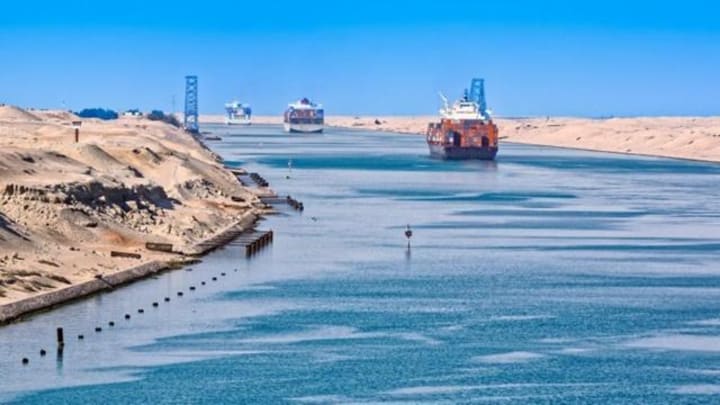
First, the Suez Canal. Suez Canal is the dividing line between Asia and Africa, located between the main and mainland of Egypt and the Sinai Peninsula. Before the opening of the Suez Canal, between the mainland of Egypt and the Sinai Peninsula is a narrow piece of land, called the Suez isthmus.
The Isthmus of Suez is a geological fault, a desert area with many shallows, swamps, and saltwater lakes due to its low altitude. According to the research on human genes and chromosomes, human ancestors first lived in Africa, and later came out of Africa through the Suez Isthmus and spread all over the world. However, in the age of great navigation, the Suez Isthmus is of little value by land.
The Suez Isthmus is bounded by the Mediterranean Sea in the north and the Red Sea in the south. If a canal is opened, the two seas can be communicated, and then the Atlantic and Indian Oceans can be communicated. After the beginning of the great voyage, the shipping between Europe and Asia was bypassed by the Cape of Good Hope at the southern tip of Africa, which was very far away.
In 1869, the Suez Canal was opened to traffic and thereafter entered the Indian Ocean through the Mediterranean Sea, becoming the closest route between Asia and Europe, saving 8,000 to 10,000 kilometers of travel compared to the Cape of Good Hope at the southern tip of Africa. To this day, the Suez Canal remains the busiest canal in the world and can bring huge economic benefits to Egypt every year.
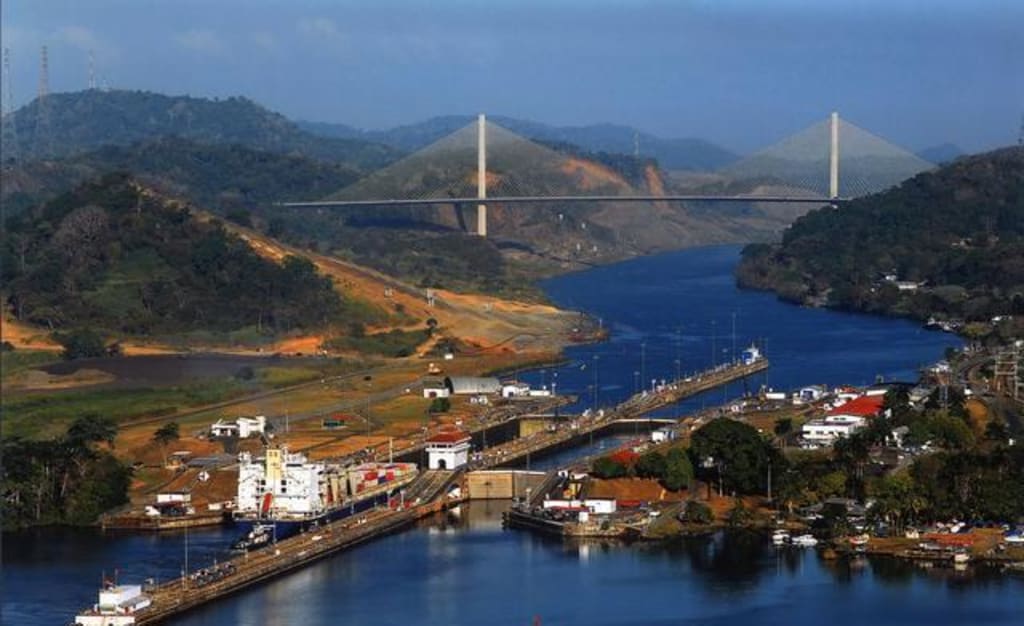
Second, the Panama Canal. Panama Canal is located in Panama, a Central American country, and is a major shipping route through the isthmus of Panama, bridging the Pacific and Atlantic Oceans. The Isthmus of Panama is a narrow section of land located in the middle of America, which plays the role of connecting the north-south land route of America.
The isthmus of Panama is flanked by the Pacific Ocean and the Caribbean Sea of the Atlantic Ocean. In its long history, the American continent was the home of the Indians. After the beginning of the Great Age of Navigation, America gradually fell into the colonies of European countries, and the interaction between the east and west coasts of America became more and more frequent.
At that time, the East and West coasts of America's goods to and from, need to go around the southernmost American Magellan Strait, Drake Strait, also through the Isthmus of Panama, but through the Isthmus of Panama, you must use land transport. Therefore, as early as the 15th century, the Spanish colonists came up with the idea of opening a canal. But it was not until 1914 that the Panama Canal was completed and opened to traffic. Now the Panama Canal is the second busiest canal in the world.
Third, the Kiel Canal. The Kiel Canal is located in northern Germany and is also known as the North Sea-Baltic Canal. Germany is a country located in the middle of Europe, compared to Britain and France, and other traditional maritime powers, Germany's coastline is relatively short, and poorly located, more closed.
Germany's coastline is located in the northern region, bordered by the North Sea in the northwest and the Baltic Sea in the northeast. Blocked by the Danish territory in the northern part of the Jutland Peninsula, the two sections of Germany's coastline could not originally interact directly. The Baltic Sea is an inland sea located in the northeast of Europe. In addition to Germany, there are several countries along the Baltic Sea that trade by sea and also enter the North Sea as well as the Atlantic Ocean through the strait between Denmark and Sweden.
Based on this demand for shipping, Germany started to build the Kiel Canal in 1887. In 1895, the Kiel Canal was opened to traffic, and the Baltic countries entered the North Sea through the Kiel Canal, saving about 756 km of the voyage than going around the northern part of Denmark, and from the commercial point of view, the Kiel Canal has become the most convenient and economical waterway between the North Sea and the Baltic Sea, through which a large number of ships pass every year. These are three of the busiest canals in the world, all of which bring great benefits to the countries where they are located.
About the Creator
Hakkali
Break up with war and make peace!
Take a Hike in Mexico
The Ajusco Summit Trail, located in the Cumbres Del Ajusco National Park, is one of the most popular hikes in Mexico. Hikers hike to the peaks of Ajusco or Malacatepeti for awesome views. Trails take hikers through forests and rough terrain. The trail is a 10 km long loop and is a high-altitude trek. The trail passes through high mountain pine forests and alpine meadows, providing a diverse hiking experience.
By Rasma Raisters7 days ago in Wander
Miss Persephone's Manual to a Seemingly Ordinary Life
Miss Persephone was found at the dining table, her blue eyes swollen, her tears arriving and retreating like the tides of the ocean. Earlier that day, her family had visited her in the retirement home where she had lived for eight years. It was her eightieth birthday.
By Imola Tóth5 days ago in Fiction



Comments
There are no comments for this story
Be the first to respond and start the conversation.