
The London Eye
The capital city's famous "big wheel"

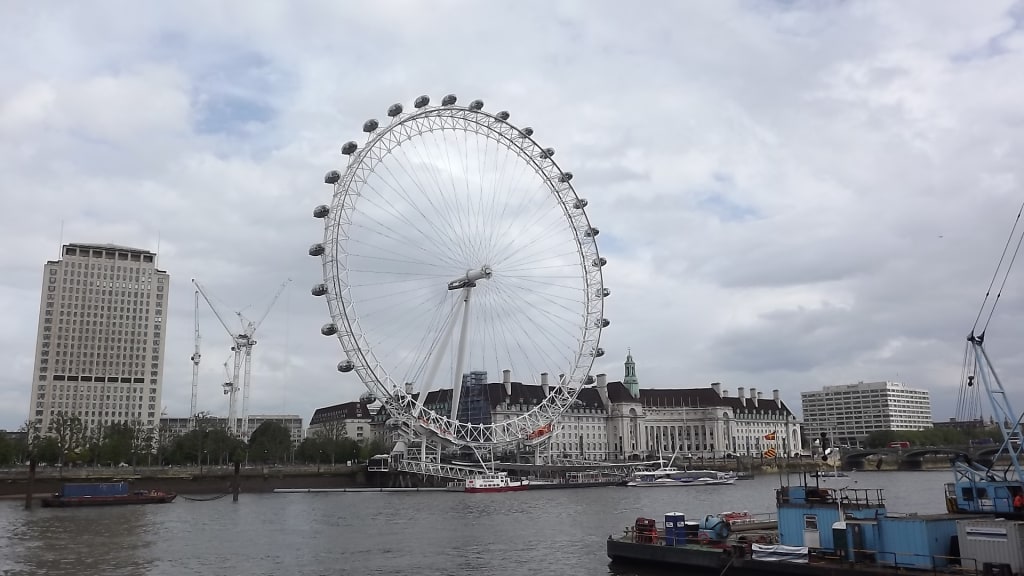
The London Eye is the World's tallest observation wheel at 135 metres (440 feet), making it the fourth highest construction in London. It stands right next to the River Thames, alongside the former County Hall and very close to the South Bank complex of theatres and art galleries.
It offers a perfect opportunity to view London "at a glance", with the whole city laid out beneath you. You might find a pair of binoculars helpful, and you'll really kick yourself if you forget your camera!
The Eye revolves at a steady 0.6 miles an hour, so a complete revolution takes about 30 minutes. You travel in one of 32 capsules that gives you an all-round view of London. You can stand or sit, or take in the experience from your wheelchair. The wheel keeps going all the time, but slowly enough for you to step on and off in perfect safety.
The Eye was opened for business in March 2000, originally as a temporary structure to mark the Millennium. However, it has proved to be so popular that it has stayed put, and it now carries about 3.5 million passengers every year. The Eiffel Tower in Paris was supposed to be temporary, too!
What can you see?
The Eye revolves from east to west, so your first views are towards the east, and London's business district. To be strictly accurate, this IS London - much of what most visitors think of as London is actually the City of Westminster!
Although the Thames runs through the heart of Greater London, at least 90% of the buildings and sights of interest are north of the river. Not surprisingly, most visitors point their cameras in that direction.
Looking East
Had the Eye been running when I first visited London, as a schoolboy in the 1960s, the view would have been dominated by Wren's St Paul's Cathedral, which was the tallest building in London from its construction after the Great Fire of 1666 until only about 40 years ago. St Paul’s is still very much part of the scene, and you can also see the spires of several other Wren churches poking up. However, the dominating features of the skyline are now the NatWest Tower and the Swiss Re building, which is known familiarly, because of its shape, as the "Gherkin" (Incidentally, if you are seriously rich, I gather that dinner in the restaurant at the top of the Gherkin is quite something!)
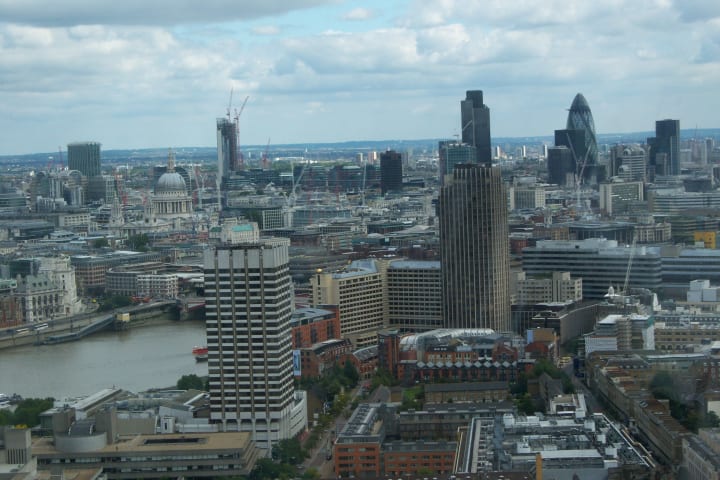
Also visible from the Eye are Canary Wharf, Tower Bridge, and the Tower of London. If you look carefully should also be able to catch a glimpse of Olympic Park – the venue for the 2012 Olympic Games.
Looking North
You get a good impression of how London sits in a basin. Hills rise a few miles from the central plain, and these now comprise some of the more desirable residential districts, such as Hampstead, Highgate and Muswell Hill. If you look to the south, you can see the land rising towards Crystal Palace and Croydon.
Just below the Eye, on the north bank, is Cleopatra's Needle, which must be London's oldest monument, having started "life" in ancient Egypt.
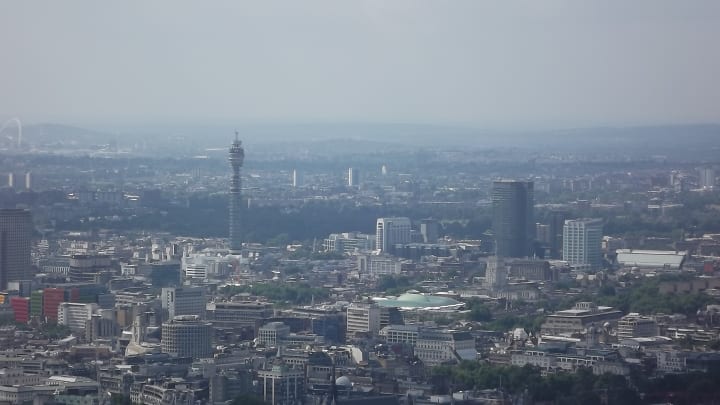
You can see the green dome of the former reading room of the British Museum. This is where Charles Dickens and Karl Marx once studied. Just beyond, you can see the white tower of the London University Senate House. Most of the tower comprises the stacks of the London University Library, where I had my first job. I used to think that the view from there was quite good, too!
If you use Cleopatra's Needle as a pointer, you can just catch, in the far distance, Alexandra Palace and its radio mast. This is the building where BBC television was born.
Looking West
You are now looking up-river, with the Palace of Westminster very visible to your right, and St Thomas's Hospital almost directly beneath you on your left. Also on the left is Waterloo Station, and, if the evening sun catches the rails, you can see them snaking away into the distance, with trains taking commuters home to the suburbs or south central England.
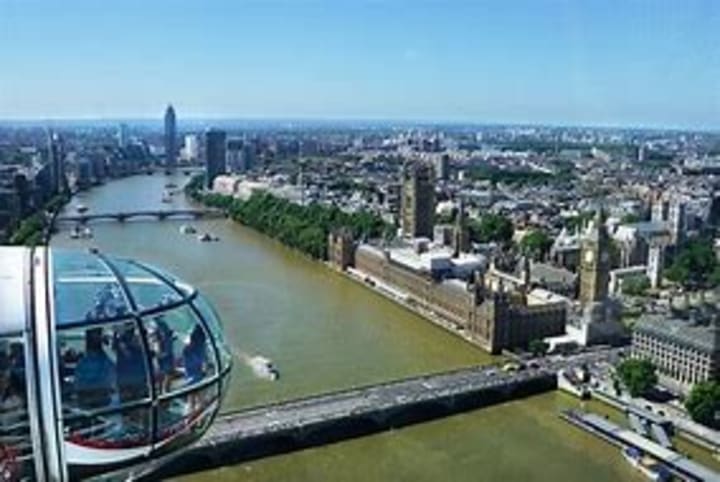
You get an excellent view of the heart of government, from the Houses of Parliament (with the Big Ben clock tower) to the government buildings in Whitehall and Buckingham Palace at the end of the Mall. You can also pick out Nelson's Column in Trafalgar Square and the unmistakable spindly shape of the Post Office Tower.
One thing you will be struck by is how green much of this part of London appears to be. There is a chain of parks, stretching from the Palace Gardens (the Queen's private back garden!) through St James's Park and Green Park to Hyde Park and Kensington Gardens, and several of these have quite large lakes in them as well. However, many of the squares and streets that were laid out in Regency and Victorian times made good use of green space, and were lined with trees, particularly the London plane that is able to shed its bark and thus survive the ravages of a polluted city (at least, as it was then).
You may also find that, especially in the evening, the view can be disrupted by haze. London has no heavy industry these days, so the "pea-souper" fogs are long gone. However, exhaust fumes have replaced factory smoke to spoil the view, despite the undoubted success of the "congestion charge" that has discouraged private motorists from driving into central London. On a clear day, you can see about 25 miles into the distance, which is as far as Windsor Castle.
Looking South
There is much less of interest to be seen on the south side of the London Eye, but one noticeable feature has given rise to the strange belief – apparently a popular one with some American visitors – that they have caught a glimpse of the Eiffel Tower in Paris! No – the view on offer is good, but it is not that good! The steel tower that can be seen on a distant ridge is the communications tower at Crystal Palace, from which many TV and radio stations broadcast to South London and beyond. Agreed, it does bear a passing resemblance to the famous Paris edifice, but that is where the similarity ends!
A few more details
The London Eye is open every day except Christmas Day, and during its annual maintenance (10 days in mid-January). It starts running at 10.00am and continues until 8.00pm (later in high summer, 9.00pm or 9.30pm). After dark trips are a completely different experience, as you can see just how much electricity a city consumes at night!
About the Creator
John Welford
John was a retired librarian, having spent most of his career in academic and industrial libraries.
He wrote on a number of subjects and also wrote stories as a member of the "Hinckley Scribblers".
Unfortunately John died in early July.
Keep reading
More stories from John Welford and writers in Wander and other communities.
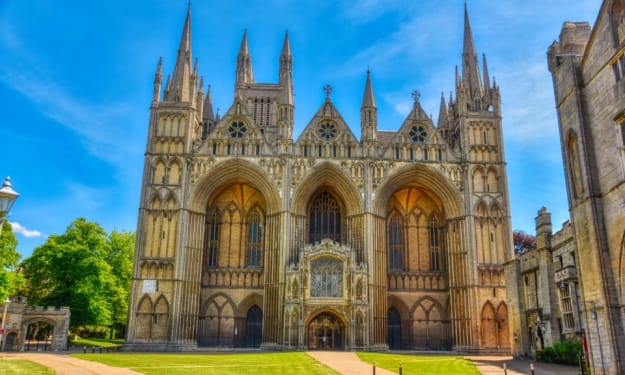
Peterborough Cathedral, Cambridgeshire
Peterborough Cathedral is perhaps the second finest Norman church in England after Durham Cathedral, and is certainly one of the least altered. The city of Peterborough, in north Cambridgeshire, has relatively few attractions for the visitor, but the cathedral makes the trip very worthwhile.
By John Welford5 years ago in Wander
Take a Hike in Mexico
The Ajusco Summit Trail, located in the Cumbres Del Ajusco National Park, is one of the most popular hikes in Mexico. Hikers hike to the peaks of Ajusco or Malacatepeti for awesome views. Trails take hikers through forests and rough terrain. The trail is a 10 km long loop and is a high-altitude trek. The trail passes through high mountain pine forests and alpine meadows, providing a diverse hiking experience.
By Rasma Raisters2 days ago in Wander
Center Stage with Paul Stewart
*** I'm keen to republish the interviews I did for my series with Vocal creators. It's been a few years and I thought it might be nice to revisit these wonderful conversations. I'll be releasing them one at a time for a few weeks/months.
By Heather Hublerabout 12 hours ago in Interview


Comments
There are no comments for this story
Be the first to respond and start the conversation.