
The Curious Mind: How Wandering Shapes the Human Psyche
Exploring the Psychological Power of Positive Mental Meandering and the Drive to Roam

Amara never meant to get lost.
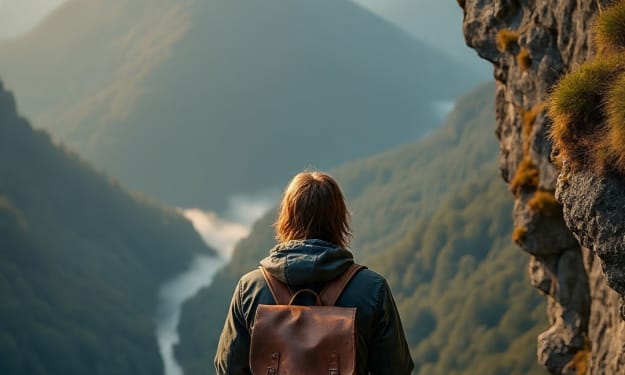
She’d only meant to stretch her legs, to escape the digital noise of her cramped apartment and the pressure of unanswered emails. A simple walk in the hills beyond the village. No map, no goal—just the pull of the path as it curved out of sight.
She didn’t realize it at the time, but that aimlessness was the point.
The morning fog had begun to lift, and golden sunlight filtered through the trees. With every step, the sound of her internal chatter quieted. Her thoughts, once tangled and anxious, began to unravel like threads from an old scarf—soft, slow, and full of forgotten warmth.
At first, she worried about her direction. Should she turn back? Was she wasting time? But the winding trail offered no straight answers, only a gentle invitation to keep going. And so she did.
The farther she walked, the more her mind wandered—not in circles, but outward. Memories surfaced. Childhood afternoons lying in fields, watching clouds drift like continents. Long-forgotten questions bubbled up: Why do birds sing more after rain? What if humans are wired to wonder?
Her inner critic, always ready with deadlines and doubts, grew silent. In its place came a quieter voice, one that didn’t demand but asked: What if this is exactly what you need?
Amara’s journey wasn’t dramatic. She didn’t scale a peak or discover an ancient ruin. Instead, she sat on a mossy rock by a creek and listened. The gurgle of water was more meaningful than any podcast. The chirping of birds, more grounding than any meditation app.
Something shifted. It wasn’t clarity, exactly, but a comfort with not knowing. The questions in her mind weren’t problems to solve but places to explore. Each idea was a trailhead.
---
Psychologists have a name for this kind of experience. It’s not just “getting lost”—it’s positive constructive daydreaming. A mental state where the mind gently roams, often triggered by light activity and low stress. In these moments, we become more creative, more resilient, even more self-aware.
In a world obsessed with productivity and precision, the value of wandering—both physically and mentally—has been forgotten. But science tells us it’s essential.
Wandering encourages the default mode network of the brain to activate—a system linked to memory consolidation, imagination, and emotional insight. It’s the same network that lights up during moments of deep reflection, storytelling, and innovation.
And here, amid trees and trails, Amara’s brain was doing something beautiful. It was healing.
---
After a while, she stood and continued walking. The trail led her to a small meadow where wildflowers bloomed in quiet rebellion against the season. She lay down, let the sun warm her face, and laughed softly at how far she’d come—not in miles, but in mood.
She wasn’t running from anything anymore. She was roaming toward something. Toward herself.
By the time she returned home, dusk had painted the sky in shades of rose and indigo. Her inbox was still full. The world hadn't changed. But she had.
There was space now between her thoughts—space to breathe, to wonder, to begin again.
---
Wandering, it turns out, isn’t about being lost. It’s about letting go of the need to always know where you’re going. It’s about trusting that somewhere between the trees, between thoughts, lies a path worth walking.
Amara’s story is a reminder: the human mind, like the soul, was built not just to strive—but to wonder.
And sometimes, the most meaningful journeys begin with a step you don’t plan.
About the Creator
Keep reading
More stories from Muhammad Saad and writers in Wander and other communities.
The Restless Mind: Unraveling the Psychology of Wanderlust
The first time Mira stood at the edge of a new land—backpack strapped, boots dusty, air filled with a scent she couldn’t name—she felt something awaken. It wasn’t just excitement. It was older, deeper, like an instinct echoing from her bones. She called it “wanderlust,” but what truly stirred in her was something scientists and psychologists have begun to study with increasing curiosity: the psychology of why we wander. For most of human history, wandering wasn’t optional. It was a necessity. Early humans were nomads, tracking seasons, prey, and safety. Migration was not just a survival tactic—it was a way of life. Modern research suggests that this legacy is still etched into our DNA. Psychologist Dr. Julia Becker calls it “evolutionary restlessness.” “We’re hardwired to explore,” she says. “The same neural systems that once motivated us to find food or shelter now light up when we seek new experiences.” Dopamine—the brain’s reward chemical—spikes when we plan a trip, see a new place, or imagine the unfamiliar. The same brain pathways that light up when we eat chocolate or fall in love are activated when we look at a map and dream. For Mira, the signs were always there. She’d stare at airplanes overhead as a child, wondering where they were going. In school, she traced foreign coastlines with her fingers, imagining languages she didn’t speak and faces she’d never seen. Her parents called it distraction. Her teachers called it daydreaming. But it was more than that. It was a longing not just to escape—but to discover. Modern psychology identifies this pull as “wanderlust,” a term with roots in German: wandern (to hike or travel) and Lust (desire). It’s more than a trend; it’s a recognized trait. Some people have what’s called a high “Openness to Experience,” one of the five major personality traits. These individuals seek novelty, adventure, and the unfamiliar. They’re more likely to travel, switch careers, or even reinvent themselves. But for others, the desire to wander appears in subtler ways—through books, stories, music, or even dreams. Dr. Becker explains that wanderlust isn’t about geography—it’s about curiosity. “You don’t have to cross an ocean to feel it,” she says. “It’s a state of mind. A hunger for what lies beyond the horizon, both physically and mentally.” Neuroscience backs this up. Studies using brain imaging have found that imagining new places or planning a trip activates the brain’s default mode network—the part of the brain associated with introspection, imagination, and memory. In other words, thinking about travel helps us reflect on who we are and imagine who we might become. But why do some people feel this more strongly than others? The answer may lie in genetics. A variant of a gene called DRD4-7R—often nicknamed the “wanderlust gene”—has been found more commonly in people who love adventure, take risks, and seek novelty. This gene affects dopamine receptors in the brain, potentially making those who carry it more sensitive to the rewards of new experiences. Mira, though unaware of her genetics, felt its tug every time she stayed too long in one place. It wasn’t dissatisfaction—it was the quiet whisper of potential. What if there’s something more? What if I’m meant to see it? Still, the desire to wander comes with tension. In a world that often values stability, roots, and routine, those who move are sometimes seen as lost or unsettled. But psychologists argue the opposite: wandering can be a way of finding clarity. “Movement creates perspective,” says Dr. Becker. “When we leave the familiar, we see ourselves differently. We notice what we miss—and what we don’t. Wandering, in that sense, is not running away. It’s running toward.” Mira’s travels eventually took her to silent deserts, loud cities, high mountains, and quiet villages. She met people who lived in one place their entire lives and others who moved with the seasons. Some called her brave. Others called her reckless. But what she discovered—more than any sight or souvenir—was a deeper understanding of herself. Wandering, she learned, wasn’t about getting lost. It was about getting closer—to the world, to others, and to the vast, unexplored corners of her own mind. Today, psychologists continue to explore the value of wandering. In a fast-paced, hyper-connected world, the need to disconnect and explore—whether across continents or simply through new ideas—is more vital than ever. It reminds us that life isn’t always about arriving. Sometimes, it’s about moving. And so, the human mind wanders—not out of boredom, but out of deep, ancient instinct. Because somewhere beyond the horizon lies something new. And within each of us is the curiosity, the courage, and the restless spark to go find it.
By Muhammad Saad 8 months ago in Wander
Tatt~Master
— Assembly Line Tatt Machine ~ Impressions to Impress — As I begin to understand more about the Tattoo Phenomenon. I've written silly, yet verbatim, dating site anecdotes in 'Frazzled.' So let me ask you: Would you be More attracted to someone slathered with tattoos, or Less?
By Jay Kantor6 days ago in Humor


Comments
There are no comments for this story
Be the first to respond and start the conversation.