
The Child Who Taught the Stars to Dream
A timeless tale of awe, curiosity, and the invisible magic stitched into everyday life.
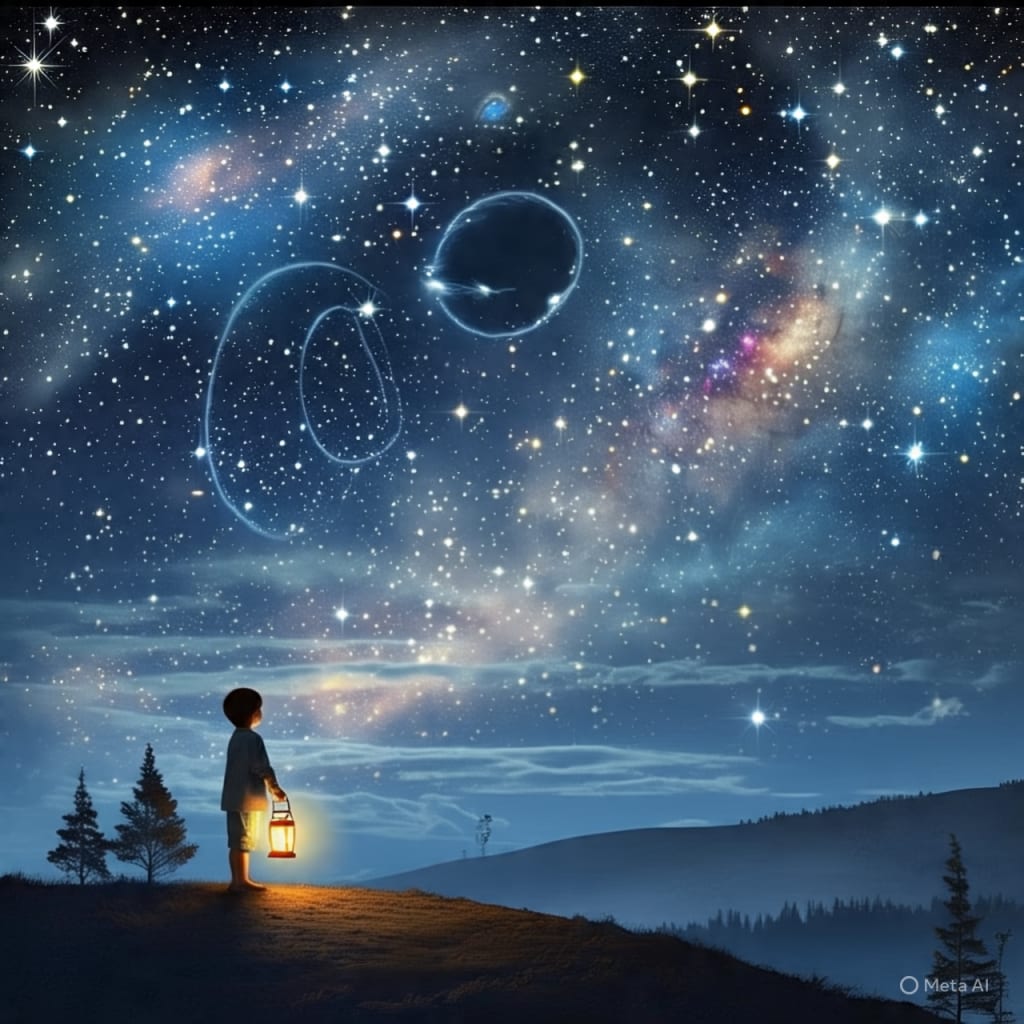
The village of Bramblewood was a quiet place, nestled between silver-threaded forests and soft hills that shimmered in the moonlight. Nothing ever really happened there—or so the grown-ups liked to say. But children know better than adults what happens when the world goes quiet. That’s when wonder tiptoes in.
At the edge of the village lived a small girl named Liora. She was an odd child, by Bramblewood standards. She didn’t play the usual games or chatter about chores and school. Instead, she spent hours staring at the sky, lying in the tall grass, whispering stories to the clouds and listening for their replies.
"She's always dreaming," the townsfolk said with a shake of their heads. "That one’s got her head in the stars."
They weren’t wrong.
Every night, after the lanterns were blown out and the fires faded, Liora would slip out of her cottage and climb Windwhistle Hill. She brought only a blanket, her sketchbook, and a tiny glass lantern that glowed even without a flame—something she said was a gift from the moon.
No one knew where it had come from. But it pulsed softly with light, like a heartbeat.
Liora would sit beneath the sky for hours, watching the stars blink awake. She saw more than anyone else did. Not just constellations or planets—but stories. She said the stars dreamed, just like people. But they’d forgotten how.
“They're lonely,” she whispered one night to a small field mouse who had curled beside her. “They shine so bright, but they’ve forgotten why.”
So Liora did what she did best: she told them stories.
Each night, she’d choose a star and whisper to it. Tales of dragons who learned to sing, of raindrops who wished to be snowflakes, of clocks that ticked backwards to visit forgotten days. She believed that if she could give each star a dream, they might remember how to make their own.
And something strange began to happen.
At first, no one noticed. But the skies over Bramblewood began to shift. Stars flickered in strange rhythms, like laughter. New constellations appeared—ones not in any map. A leaping fox. A child with wings. A lighthouse surrounded by clouds.
The astronomers in the cities scoffed. “Optical illusions,” they claimed.
But the children in Bramblewood felt it. When they looked up, they felt warmth behind their eyes, like being remembered. Some even said the stars whispered back.
One night, as Liora settled into her usual spot, she noticed something unusual. A single star—low, golden, and trembling—seemed to be pulsing brighter than the others. She focused on it, her breath catching.
“I’ve never seen you before,” she murmured.
The star blinked. Once. Twice. Then—
It fell.
A streak of gold slashed the sky and vanished behind the trees near the old well.
Without thinking, Liora grabbed her lantern and ran. The forest wasn’t kind at night. It creaked and groaned and sometimes rearranged itself when no one was looking. But Liora was not afraid. She had walked this path in her dreams a thousand times.
She found it in a clearing: a small figure curled into a glowing ball, like a child made of light and starlight. As she stepped closer, it opened its eyes—vast and deep, like entire galaxies had been folded into them.
“You called me,” it said.
Liora’s voice trembled. “You’re a star.”
The child nodded. “You gave me dreams. Now I want more.”
Liora sank to her knees. “Why me?”
The star-child tilted its head. “Because you remember wonder. Most forget. But you… you tell it stories.”
It reached out and touched her forehead. And suddenly, Liora saw things—universes being born in silence, comets that sang lullabies, black holes that kept secrets like old diaries. And in the middle of it all, a great loneliness.
“They're all dreaming alone,” she whispered.
The star-child nodded. “But dreams grow brighter when shared.”
They stayed there until the first hint of dawn. Then the star-child rose, glowing even brighter.
“I must return,” it said. “But I’ll carry your stories with me. And I’ll teach the others to dream again.”
Liora reached out, touched its hand. “Will I see you again?”
The child smiled. “Look up.”
And with that, it rose—slowly, then swiftly—like a lantern caught by the wind, returning to the sky. It flared once, brilliantly, before settling into place among the stars.
That morning, the villagers woke to find a new star shining directly above Windwhistle Hill. Brighter than any other, it pulsed in steady rhythm—like a heartbeat.
They didn’t know what it meant. But the children did.
Liora never stopped visiting the hill. She still told stories. Only now, she wasn’t alone. More children began to gather, blankets in hand, eyes wide with wonder. They listened, and soon, they started sharing stories of their own.
The stars listened too.
And high above, in the endless tapestry of night, new constellations bloomed—each one born of a story, a dream, a whisper from a child who still believed.
Some say stars burn because of science. But maybe, just maybe… some of them burn because of stories told by children who never stopped believing in wonder.
About the Creator
Keep reading
More stories from Muhammad Saad and writers in Wander and other communities.
The Day Time Froze at 11:11
I remember the exact moment time stopped. It was 11:11 a.m., Tuesday. The sun had just broken through a week-long storm, scattering gold across my bedroom wall like scattered coins. I was sipping lukewarm coffee, half-listening to the soft whirr of the ceiling fan, when the world grew... still. At first, I thought it was just me — that dizzy, floating sensation I’d come to associate with grief. But it wasn’t in my head. The coffee froze in mid-pour as I tilted the mug. Outside the window, a crow hovered mid-wing, trapped in silent flight. The fan above didn’t turn. The second hand on my grandfather's clock, always loud, had gone quiet — caught between the tick and the tock. 11:11. The moment itself wasn’t unusual — people make wishes at that time. I had, too, as a kid. Back then, I believed time listened. I believed everything mattered. That belief had faded. Until now. --- I walked through the house in slow motion, though it wasn’t me who was slowed — it was the world. My mother’s knitting needles were frozen mid-air in the living room, suspended in the middle of an unfinished scarf she’d been making for winter, though winter was months away. My younger brother, Sam, was on the porch, one sneaker half-on, reaching toward a paper airplane he’d just thrown. It hung in the air like it had never left his hand. Everything — and everyone — was locked in that precise instant. Except me. Panic flickered in my chest, but it was softened by awe. The kind of awe you feel at the edge of a cliff or inside a cathedral. It wasn’t terrifying. It was... reverent. Like time had taken a breath — and I’d been invited to witness it. But then, I saw her. --- She stood in the hallway at the end of the house, just outside my father’s old study. I hadn’t seen her in over a year, not since the accident. Her dress — the soft yellow one she wore the summer we fell in love — floated around her knees like a painting come to life. Her eyes met mine, warm and tear-glossed. “Ellie?” I whispered. She smiled. I stepped forward, heart slamming in my chest. “Is this real?” She nodded. Ellie — my Ellie — had died in a car crash last spring. I’d tried to tell myself it wasn’t my fault. I wasn’t the one driving. But I had made her late. We’d argued over something stupid — which song would be our first dance at the wedding. She left in frustration. I watched from the window as she pulled away. That was the last time I saw her alive. Until now. --- “How are you here?” I asked, barely breathing. Ellie reached out, and though I couldn’t feel warmth, I felt weight — the pressure of her hand wrapping mine. Her fingers brushed my palm, leaving a tingling trace of memory. “This moment isn’t for the world,” she said softly. “It’s for you.” “But how?” She stepped closer. “Time broke for you, because you broke it first. You’ve been stuck in that moment — the moment I left. Even when the clocks kept ticking, you didn’t move forward.” I felt tears rising. “I didn’t know how.” “You still don’t,” she said gently. “But now, you’re listening.” I looked around — at the house frozen in motion, at the silence that hummed like a heartbeat. “Why 11:11?” I asked. Ellie smiled. “Because it’s a wish. It’s the universe’s way of opening the door. But you had to walk through.” I wanted to hold her. To beg her to stay. To scream that this wasn’t fair — that we’d never gotten our first dance, our shared apartment, our stupid dog. But all that came out was, “I miss you.” “I know,” she said. “But you can’t live in missing. You have to live in the now.” --- We stood together in the stillness — the last moment of us. Then she leaned forward and kissed my forehead. Her lips were cool, like a memory fading in the breeze. “When time starts again,” she said, “promise me you’ll move with it.” I tried to answer, but my throat clenched. And just like that, she stepped back into the hallway shadows. Her outline blurred, like fog meeting sunlight. She faded — not all at once, but gradually, like a song slipping out of reach. Then I heard it. Tick. The clock resumed its motion. The crow outside cawed in surprise and flew on. Sam’s paper airplane glided lazily through the air and landed on the porch steps. The coffee finished its pour. Everything — everyone — moved forward. Except now, so did I. --- The world didn’t notice what had happened. But I did. Every 11:11 since then, I pause — not to wish, but to remember. To listen. Because time froze once, just for me. And in that suspended moment, Ellie left me a secret: That healing doesn’t come from forgetting. It comes from moving with the hands of the clock — not against them.
By Muhammad Saad 7 months ago in Wander
Center Stage with Paul Stewart
*** I'm keen to republish the interviews I did for my series with Vocal creators. It's been a few years and I thought it might be nice to revisit these wonderful conversations. I'll be releasing them one at a time for a few weeks/months.
By Heather Hubler2 days ago in Interview



Comments
There are no comments for this story
Be the first to respond and start the conversation.