culture
Get the authentic cultural experience on your next foreign jaunt. Wander like a local; here, there, and everywhere.
MAGICAL CITY
“Magic.” That word entices us to dream. When the Mexican government attaches such a name to a city in Mexico, it is indeed magic. It’s an honor based on the municipality’s beauty, historical importance, or its natural wonders. Accolades befitting royalty are heaped upon it, and the venerable title of Pueblo Magico (Magic Town) is bestowed on the community. It becomes a tourist’s dream destination.
By James Dale Merrick4 years ago in Wander
FINNISH FOREVER
Finland is a small often forgotten country between Russia and Sweden. The people are quiet, reserved and hate small talk more than anything else (if you don’t count the constant need to share the lovely culture and wonders of Finland). Despite the reserved nature of the people living in Finland, you should meet a Finnish family and get to know this northern culture. And don't forget to try Finnish food in this country full of kind individuals ready to help you!
By Dandelionclub4 years ago in Wander
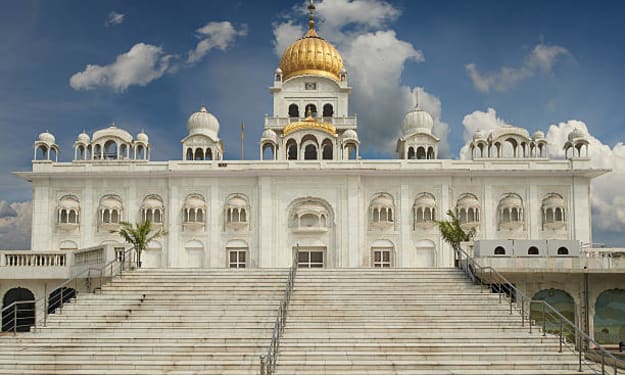
Bangla Sahib Gurudwara, Delhi: A Magnificent Sikh House of Worship
This 17th-century shrine is dedicated to the memory of Guru Har Krishan, who was the eighth Sikh Guru. Located near Connaught Place, the busiest neighborhood in the national capital, the Gurudwara draws attention due to its magnificent structure, architectural beauty, and the large water body aka ‘Sarovar’ located within the complex. It definitely deserves to be on your itinerary when you book your hotels in Delhi for a holiday or sightseeing escapade.
By rahul kumar4 years ago in Wander
The Spanish island that communicates by whistle
in the rugged crags of Barranco de Ávalo, a ravine on the small Canary Island of La Gomera, two local 12-year-olds were practicing their Silbo Gomero, the local whistling language. For an entrancing few minutes, Irún Castillo Perdomo and Angel Manuel Garcia Herrera's lilting warbles reverberated around the barren gorge and soared proudly into the air like eagles in flight.They were accompanied by 70-year-old retired Silbo Gomero teacher Eugenio Darias, whose grandfather used to own and work on this very same land. He told me that the boys' whistled conversation was similar to any they would have over text message or in the playground, but the focus was instead on the six differentiating sounds that make up La Gomera's protected whistle language.While it's true that most children their age would sooner pick up their phone and tap away, this small Canary Island invites them to think differently. Thanks to Darias, their threatened tongue has been a compulsory school subject since 1999 – and almost all 22,000 residents can understand it alongside their mother tongue of Canarian Spanish. "It's important to give students the idea that they can really use it if they need to, like other languages, but also that it's not necessary for everyday use," said Darias, who pioneered the Silbo Gomero learning programme. "Our aim is to give the whistle more importance so that the children can be confident using it together. Importantly, having the whistle protected within our compulsory curriculum prevents extinction altogether." Whistle languages, in varying guises, exist in as many as "70 places", according to local broadcast journalist Francisca Gonzalez Santana. "In Turkey, for example, the whistle began 500 years ago during the Ottoman Empire," she said. "It then spread to all regions of the Black Sea; and in Mexico, we can still find whistled communication in Spanish – Chinantec." Silbo Gomero, which is one of the most studied whistling languages and was officially declared an Intangible Cultural Heritage by Unesco in 2009, uses six condensed sounds to communicate. Two differentiating whistles replace the five spoken vowels in Spanish, while just four replace the 22 consonants. Whistlers elongate or shorten the sounds to mimic the words.Several whistling methods exist on the island, though perhaps the most traditional is demonstrated by local sculptor José Darías. His Whistling Tree sculpture at Mirador de Igualero, a viewpoint in Vallehermoso overlooking a ravine where Silbo Gomero was most active, shows how the index finger should be bent and placed inside the mouth while whistling with an open palm beside it to amplify the sound. Experienced whistlers use different finger methods and can often tell who is calling by the whistle's "accent" alone – but most whistlers will introduce themselves and call the recipient's name. When the message is understood, they whistle back "bueno bueno". Short and simple indeed.
By NANNIE FRANCES4 years ago in Wander
About Kedarnath Dham
Devotees all over India have not been able to visit places of worship for a long time, but now with the government allowing them to open, many would be thronging these places. India is a country that has many temples dedicated to the many gods that are worshipped, and among the more prominent ones is the Kedarnath Temple.Also Read - Legend of Badrinath Temple: As Shrines Reopen Post COVID-19 Lockdown, Here's More History on The Famous Religious Place
By prateek thakur4 years ago in Wander
The Yoga Of Sound
The Yoga Of Sound: Pilgrimage to Tamil Nadu This was a new type of school. I read that it was supposed to combine spirituality and spiritual practice with social justice. I guess that’s why I wasn’t surprised to find myself far away from home in Oakland CA at the University of Creation Spirituality in a doctoral program doing movement and prayer early in the morning, taking a class on Evil--What it is and Where it Comes From, mid morning, and studying Nada Yoga in the afternoon.
By Om Prakash John Gilmore4 years ago in Wander
The Danish Recipe for Happiness
Denmark creates a lot of media interest in its ways. Denmark is one of the happiest countries in the world. It’s fascinating that one of the happiest countries is par on indexes which is indicative of the overall development of such as GDP, inflation, and economic indices. Why Danes are happy even though other parameters show the opposite inclination.
By Anuraj Rajeev4 years ago in Wander
Swirl
The store sat at the corner of 8th. It had transitioned between stores until finally ending up where it was. At one point it was a butcher, an eye glass store, and a corner market. Now it was a consignment store. A little paradise in a city of cookie cutter houses and chain food restaurants. The store was different and it was busy. I worked at the store working through college. I knew who was a serious buyer and who was a browser, I knew the people who would bring in 1980s crap and call it “vintage” and the pickers who would bring in something beautiful. Like lemonade pink glass Fostoria pitchers, Victorian teacups and saucers, or mid-century walnut furniture. Yes, it was a lot of work to filter the important from the junk, and sometimes clients felt that I wielded my power-axe of “no” too often. Maybe. But, no one could accuse me of taking something that you could find at the next antique store. I took beautiful. I selected it. I handpicked it. And I was good.
By Elli Williams 5 years ago in Wander
Life of Sherpas In Nepal
Sherpa is a member of a Tibetan tribe, located in the mountainous region of Nepal in the Himalayan province of Tingri. The name Sherpa (Sherwa) is derived from the word Sherpa she-shar (East P-pa), which people refer to in their place in East Tibet. The name Sherpa is given as Sarwa to show how people pronounce the name Sherpas, meaning "East Tibet" and refers to their origin in Khamsin East Tibet.
By saurab sharma5 years ago in Wander