
Seven Isles & the Sea: The Untold History of Heptanesia
Beyond postcard beaches, the Seven Isles of Heptanesia hold tales of Odysseus, Venetian fortresses, and a forgotten republic that shaped Mediterranean history.
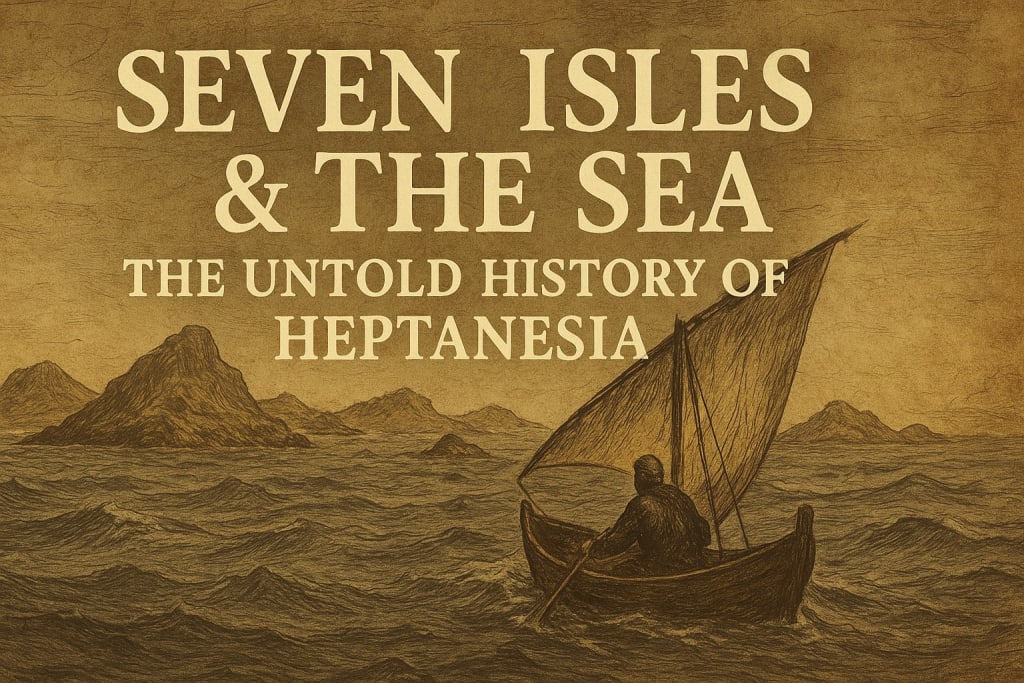
Picture a lone sailor sailing across the Ionian Sea, his ship racked by ferocious tempests, scanning the distant horizon.He's looking for somewhere to live.For many, this conjures the story of Odysseus, the king of Ithaca.For some, it tells the actual story of several sailors, traders, and explorers looking for safety on seven stunning islands like gems in the ocean.
Heptanesia—meaning "Seven Isles"—is the name of these islands.This group is often forgotten by history. Kythira, Zakynthos, Kefalonia, Ithaca, Lefkada, Paxos, and Corfu.For most of today's visitors, they represent the perfect getaway.For hundreds of years, still, they were the primary entrances to the Mediterranean, influencing commerce, culture, politics, even legends in ways the globe sometimes forgets.
A Meeting Point of Worlds
Because of their great location, the Heptanesia were never separated from the other earth.For millennia, boats from Venice, Constantinople, North Africa, even faraway places like Spain and Arabia visited their beaches.Promoting the flow of languages, culinary traditions, and ideas, these islands were a maritime center linking East and West.
Unlike other areas of Greece, the Seven Isles were not completely under Ottoman control.Venetian and later British control, however, had a greater impact on them and resulted in a unique combination of Italian Renaissance complexity and British administrative techniques.Still towering, the Venetian ramparts on Corfu and Zakynthos conjure past naval conflicts and changing coalitions.
Myths and Reality Are Closely Related
Their history is equally as significant as the stories of these islands.Think of Ithaca, for example, always remembered as the home of Odysseus, the brave ruler of Homer's Odysseus, whose epic journey from Troy has motivated generations upon generations.
While the people of Zakynthos tell tales of sea spirits aiding fishermen in storms, the inhabitants of Corfu share anecdotes of saints who intervened to protect the island against invasions.Here, folklore is an inseparable part of the core of the Heptanesians; it is not different from reality.Every wave, rocky cliff, and olive tree has a narrative to share handed down over the ages.
British Legacy, Venetian Grace
Between the fourteenth and eighteenth centuries, the Venetian Republic governed most of Heptanesia; it left a long-lasting legacy evident still in its architecture, food, and even music.Street cobblestones evoking Venice, lovely pastel houses with wrought iron balconies, and churches where Venetian tunes resound are all visible as you wander Corfu Town.
Still, the direction of history has not always been straightforward.Pirate raids, intense conflicts, and regular leadership changes marked these islands.Establishing a well-structured government, schools, and even cricket—a distinct yet enduring legacy of their rule still quite popular in Corfu—the British took control of them temporarily in the nineteenth century.
This complex history shows how Heptanesia is a distinctive blend of Greek, Venetian, and British influences shaped by the adjoining sea.
The Forgotten Republic
Few outside Greece are aware that Europe's first modern Greek republic was founded on Heptanesia.The Ionian Islands became the Septinsular Republic (1800–1807), a quasi-independent nation under protection from both the Ottoman Empire and Russia following Napoleon's 1797 loss.
This brief republic was radical in a region often ruled by empires as it foretold Greek freedom and one of the few instances of democracy there.Citizens established parliaments, experimented with different types of governance, and wrote constitutions as the great powers watched from a distance.
This little republic planted the seeds of the bigger fight for Greek liberty in the 1820s.
Culture, cuisine, and identity on the Islands
Still, Heptanesia's fundamental nature is defined by both its political story and its multiculturalism.
Music: Developed on Italian opera but presented in the native tongue, the islands generated a distinctive musical genre known as kantades, which were romantic serenades.You can still hear the beautiful sound of people singing love songs even at night when walking across the small streets of Corfu or Zakynthos.
Food: Dishes influenced by Venetian cuisine abound in Corfu: soffrito (beef in garlic and white wine sauce) mixes Italian and Greek flavors with pastitsada, pasta with spiced meat.Local diets have been changed for years by olive groves, vineyards, and citrus farms.
Spirit: The citizens of Heptanesia are well-known for their friendliness and patriotic attitude.They regard themselves as defenders of a maritime civilization with a past both distinctive and shared.
The Value of This LegacyToday
Often seen in our busy tourist world, the Seven Isles may be basic postcard photographs highlighting turquoise waters, white cottages, and magnificent hotels.But beneath this façade resides a strong story of fortitude, cultural identity, and fusion of customs.
Heptanesia teaches us that history is not only produced in great cities or on battlefields.It is produced in little ports, via melodies sung at dusk, and in the tenacity of islanders who have evolved to accommodate the changes brought by several civilizations while still true to themselves.
Many times, the Seven Isles represent the connections within the Mediterranean.They show how geography shapes fate, how civilizations combine across millennia, and how even little sites can have a big effect on the bigger course of our world.
Heptanesia: The Archipelago of Memory
Beyond the simple past, the story of the Heptanesia epitomizes the act of remembering.It aims at exposing the tales under the surface of promotional tourism.Furthermore, it honors the resilience of the people who kept their customs while welcoming many influences from across the sea.
More than only a historical story, the Seven Isles and the Surrounding Sea remind us that identity is complex, nuanced, and frequently shaped by the seas connecting us all.
Therefore, when someone talks about Mediterranean history and jumps straight to Rome or Athens, softly remind them of the seven islands, embraced by the sea, which bear their own secrets: Heptanesia.
Fact Box: The Seven Isles (Heptanesia)
Corfu (Kerkyra): Venetian fortress, British cricket, cosmopolitan history.
Paxos & Antipaxos: Tiny gems known for olive groves and turquoise coves.
Lefkada: Home to ancient poets like Sappho (legend says she leapt from its cliffs).
Ithaca: Homeland of Odysseus.
Kefalonia: Known for Mount Ainos and its strong Kefalonian character.
Zakynthos: Birthplace of national poet Dionysios Solomos; famous “Shipwreck Beach.”
Kythira: Mythical birthplace of Aphrodite.
About the Creator
Keep reading
More stories from Shahjahan Kabir Khan and writers in Wander and other communities.
Lauterbrunnen: The Valley of 72 Waterfalls
Lauterbrunnen in Switzerland is a location to see that more closely resembles a dream than just a location.Tucked in the Bernese Alps, this valley stands among the most beautiful places on Earth.Known as the "Valley of 72 Waterfalls," Lauterbrunnen looks like a natural amphitheater with majestic cliffs, tumbling rivers, bright meadows, and quaint chalets straight out of a storybook.
By Shahjahan Kabir Khan5 months ago in Wander
Literary Heartbeats
Step through an unassuming storefront in Saratoga Springs, New York. Let the city’s familiar bustle fade behind you. Sink into the creak of hardwood floors as your gaze is drawn toward a labyrinth unfolding, room after room, swollen with stories. This is the Lyrical Ballad Bookstore—a place where literary ghosts linger, and generations of readers, writers, and dreamers have lost themselves amid 200,000 volumes of wonder.
By Kristen Barenthaler4 days ago in Wander
Take a Hike in Central America
In Guatemala, at Lake Atitlán is the Atitlán Volcano. The hike takes 5 to 6 hours to complete. Beautiful Lake Atitlan is among the top attractions in Central America and among the best hikes. This is an impressive crater lake flanked by three volcanoes and surrounded by steep, scenic hills.
By Rasma Raistersa day ago in Wander


Comments
There are no comments for this story
Be the first to respond and start the conversation.