
Salzburg's secluded hidden gem
Discover a rugged secret theatre carved out of the rock.

Salzburg is known as the ‘Rome of the North’. The name is a reference to the city’s beautiful baroque architecture, imagined and built by the Catholic Prince Archbishops of the seventeenth century. Tourists are keen to seek out the film locations from the beloved film The Sound of Music and music lovers regularly embark on pilgrimages to the birthplace of Mozart. But this Austrian town has more unusual secret spots to discover too.
Both locals and travellers share a love for Salzburg’s most magnificent palace - Hellbrunn Palace. The palace’s stunning grounds include delightful trick fountains, neatly trimmed lawns and a serene green-blue water garden. But those who only explore this far are missing the estate's most mysterious and impressive attraction.

Away from the picnic field and into the dark green trees, the path winds upwards. Leaving the water gardens behind, the forests of Hellbrunn are still relatively tame, but viewed from the other side the peak looks more like a miniature mountain with rough, craggy cliff edges. There are fewer people up here. The trees absorb the noise and agitation of the surrounding city. Despite the dense trees the paths are wide and clear. If you wander around long enough you’ll stumble upon the monumental stone construction known as the ‘Steintheater’; the Stone Theatre.

When I arrived it was empty, except for a small child with her mother and grandmother. The little girl ran around, clambering up the rocks which form the stage. As she explored, her laughter and shouts were amplified around the open chamber.
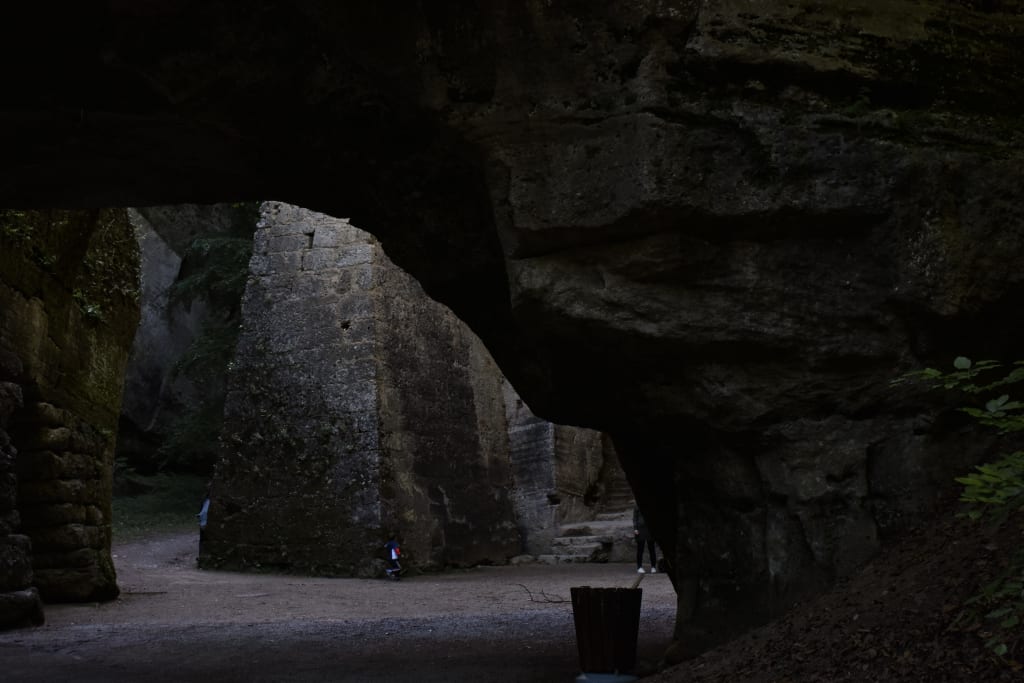
The improbability of the place is delightful. The entrance is a sweeping stone archway which collides with the unyielding stone pillar of the adjacent rock, which rises up in strange shapes. It couldn’t be more different from the domesticated and refined gardens only fifteen minutes walk below.

Labyrinthine corners and pathways create a deceptive sense of space, although the whole complex is surprisingly small. The scent of damp earth and the little green plants reaching out of the cracks between the rocks make it feel like you’ve stumbled into some long-forgotten castle. A few supportive columns mark the boundaries, their bricks full of smooth shells. They seem to have been mined from the very sea-floor, adding to the sense of the surreal.

It looks so obviously like a theatre, that it’s surprising to learn it was actually originally a quarry - the stone mined here was used to construct the ornate baroque Hellbrunn palace. But it is no accident that it suits its role so perfectly. In the 17th century the Archbishop Markus Sittikus arranged a theatre to be created out of the quarry cavern, and it’s possible that its final form was even intended before the quarrying began. In 1617 the first opera performance outside of Italy took place here.

Hellbrunn’s construction was inspired by the desire to unite contradictions, which the Steintheater does with elegance. It unites the defining forces of the city itself - the baroque architecture and love of culture. Although the theatre superficially bears no resemblance to the multitude of ornate surrounding palaces, they have more in common than first appears. It is a dedication to the music and arts that are so beloved in Mozart’s hometown. The fact that this altar is carved out of the space left behind by the construction of the city’s finest buildings is rather poetic. Even the stones of Salzburg worship the arts. Whilst those stones are now part of Europe’s most beautiful buildings, the earth they come from continues to play tribute to the art and music intrinsic to Salzburg.
About the Creator
Alissa Mann
Linguist, explorer, food lover
Photographer-in-training
Keep reading
More stories from Alissa Mann and writers in Wander and other communities.
Everest Three Passes Trek 15 Days: A Demanding But Rewarding Route
The Everest region is often associated with the classic Everest Base Camp trail. But for trekkers looking for something more challenging and less predictable, the Three Passes route offers a deeper experience of the Khumbu.
By Saraswati Karkia day ago in Wander
Away from the Crowds in Wyoming
Devils Tower is the first declared National Monument in the US. It is not really known how this formed into such a unique shape. Legend has it that two girls were playing, and along came giant bears. They tried to run away from the bears and climbed to the top of a rock, praying to be saved. Then the rock rose high up into the air, and the girls were saved while the bears left their claw marks on the side of the mountain trying to climb it but failing. The Devils Tower received the honor of becoming the first National Monument in 1906, 13 years after the first recorded climb of the mountain by William Rogers and W.L. Ripley in 1893.
By Rasma Raisters3 days ago in Wander
"Scream 7" (2026): Running out of Fresh Screams
This is the seventh time we’ve had a Ghostface crisis. Scream 7 is the latest edition of the Scream franchise. Sydney Prescott and her family are under attack by another anonymous killer dressed in a Ghostface costume. While having issues with her daughter, Tatum, they run from the bloody murders, trying to determine who is behind it all.
By Marielle Sabbag3 days ago in Horror



Comments
There are no comments for this story
Be the first to respond and start the conversation.