
Rolls-Royce
Rolls-Royce CEO Explains How This Innovative Engine Will Redefine Aviation Standards

In the fiercely competitive aviation sector, staying ahead demands constant innovation. Rolls-Royce, renowned for its luxury and engineering prowess, is poised to transform industry benchmarks with its cutting-edge UltraFan engine. Recently, Rolls-Royce's CEO unveiled insights into how this groundbreaking engine could revolutionize aviation. The UltraFan is not merely a new engine but a leap towards the future of sustainable and efficient air travel. With its impressive design and advanced technology, the UltraFan aims to set new standards for performance and environmental responsibility. This blog delves into the UltraFan’s key innovations, its potential to reshape aviation, and how it positions Rolls-Royce as a trailblazer in the industry. Discover how this revolutionary engine could redefine the future of flight and propel Rolls-Royce into a new era of aviation excellence.
Rolls-Royce Company

Rolls-Royce has long been synonymous with engineering excellence and luxury. Founded in 1904, the company originally made its mark in the automotive industry before establishing itself as a leading aircraft engine manufacturer. Over the decades, Rolls-Royce has become a global leader in propulsion systems, known for its high-performance engines that power both
For investors, Rolls-Royce has been a company of both high promise and significant challenges. The company’s journey has seen considerable fluctuations, marked by periods of robust growth followed by financial setbacks. Rolls-Royce has experienced several periods of robust growth throughout its history. During the Post-War Boom (1940s-1960s), after World War II, Rolls-Royce capitalized on the rapid expansion of commercial aviation. The introduction of engines like the Avon and the Conway propelled the company into a dominant position in the global market. This period was marked by significant technological advancements and a surge in demand for new aircraft engines. During the expansion into modern jet engines (1980s-1990s), The introduction of the RB211 and Trent engine families was a milestone for Rolls-Royce. These engines were pivotal in powering major aircraft models, including the Boeing 757, 767, and the Airbus A330. This era saw substantial growth in both market share and technological reputation, solidifying Rolls-Royce’s status as a leading engine manufacturer. During innovations and market leadership (2000s-2010s), the company continued its trajectory of growth with the launch of advanced engines like the Trent XWB, which became the world's most efficient large aero engine. Rolls-Royce’s investments in innovation and its strong partnerships with major airlines and aircraft manufacturers bolstered its financial performance and global influence.
Despite these periods of growth, Rolls-Royce has faced significant financial setbacks. For instance, during the RB211 and Financial Crisis (1970s-1980s), The development of the RB211 engine was initially a major success but became a financial burden due to delays and cost overruns. Rolls-Royce faced severe financial difficulties, leading to a government bailout in 1971. The company was subsequently restructured, but the RB211 saga remains a notable example of the risks associated with large-scale engineering projects. During the Trent 1000 Issues (2010s), that is the Trent 1000 engine, used in the Boeing 787 Dreamliner, encountered severe technical problems, including premature corrosion and cracking of turbine blades. These issues led to costly groundings of aircraft and significant repair costs, impacting the company’s financial performance and reputation. During COVID-19 Pandemic (2020s), the COVID-19 pandemic had a devastating impact on the aviation industry, with a dramatic drop in air travel leading to decreased demand for new engines and maintenance services. Rolls-Royce, heavily reliant on the aviation sector, faced substantial revenue losses and operational challenges. The company had to undertake restructuring efforts and cost-cutting measures to navigate this difficult period.
Despite these setbacks, Rolls-Royce is now in a recovery phase, driven by innovations like the UltraFan engine. The company is focusing on enhancing its technological capabilities and expanding its market presence to regain its financial footing. The UltraFan, with its cutting-edge design and efficiency improvements, represents a critical element in Rolls-Royce’s strategy to overcome past challenges and pave the way for future growth. The cyclical nature of growth and setbacks underscores the complexities and risks inherent in the aerospace industry. Rolls-Royce’s ability to navigate these challenges and capitalize on new opportunities will be crucial in shaping its future trajectory. The introduction of the UltraFan is a strategic move aimed at reinvigorating investor confidence and positioning Rolls-Royce for long-term success. The engine’s advanced technology and potential market impact are expected to enhance shareholder value and attract further investment.
Key stakeholders in Rolls-Royce include its shareholders, customers, and employees. Shareholders are primarily concerned with the company’s financial performance and return on investment. Customers, including major airlines and defense organizations, look for reliability, performance, and technological advancements. Employees are integral to Rolls-Royce’s success, contributing to the development and implementation of innovative solutions like the UltraFan.
Rolls-Royce’s financial performance has been a mixed bag in recent years. Despite its prestigious position in the industry, the company has faced financial challenges, including losses linked to engine issues and the impact of the COVID-19 pandemic. However, the introduction of the UltraFan is anticipated to reverse these trends. In recent financial reports, Rolls-Royce has shown signs of recovery, with increased investments in research and development and a focus on expanding its product portfolio. The UltraFan is projected to boost revenues significantly by capturing a larger share of the market and providing new opportunities in the commercial and defense sectors. The engine’s expected improvements in fuel efficiency and performance are designed to attract major airlines and aircraft manufacturers, driving demand and, consequently, financial growth. With its advanced design and sustainable technology, Rolls-Royce aims to solidify its financial stability and enhance shareholder returns in the coming years.
The UltraFan
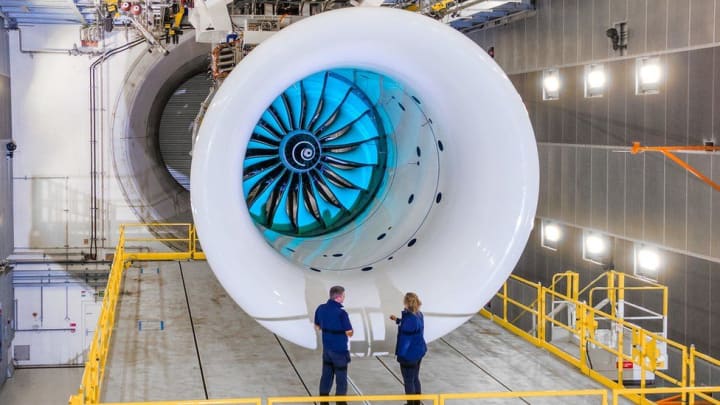
Rolls-Royce’s UltraFan represents not just a technological leap but a crucial step in the company’s financial and strategic recovery. By addressing investor concerns, meeting stakeholder expectations, and leveraging its engineering legacy, Rolls-Royce is set to redefine the aviation industry and position itself as a leader in the future of sustainable flight.
Rolls-Royce's UltraFan is not just another engine—it's a bold statement in aviation innovation. As the largest jet engine ever created, the UltraFan marks a major advancement in technology and efficiency. Designed to rival General Electric's (GE) GE9X, this engine is set to redefine industry standards for fuel efficiency and environmental sustainability. With an impressive diameter of 140 inches, the UltraFan surpasses the GE9X's 134 inches, demonstrating its monumental size and capability. It generates a staggering 64 megawatts of power and offers a maximum thrust of up to 110,000 pounds. This makes it suitable for both narrowbody and widebody aircraft, showcasing its versatility. The UltraFan is not merely a competitor but a potential game-changer, setting new benchmarks in the aviation industry for performance and eco-friendly technology. Rolls-Royce's UltraFan heralds a new era of aviation, blending cutting-edge design with unparalleled power and efficiency.
The UltraFan incorporates a geared turbofan with a pitch fan system. This allows both the fan and the turbine to operate at their optimal speeds, resulting in improved efficiency and performance. The use of lightweight carbon composite blades makes the UltraFan 10% more efficient than its predecessor, the Trent XWB. One of the most notable features of the UltraFan is its 25% improvement in fuel burn compared to the Trent engine. This is achieved through advanced engineering and the use of sustainable aviation fuel (SAF). Rolls-Royce’s commitment to SAF sets it apart from competitors, aligning with global efforts to reduce aviation's carbon footprint. The UltraFan’s three-spool jet engine design is a major technological advancement. It uses multiple turbines and concentric shafts to allow different parts of the engine to rotate at varying speeds. This innovation enhances efficiency and performance, making the UltraFan a standout in modern aviation technology. To address environmental concerns, Rolls-Royce has introduced a new lean-burn combustor system. This system reduces harmful emissions, further supporting the engine’s role in sustainable aviation. Rolls-Royce faces stiff competition from other major players in the industry. Pratt & Whitney's geared turbofan and CFM's upcoming open fan engine are formidable rivals. Both companies are also utilizing advanced materials and technologies to enhance their engines' performance and efficiency. What sets Rolls-Royce apart is its focus on scalability and adaptability. The UltraFan is designed to be scaled down for smaller aircraft, which could potentially allow Rolls-Royce to tap into a broader market segment that includes narrowbody aircraft like the Boeing 737 and Airbus A320.
Despite its impressive features, the UltraFan is not without challenges. Rolls-Royce must navigate the complexities of scaling the engine for different aircraft types while competing with established players. Additionally, recent setbacks, such as the impact of the COVID-19 pandemic and issues with the Trent 1000 engines, have highlighted the need for strategic adaptation. However, the UltraFan presents a significant opportunity for Rolls-Royce to regain its competitive edge. If successful, it could lead to substantial profits and a major shift in the aviation industry. The ability to provide a versatile, high-performance engine that meets both current and future demands is crucial for Rolls-Royce's success.
Final Thoughts
Rolls-Royce's UltraFan engine represents a bold step forward in aviation technology. With its innovative design, enhanced efficiency, and commitment to sustainability, the UltraFan has the potential to redefine industry standards. As Rolls-Royce continues to push the boundaries of engineering excellence, the aviation world eagerly awaits the impact of this revolutionary engine. The future of aviation may very well be shaped by the advancements brought forth by Rolls-Royce's UltraFan.
About the Creator
Horace Was
Essay Writer, Aviation and Technology Expert
Keep reading
More stories from Horace Was and writers in Wander and other communities.
Dubai's Pearl
In a candid interview, Mohi-Din BinHendi, former Director General of Civil Aviation for Dubai, shared his remarkable journey that started when he was appointed to the role at the young age of 28. His insights provide a fascinating look into the evolution of Dubai’s aviation industry and the development of the world-renowned Dubai International Airport.
By Horace Wasabout a year ago in Wander




Comments
There are no comments for this story
Be the first to respond and start the conversation.