
Riding It Out on a Cursed Lake
Canada’s Cultus Lake has worse things than evil spirits
I never really know what I’m doing
It’s better that way. Once you achieve mastery of something, there’s nowhere to go but down. Besides, I’m the kind of man who’s pathologically incapable of asking for directions. I’d rather be lost.
So I never learned to kayak safely. I never took a class. I just went out and bought one. My classroom was the deep cold lakes of British Columbia.
And when a roaring speedboat cut in front of me, far too close for safety, I didn’t know quite what to do. The water swelled toward me like some sleeping creature rising with the morning, the sunlight glittering along the battlements of a rolling green wave.
All you can do, I decided, is meet it head-on.
This lake is bad
When Europeans first came to this part of the world, they and the aboriginal people who were already here had developed a pidgin language called Chinook Jargon to facilitate trade. It was nobody’s first language. It was a compromise, made up of words taken from any of the hundreds of native languages along the West Coast from California to Alaska, combined with English and French and the detritus of other tongues.
In Chinook, the meaning of cultus is slightly ambiguous. But it doesn’t mean anything good.
There’s a darkness here. And the lake, though not especially large, has claimed its share of lives. The latest was an Indian student, perhaps unaware of how cold Canadian waters can be even on the hottest of days.
The natives used to say that the lake was bottomless, that the underground rivers beneath the surface could drag people away and carry them, lifeless and blue, all the way to the distant ocean. They talked of the devilfish that lurks in the depths, and the strange unrecognizable creatures that washed up sometimes on beaches of black stone.
That’s how a mountain lake earns a bad name.
But now, the lake is a summer playground. It’s home to the largest waterpark in the province, a towering coil of looping slides on either side of the road into the vacation village. Sometimes, traffic backs up for miles, the single road through the mountains unable to handle the volume of visitors a sunny day brings.
That’s why I’ve avoided it until now. In October, I thought, I might be safe from crowds. Even though the day was bright and sunny and as warm as July. After all, this lake is only twenty minutes from my house. A chance to get away without really going away. A vacation at the end of the street.
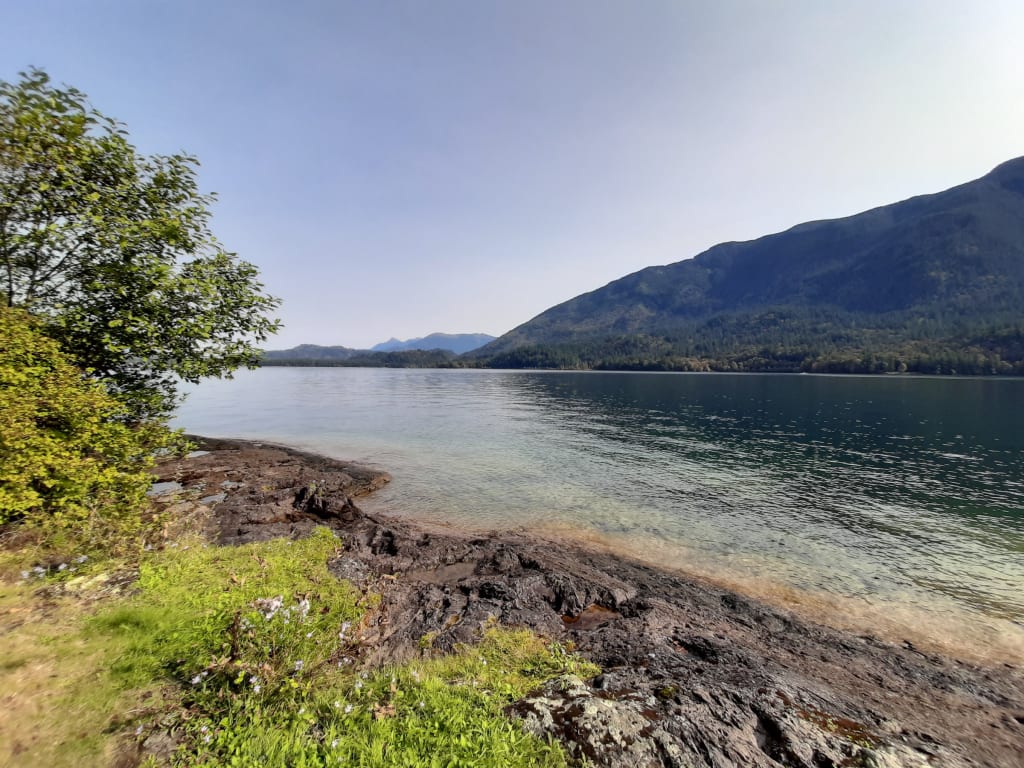
The shining morning seemed to agree with me. The handful of dog walkers and paddleboarders and suntanners wouldn’t be hard to avoid. I launched my kayak from the beach and left them all behind, gliding out over the dimpled water that spiders dance across, too light to break its steel-colored skin.
But it didn’t last. As the sun moved through a sky tinted like sepia from the forests burning miles away, the boats came out. Engines growled and baselines thumped and obnoxious laughter drifted over the water. This is the trouble with every beautiful thing. We all want to be in paradise. And once we’ve found it, we leave it littered with beer cans and cigarette butts.
Fifteen thousand years ago, the lake had no name at all.
Nothing did. The continent was unnamed and unknown, and the circling eagles didn’t know that they were eagles. The bees didn’t know they were bees. They didn’t have us to tell them.
Then people came, crossing a waste of grinding ice in search of food to eat and a place to stay warm. Desire and need drew the ancestors of the first North Americans to a pristine continent. Whatever curses and spells they discovered in the landscape were their own.
And now, rough waves beat the beaches and the stink of diesel hangs on the air. People like me get mad about things like this. When your own passions are more or less silent, it’s difficult to empathize with people who seem addicted to making noise. Hence the boat. Hence the hiking boots. Hence the bear spray tucked into a waterproof hatch of my kayak.
I like to get away, to go to places that seem as though no human ever touched them. Give me a 3000-year-old city or an untouched forest glade. It’s the stuff in the middle I can’t get behind.
But when I finally find the silence I’m looking for, I become uneasy. The silly stories come back to me. The ones that are easy to laugh at in bright sunlight with a loud group, and not nearly so funny in the silence and the dark.
I didn’t grow up here. I moved across the world for exactly these kind of places. The clean water. The lofty mountains. Where I’m from, all the danger is human. Over there, the world was long ago beaten into submission.
Not here.
That’s what makes it beautiful. And sometimes terrifying.
One after another, the waves broke
Raised up by one wave, I plunged headlong into the next. The water washed over the bow of my boat, splashing across the scrap of tarp I had used to make a DIY spray skirt. Somehow, I had the presence of mind to raise my knees so that the water streamed around me on both sides, rolling over the kayak and reuniting with the lake.
My little boat bobbed back up to the surface, shining wetly in the sun while I rode out the rest of the waves the boat had caused. Somehow, I was still upright, still more or less dry, still gripping a paddle that flashed as I raised it and hurled curses at the pilot of the boat that had nearly swamped me.
But in a way, it was fun. Few things in life are more rewarding than a challenge that you’re just about equal to. Few things are better than figuring it out for yourself, learning how to move in the world you were born for with nothing but your own capabilities. These are the things you learn in the lakes and on the mountain trails and in the darkness under the trees.
You learn what you’re capable of. You learn when you’re overmatched. You learn that the world, no matter how placid and benign it may sometimes seem, is made up of forces much greater than you are. The calmest lake can rise up at any time and become a killer. All you can do is try your best to ride the waves and stay afloat.
As I paddled back to the beach, the water that had been as flat as a pane of polished glass in the morning now rose and fell like a bedsheet hung out to dry. I rose and fell with it, not fighting it, just trying to steer to where I wanted to go. Eventually, I reached shallow water.
Maybe Cultus Lake is a bad lake. Maybe it really is the home of devilfish and treacherous currents and evil spirits with fish scales for hearts. But it’s not the old myths and legends that will keep me away in the future.
It’s the smell of diesel and the blaring music and too many oblivious people.
About the Creator
Ryan Frawley
Towers, Temples, Palaces: Essays From Europe out now!
Novelist, entomologist and cat owner. Ryan Frawley is the author of many articles and stories and one novel, Scar, available from online bookstores everywhere.
Keep reading
More stories from Ryan Frawley and writers in Wander and other communities.
Away from the Crowds in Wisconsin
Located on Lake Superior, the Apostle Islands are great for outdoor adventures. They are known for pristine beaches and sea caves. Cliffs offer awesome views. Visitors enjoy hiking along scenic trails or getting out on the water and sailing.
By Rasma Raisters6 days ago in Wander
Cassie and Johnny
I’m the kind of dame you notice. I’m no femme fatale, but you can’t ignore me, at least not until I warn you about what’s coming, then everybody ignores me. Hell, they usually blame me afterwards and give Johnny all the credit for saving the day, but my Johnny couldn’t save a seat at the movies without my help. Sure, he’s brawny, but brainy? Not so much. Like that time I asked him to spot me five bucks, and he said he didn’t see it anywhere on me, and believe you me, he looked but good.
By Harper Lewis5 days ago in Critique



Comments
There are no comments for this story
Be the first to respond and start the conversation.