
Oxapampa: German Heritage in the Peruvian Jungle
Visiting a remote, unique region of Peru


Peru’s travel industry is centered on the coast and Cusco. The coast includes the capital city of Lima, beach resorts like Mancora, and other major cities like Arequipa and Trujillo. Cusco is a beautiful city that provides access to Machu Picchu, the country’s top tourist attraction.
While Cusco and the coast offer the most well-known and accessible travel experiences, Peru is a large country (nearly twice the size of Texas) with an incredible variety of landscapes.
In a recent adventure, my partner and I took a bumpy 11-hour bus ride to explore the Oxampampa Province, a jungle region that connects the eastern slopes of the Andes mountains with the western fringe of the Amazon rainforest basin.
We stayed in the town of Oxapampa, the capital of the Oxapampa Province and home to around 14,000 residents.

The region is known for natural beauty, biodiversity, and a unique history. Oxapampa and the nearby town of Pozuzo were founded by German and Austrian colonists who arrived in 1859.

The history of the colonists is fascinating.
Here are the basic facts:
A group of around 300 Germans and Austrians sailed from Belgium, across the Atlantic Ocean, around the tip of South America, and up the continent’s west coast to Peru. Then they trekked through desert, mountains, and jungle for two years before stopping in the verdant valley of the Huancabamba river.
First, they settled Pozuzo in 1859. Then, in 1890, some of the colonists traveled 47 miles (77 km) south to form Oxapampa.
Today, Pozuzo is tiny, consisting of a small central plaza, a few historic buildings, some restaurants and lodges, and scattered housing along the hillsides. Oxapampa is larger and serves as the region’s center of tourism and commerce.
Because the colonists built primarily with wood, few historic structures remain. However, German heritage is very much alive. This seems to be partly a ploy to attract tourists and partly a result of the population’s historic isolation. Until the 1980s, there was no highway connection to the coast. Although the colonists’ descendants gradually intermarried with indigenous and mestizo Peruvians, German family names, histories, and traditions were maintained.
Tourist-facing German influences include business names like Hassinger and Muller, architectural details, bartenders in Oktoberfest-style dresses, and restaurant dishes like schnitzel and strudel.
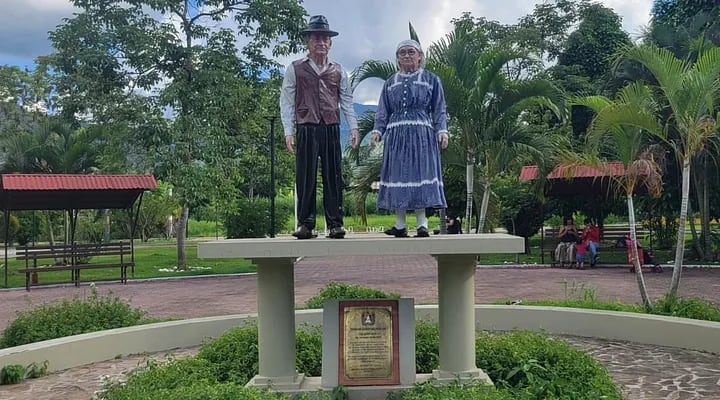
Oxapampa has a lovely central plaza and a wood church that was built in 1939. Outside the town center, the aesthetic is more typical of small-town Peru: concrete walls, metal roofs, dirt roads, and an abundance of dogs.


Our visit included a 10-hour tour through Yanachaga-Chemillen National Park. We were 14 tourists, packed tight in a van. The ride was exhausting, over bumpy dirt roads that run alongside steep cliffs. The scenery was, of course, spectacular.

The highlight of the day was a swim in this mountain stream. The water was turquoise, transparent, and calm. Despite the small crowd of swimmers, it was easy to feel peaceful in this beautiful place.

To reach the stream, we were asked to hop out of the van and proceed on foot. We had to walk over a long, wobbly, wooden bridge. I was shocked to look back and see that our driver was following us across, after shedding the weight of 14 tourists.


We loved our visit to Oxapampa. I wouldn’t necessarily recommend this region over Peru’s more popular destinations, because getting in and out of the area is rough. After an initial 11-hour bus ride from Lima, our ride home was delayed by a landslide and turned into a 14-hour journey. However, for those who prefer to stray from the beaten path, Oxapampa is truly a hidden gem.
This story was originally published on Medium, here.
About the Creator
Keep reading
More stories from Kenny Minker and writers in Wander and other communities.
Seaside Charm and River Restoration in Southwest England
In the summer of 2023, my partner and I spent three months slow traveling and working remotely in Europe. The general idea was to spend around one month each in three countries. This was modeled after my previous visit to Europe, in which I stayed in Estonia, Germany, and Slovenia. This time, we chose Slovakia, Germany, and the UK.
By Kenny Minker12 months ago in Wander
Worth the Wait: Puerto Viejo, Costa Rica
Beach bumming in a small Caribbean beach town sounded like a perfect way to end our 6-month trip through Mexico and Central America. Or so we thought. The foul, fishy stench of rotten seaweed hit our nostrils as we stepped from the cramped bus and looked out at a rather depressing, empty, and underwhelming black sand beach. It was pouring with rain, and we had to quickly fish out our ponchos. We thought, this couldn’t be it, could it?
By Sh*t Happens - Lost Girl Travel4 days ago in Wander
Lost in Translation: How Getting It Wrong in Asia Taught Me How to Travel Right
My first morning in Hanoi started with a sensory assault. I was sitting on a tiny blue plastic stool, knees touching my chin, watching a woman whisk an egg yolk into a cup of robusta coffee. The air smelled of charcoal smoke, cilantro, and exhaust fumes. It was chaotic, loud, and utterly mesmerizing.
By Eleni N. Markouabout 20 hours ago in Wander
A More Human Vocal
When we launched Vocal nearly a decade ago, the world was a very different place. LLMs did not exist, and stories were created one at a time by people sitting down to write, revise, and share something personal. Many of our assumptions about publishing, trust, and participation were built for a world where effort and output were inseparable.
By Justin @ Vocal5 days ago in Resources



Comments
There are no comments for this story
Be the first to respond and start the conversation.