
Oregon Caves: A Hidden Gem in the Forest
Nearly thirty-years ago, and by chance, I discovered the Oregon Caves while on a road trip through the Pacific Northwest. What I discovered was a hidden gem.

A Sign Leads the Way
During the Summer of 1996, my sister, brother-in-law and I took a road trip from the Bay Area of Northern California all the way to British Columbia. Along the way, we spotted a sign indicating an exit for the Oregon Caves National Monument.
None of us had heard of this place. And in the days before smart phones, we couldn’t exactly Google it to find out exactly what it was. Thus, on a whim we decided to take that exit. We were not disappointed by the results.
Getting There
Getting to the Oregon Caves National Monument is not an easy drive. Highway 46 meanders along the side of a perilous mountain pass 48 miles south of Grants Pass and heads east through heavily forested mountain slopes. However, within 20 miles north of the California border - and 19 miles east of the town of Cave Junction, Oregon - one of the state's least known treasure awaited.
The Oregon Caves National Monument, better known as the Oregon Caves, is a natural wonder barely known to people outside the Pacific Northwest. It's not as big as the Carlsbad Caves. Still, it showcases nature's artistry at its finest.
The Hall of Marbles
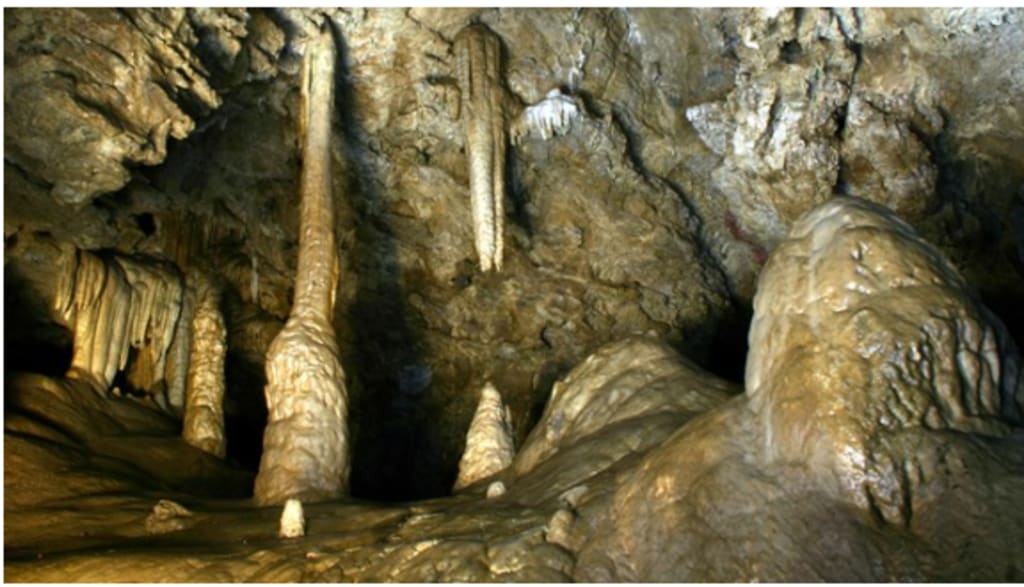
The 3.5 mile long cave system - nicknamed the "Hall of Marbles" - consists of natural formations of white pillars, ornate ceilings, and decorative walls made of marble. They are well preserved by an overlooked feature within this system: its consistent temperature of 44 degrees.
Besides its unique formation, Oregon Cave is the home to the largest assemblages of cave dwelling insects in the United States. And, where there are insects, there is another famous group of cave-dwellers that call the caves home: bats.
It also boasts several chambers. Some of these chambers were recently discovered, and more are believed to be in existence. The discovery of them has shed more light on how the caves served as a natural habitat for animals over the years. Recently, fossils of jaguars from the Pleistocene era were discovered. In addition, grizzly bears from that era were discovered in some of the deeper chambers in the system.
The cave walls and pillars are fragile. Even a smudge from a human finger can cause some damage to its luster or leave permanent marks. This lesson was learned the hard way when a geology class from Oregon State University came to study the caves in the early 20th century. Some of the students and researchers used pencils to mark the growth of the stalactite pillars. Those markings can still be seen today.
Outside the Caves
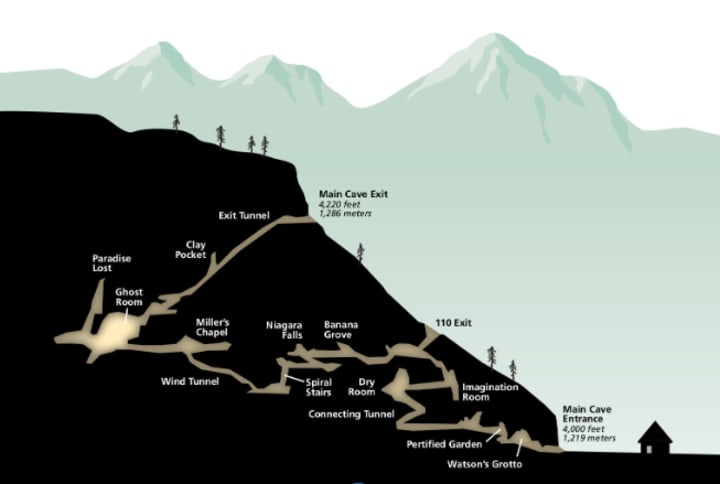
Oregon Caves National Monument is more than just the caves – although they are the main attraction. It is located within the Siskiyou Mountains at an elevation of 4,000 feet above sea level, and is situated in an ancient pine forest containing some of the largest Douglas-fir trees and Port Orford cedars in the state (NPS.GOV, 2011).
The forest itself is an attraction. There are several hiking trails and picnic areas in it. Many of them go directly above the area where the caves are located. Also, the area is a geological treasure trove. The rocks and soil are composed of ophiolite (ocean crustal rocks), serpentine rocks, and serpentine soil which are believed to be responsible for the monument’s unique vegetation.
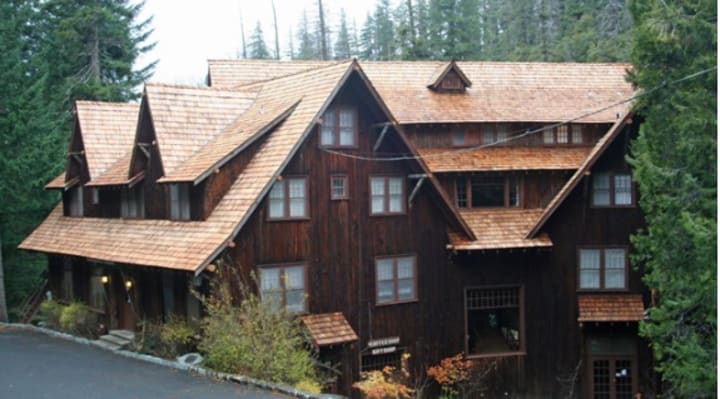
At the end of Highway 46, is The Chateau. This lodge is the starting point for all guided (on trails or off) tours into the cave. Also, this six-story structure is a hotel which contains a dining room, a 1930’s era coffee shop, and 23 rooms. Opened in 1934, the lodge has been registered as a National Park’s Great Lodge and as a National Historic Landmark. Often, it’s open between May and October of each year.
As an update, it needs to be reported that the Chateau has been going through a restoration to update its facilities. It has been closed since 2018 and its reopening is still pending. Initial repairs had been completed but there were still more structural repairs to be done. According to last reports, the target date for its reopening will be 2030. Still, that’s based on the chance they receive the $15 million needed to complete the restoration.
The Tours
The guided tours into the cave are usually done during the summer and autumn months. There are two types of tours: the 90-minute trail tour, and the off-trail tour. The trail tour covers 526 stairs. There are a few restrictions: children must be taller than 42 inches to enter the cave, and (due to its fragile formations and ecosystem) flash photos and touching are prohibited.
As of 2025, according to the the NPS website, the tours are the following:
$20 for adults (16 and over),
$15 for those under 16. Also they need to be at least 42 inches tall.
$10 for those with Interagency Senior Pass Holders (62 and older and discount applied);
10$ for Adults and $7.50 for youths with Interagency Access Pass.
Also, the tours offer reservations at Recreation.gov. Still, this reporting comes at a time when there’s a government shutdown (as its website points out at the time of this writing).
Off-trail Cave tours offer something for the adventurist. For $30 per person, one can learn caving techniques, etiquette, and preservation (NPS, 2011). The three hour tour will take a person through challenging paths in which the person will be crawling through tight spaces and rappelling into deep chambers. It is offered from July to September, Fridays and Saturdays at 10 am and 2 pm, and Sundays at 10 am only.
A Brief History
The caves were discovered in 1874 by Elijah Davidson. Davidson. He was out hunting when his dog, Bruno, chased a bear into the cave. One can imagine the shock and wonderment he must have had upon seeing the cave.
Soon, word spread of his discovery and the place became a local attraction. In the 1890s, the caves were open for business. Entrepreneurs lead tours; however, they do so with reckless regard to its ecosystem.
In 1909, President William Howard Taft declared the caves a U.S. National Monument. It would be managed by the U.S. Forest Service until the National Park Service took it over in 1933. It has been under their control since then.
ARTICLE SOURCES AND CITATIONS
http://www.nps.gov/orca/index.htm
http://oregoncaves.com/
http://www.nps.gov/orca/planyourvisit/off-trail-caving-tours.htm
http://en.wikipedia.org/wiki/Oregon_Caves_National_Monument
https://www.sfgate.com/national-parks/article/national-parks-cave-lodge-endangered-historic-land-20343041.php
About the Creator
Dean Traylor
I wrote for college and local newspapers, magazines and the Internet (30 years). I have degree in journalism, masters in special education (and credentials), and certificate in screenwriting. Also, a special ed. teacher (25 years)
Keep reading
More stories from Dean Traylor and writers in Wander and other communities.
Neighborhood Guide of South Addition in Anchorage Alaska
South Addition essentially lives up to its name: it is a community that serves as an extension to downtown Anchorage, Alaska. The residential community is nestled between the bustling streets and highways of the city’s urban center and the wide ecological expanse of the state’s south-central coast.
By Dean Traylorabout a month ago in Wander
A Texas Homecoming
Greetings, Vocal readers and subscribers! Recently, I had the opportunity to visit a familiar place that I haven't been to in almost 15 years. I've expressed my love for my hometown of Arlington, Texas in numerous stories on Vocal. Fow two days, it was my time to do some sight-seeing and nothing more. This long overdue vacation was solely about me, not about visiting family, as I've been estranged from them since 2011. I'll share a collage of pictures from my two-day stay in Arlington throughout this story. Just for reference, I took over 200 photos, so not every one of them will be featured.
By Mark Wesley Pritchard 4 days ago in Wander


Comments
There are no comments for this story
Be the first to respond and start the conversation.