
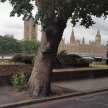

Thousands of people walk through Green Park and rarely glance around at Milkmaid's Passage. Why would they? You can't walk through it anyways. However, the name captures your attention as you walk past and dare to look behind through the gated off narrow alley. Plus, the presence f the King's men is enough to stop anyone from lingering around for too long.
The Historical Narrow Alleyway
Milkmaids Passage is closed off to the public as it’s near Clarence House. It connects the park to the Stable Yard of St James’s Palace. It lies off Queen’s Walk, a pedestrian pathway along the eastern edge of Green Park, between Lancaster House and Stornoway House.
The passage likely dates to the 18th or 19th century, with its Portland stone wall and old paving stones reflecting the historic character of the area. Westminster Council recognises it as an important part of history.
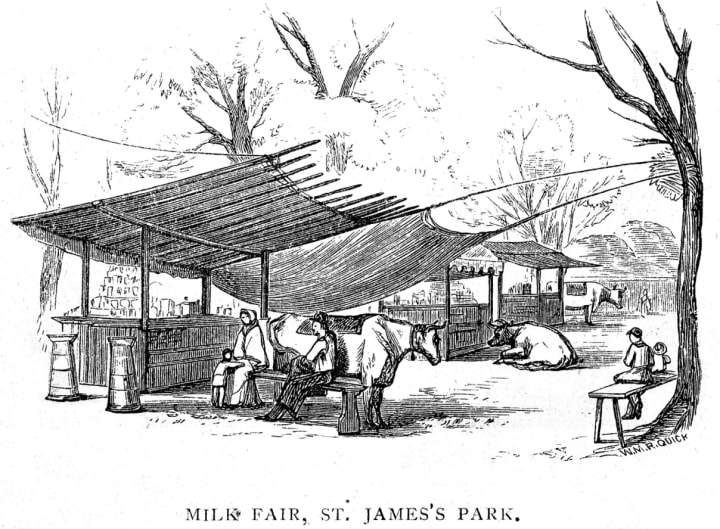
The name “Milkmaids’ Passage” hints at its historical significance, tied to the pastoral activities in Green Park and St James’s Park during the 17th to 19th centuries. Before modern refrigeration and transport, milk had a short shelf life, so cows were kept in urban areas like these parks to supply fresh milk to nearby St James’s Palace and aristocratic households.
Real Cows In The Park
Milkmaids would milk the cows and carry fresh milk through the passage to the palace dairy and other residences. By the 1830s, London had 12,000 cows, increasing to 20,000 by 1850, with Green Park and St James’s Park hosting significant numbers to meet local demand.
The passage also reflects the area’s rural past. Green Park, originally called Upper St James’s Park until 1746, was a meadowland used for hunting and grazing. Milkmaids paid fees to graze and milk cattle in the parks, with records from 1710 noting the “Lactarian” in St James’s Park as a milk-selling hub.
Milkmaid
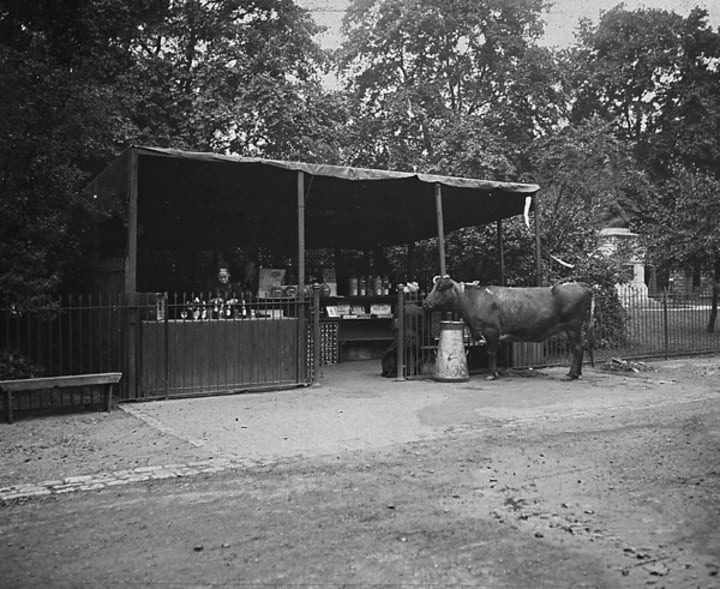
Mrs. Emma Elizabeth Kitchen (1835–1915) was a notable figure in the history of St. James’s Park and GreenPark, celebrated as one of the last prominent milkmaids associated with these royal parks in London. Her story was rooted in a centuries-old tradition of milk vending.
The Royal Connection
According to family legend, as recounted in the memoirs of her son, Fred Kitchen (1872–1951), a Victorian Music Hall performer, King James I encountered one of Mrs. Kitchen’s milkmaid ancestors in 1623 while she was milking cows in the royal park. After she provided him with a cup of milk, the king reportedly granted her and her heirs the perpetual right to sell milk on the site. While this tale may be far fetched, it highlights the deep historical connection between the Kitchen family and the parks’ milk trade.
Mrs. Kitchen’s kiosk was a fixture on The Mall until 1905, when the construction of The Mall as a processional route necessitated its relocation. The original site is now occupied by the Citadel and the National Police Memorial, with the Graspan Memorial, erected in 1903, having stood adjacent to her stall.
King Edward VII granted permission for a new kiosk to be established on the Horse Guards Approach Road, allowing Mrs. Kitchen to continue her trade. This royal privilege, tied to the female line of the family, underscores the unique status of the Kitchen family’s enterprise.
It Wasn't All Idylic
However, the parks were not always idyllic; they were known as dangerous areas at night, frequented by highwaymen and robbers. A notable incident in 1797 involved the abduction and rape of a 14-year-old milkmaid, Jane Bell, in Green Park, leading to the execution of the perpetrator, John Briant.
Modern Times
Today, Milkmaids’ Passage is a quiet, historic lane offering a unique look into London’s pastoral history.
As you exit the passage eastward, you’ll find the Royal Ocean Racing Club and the Stafford Hotel, with the latter’s American Bar being a notable nearby spot. The passage remains a functional link between Green Park and the St James’s area, preserving its historical role as a route for milkmaids serving the palace.

Travel Information
For visitors, the passage is easily accessible via Green Park Underground Station (Jubilee, Piccadilly, and Victoria lines), a short walk away. It’s a reminder that once upon a time, cows grazed in what is now a bustling urban center.
If you enjoyed reading this article and want to support my work, you can now buy me a coffee ☕️.
https://www.buymeacoffee.com/TabbyLondon
Thank you for your attention.
Best wishes
Tabby
About the Creator
Tabby London
The London I've been discovering is usually off the well-beaten track.I love the nooks and crannies and walking along the streets steeped in centuries worth of history. I'm fond of Zone 1 because that's where it all began centuries ago.
Keep reading
More stories from Tabby London and writers in Wander and other communities.
The King’s Favourite Abode
Clarence House is a royal residence in London, located on The Mall, near St. James’s Palace. Built between 1825 and 1827 to the designs of John Nash for Prince William Henry, Duke of Clarence (later King William IV), it has been a key home for senior members of the British royal family. Compared to other royal palaces, its relatively modest design reflects a comfortable, domestic style, with a pale stucco exterior and elegant interiors.
By Tabby London10 months ago in Wander
The Kelpies and The Falkirk Wheel
The Kelpies The Kelpies A few years ago I was driving up the M9 towards Dollar in Scotland, it was dark and raining and suddenly I nearly crashed the car when I saw two huge hundred-foot-high horses' heads to my left-hand side. I had to pull over. I am not sure if I tried to take a photograph but I was dumbfounded.
By Mike Singleton 💜 Mikeydred 3 days ago in Wander
Echoes
I stepped carefully around the corner, the familiar sights and sounds hitting me like a brick to the face. My eyes watered. I could practically see us, all of us, back then, clustered around the outdoor tables in front of the pizza shop, the bar, the coffee shop. I could smell the various stalls from the events we’d been to on this street. I could taste the churros and nachos.
By Phoenixica247 days ago in Fiction



Comments
There are no comments for this story
Be the first to respond and start the conversation.