
Inheritance in Twenty-Five Parts
Inside the house, I found a cardboard box.
I.
My mother died alone in the hospital early on a Monday morning.
I wasn’t allowed to visit.
Even in my protective equipment-- my noisy plastic shield, my chafe-y white duck-bill of a mask-- the hospital turned me away.
II.
Dreams my mother and I shared:
A little girl, named for us both, playing in the creek.
A roadside vegetable stand. Potatoes the size of a groundhog; carrots as long as my forearm.
A college diploma in a picture frame. A classroom full of children, gathered around a cup full of dirt and a single seed.
A litter of piglets, snorting as they bathed themselves in mud.
A gallery full of watercolor paintings, drawings done in colored pencil and lop-sided-but-sturdy clay mugs.
III.
Someone from the bank notified me that they would be taking back the things my mother had stopped paying for. The farmhouse and all seventy acres. Her rusty, maroon truck. The local art collection she showed off each time I came for a visit. Many of her personal belongings had been donated to the local thrift shop, per her will. The rest of my mother’s wishes couldn’t be fulfilled due to outstanding debts. I had thirty days to survey the property and say farewell to the land I thought I would pass on to my own child.
IV.
Thirty days. I spent the first ten days in bed, sleeping away things that were not survivable.
I spent the next ten days on the couch, eating pity lasagna from a glass casserole dish. The TV was a blur of housewives and runways, anything but sad/death/mom.
Before, there were certain traditions around heartbreak—like sitting quietly next to a friend and gathering with others to exchange memories. We shared air without discretion. We brandished our noses and mouths proudly.
After, I had no choice but to survive my grief alone. In my basement studio apartment, in my eraser-pink bedroom slash kitchen slash living room. With my imaginary friends. With my imaginary mom.
V.
Dreams I had after losing my mother:
I am hitchhiking along the Appalachian trail. Many drivers pull over to offer me a ride, but none of them are my mother. I wave them away and try, unsuccessfully, to dial her number on my cell phone. I give up and sit in the middle of the road. I don’t see any more cars.
I am floating upside down, and I know that I will fall on my head when gravity finds me again. The more I try to turn right-side-up, the higher I float. Suddenly, I drop.
My father, face blurry, yells something at me. I hide inside the kitchen pantry. It is dark and moist. I open a small jar of raspberry preserves and use my fingers to eat its contents. When I’m done, I lay on the ground and try not to listen to my parents yelling, but I hear the name Amelia said over and over.
VI.
On day twenty-one, I stuffed my pack with supplies and mindlessly drove to the farm. Leann Rimes played quietly, fuzzily, on the radio. When I saw the “for sale” sign, I felt an urge to run it over.
Inside the house, I found a cardboard box.
VII.
The box contained:
Eleven keys on a keyring, attached to a dangling Pooh bear figurine.
Two sets of gardening clothes—overalls, cargo pants, a t-shirt splattered with paint, and a tie-dye cut-off tank top.
An unglazed clay bowl that leaned to the right.
A postcard with a picture of a rattlesnake and “GREETINGS FROM UTAH” in bright pink letters.
A black notebook small enough to fit in my pocket.
VIII.
The loss of the house felt manageable. Devoid of my mother’s mismatched furniture, the sound of her voice, the smell of her rose perfume, it was no longer the home of my memories.
It was the forest that made my heart feel like it was on fire with wild desperation and grief.
I donned my backpack and carried the box down the trail into the woods.
IX.
Things I saw on the trail that reminded me of my mother:
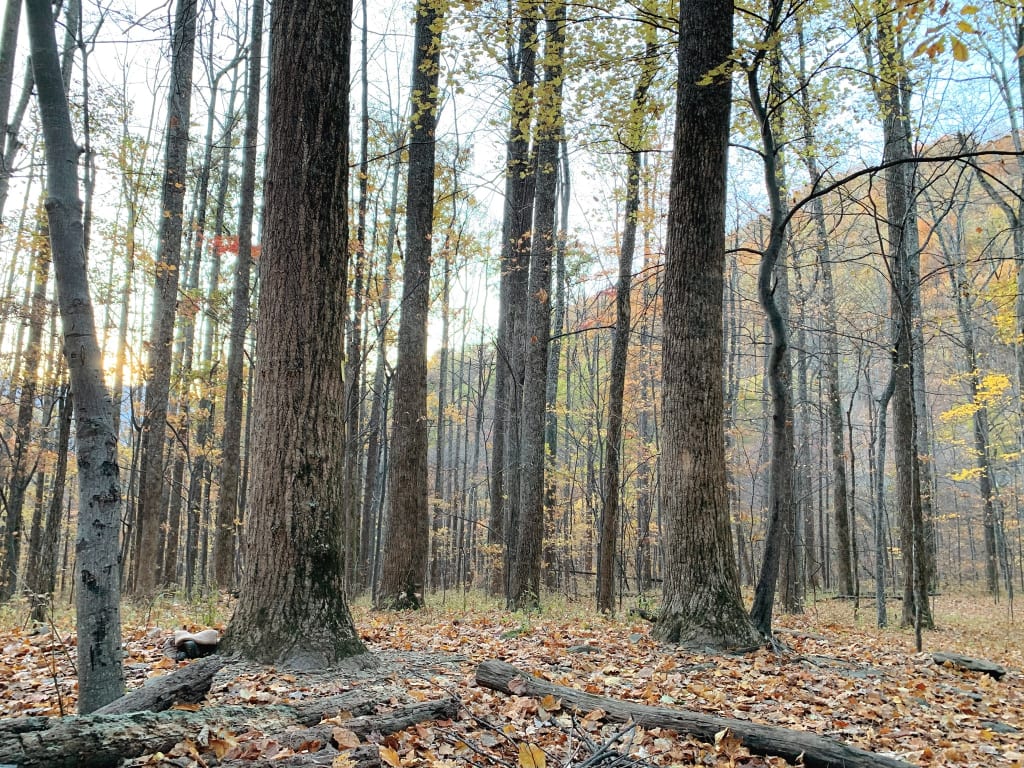
Two trees that had grown together in a tangled mess of branches, creating a spot between them just big enough for an adult woman to sit in like a chaise lounge.
The log where I saw my first snake-- a big, black garden snake I christened Cinderella. She was resting in the sun, and my presence neither surprised nor frightened her.
A huge bird’s nest stuck onto a branch, full of loud, hungry babies.
A sharp rock I crashed my sled into one snowy afternoon.
Trail after trail that we blazed together by hand. Along the trail, footsteps that could have been made yesterday.
X.
I followed the trail a mile to the noisy brook and the wide, flat stone that jutted out from the bank above it. Behind the rock stood a tree marked with my initials and a goofy-looking heart.
I pitched my tent nearby on a flat spot beside an old evergreen. I slid the cardboard box inside and nestled into my sleeping bag. Though it was early afternoon, I slept.
XI.
The next morning, by the light of a sliver of the sun, I started a fire and cooked up three hotdogs in my little cast iron pot. In the embers, I baked a tin-foil potato. I ate as the sky turned from navy to periwinkle to fuchsia to baby blue.
After, I shed my clothes and waded into the water. Under my feet, hundreds of shiny, rounded pebbles shifted to and fro.
I moved like a manatee down the creek, which was just deep enough to float in. Tiny fish nibbled at my fingers and toes. Cinderella was long gone, but one of her kind swam by me without a second glance.
I air-dried on the big flat stone, which I once used as a stage for my one-woman shows. Back then, I sang songs from the radio while making up dances to entertain my mother and myself on long afternoons spent by the water. Her enthusiasm for my performances never faltered.
I got back into my sleeping bag and fished inside the box for the little black book.
XII.
Things I found inside the journal:
Pages covered in reminders: “get eggs” “call chiropractor” “Amy- noon.”
Prayers that were written in slanted cursive.
A picture of a palm tree cut from a magazine.
A rough sketch of a flower garden she had dreamt up a few springs ago. I couldn’t remember what her garden looked like that year—did she ever get her sunflowers, her zinnias, her big swath of white gardenias?
A list of seeds.
On the next page, a picture of me as a baby, dressed up in a bright orange pumpkin costume and green tights.
Between the last page and the back cover, a single dark hair. My mom’s hair—so thick it was impossible to miss.
XIII.
That night, lamp strapped to my forehead, I re-opened the notebook. I took a deep whiff of the pages, but I could only smell the forest outside my tent. I kissed the book; I hugged it to my chest. I opened it again, holding each page up to the light just in case I had missed a thought she scribbled down and tucked away.
XIV.
Finally, a discovery: two pages stuck together. I gently pried them apart. On one side, she had pasted a recipe for an autumnal potato soup. On the other side, written in pencil: “20 steps north of Amelia’s tree.”
XV.
Was this note a set of directions to some kind of a landmark? These woods were full of our memories together. It was where I made fire for the first time. It was where we had once spotted a newborn baby deer laying in the grass and sat for hours, watching her. It was where I broke my ankle falling out of a tree. I had even dragged my middle school boyfriend into the woods for our first kiss, citing some vampire book as the reason. Really, I wanted to have all my firsts between these trees, under their canopy, the sound of creek in my ears.
I fell asleep.
XVI.
When I woke up, the sun was already high in the sky. I made thick, black coffee over the fire and oatmeal in an insulated mug.
While I ate, I sat on the big stone. All around me, birds chattered and sung. Inside my mind, my mother clapped along as I performed a boy-band classic, barefoot and clad in a pink, ruffled bikini.
XVII.
I retraced my steps to the only tree that bore my name. AMR + AMR, carved into a great oak. Underneath our initials, a severely lopsided heart.
I turned north and counted aloud.
XVIII.
“One. Two.”
This corner of the woods wasn’t particularly significant to me. It was densely populated by shrubs and contained very little space for shenanigans. I continued to count.
XIX.
“Seventeen. Eighteen. Nineteen.”
I looked up.
“Twenty.”
I took one last step. There was no colorful blaze sprayed onto a trunk or even a stick in the dirt. It was just another cluster of trees.
XX.
I sank to my knees, pressed my fingers into the damp earth and began to dig. I scooped handfuls of chunky mud until there was a small mountain of dirt beside me. I scraped my cuticles; red clay caked itself under my fingernails. I dug.
XXI.
I hit a root. My hands ached. I lay on my back and screamed. The sound of my voice echoed and then was gone. The silence enraged me. I cried myself to sleep on the forest floor, muddy hands on my face.
XXII.
I woke up startled. The sun was higher in the sky, the ground warm. I sat up and suddenly noticed a little copperhead snake a few feet away. She made her way over some leaves, in search of a rock or a beam of light. I began to dig a new hole.
XXIII.
My knuckles were bloodied when I touched something solid in the mud. I dug faster.
A box wrapped in a plastic bag was buried just a few inches down. Still, my mother must have used a shovel to dig a hole big enough for something of that size. I frantically clawed at the hard dirt until I dislodged the box. It was a shoebox, emblazoned with a recognizable orange logo. I gingerly lifted the lid.
XXIV.
I didn’t gasp when I saw it—I held my breath. Rows and rows of neat, green bills were packed tightly together. My heart beat like a timpani drum in my chest. My mother had been poor all her life. This land was the most valuable thing she owned.
I couldn’t help myself—I counted it. Twenty thousand dollars. The only trace of this money was a note, written haphazardly in a journal that might have been thrown in the trash.
I took the thick little stacks out and lined them up in front of me . Underneath the bills, at the bottom of the box, was a manila envelope.
XXV.
Inside the envelope was a colored-pencil sketch. A woman with long, dark hair sitting on a big flat rock. Leaned against her, a child in pink ruffles.
About the Creator
Keep reading
More stories from writers in Wander and other communities.
Worth the Wait: Puerto Viejo, Costa Rica
Beach bumming in a small Caribbean beach town sounded like a perfect way to end our 6-month trip through Mexico and Central America. Or so we thought. The foul, fishy stench of rotten seaweed hit our nostrils as we stepped from the cramped bus and looked out at a rather depressing, empty, and underwhelming black sand beach. It was pouring with rain, and we had to quickly fish out our ponchos. We thought, this couldn’t be it, could it?
By Sh*t Happens - Lost Girl Travel4 days ago in Wander



Comments
There are no comments for this story
Be the first to respond and start the conversation.