
Hungerford - I was just passing through
Research, gossip, coaching inn, Indian coffee and a fishing competition
They looked like a small army of men walking the length of the car park at the railway station. All were carrying fishing rods, pulling trolleys carrying steel boxes and wearing different types of camouflage jackets and trousers. It was their casual uniformity that made me think loosely of an “army”. They were in a loose formation but purposefully all heading in one direction to a destination so far unknown to me. Possibly they were all getting on a train?
Hungerford Library
Whenever I arrive in a town for the first time my starting point will be the local library, providing there still is one despite local government budget cuts, to do some research on local history in the reference section. This is my favored method of research as there are always local history books on the shelves that do not appear on the internet. And I still enjoy making my own notes by hand in my travel diary. Then, there are always the unintentionally overheard conversations. The only table available, next to the shelves of local history books, already had five ladies sitting at it but there was still room for one more, me. They had their knitting out and were clattering and chattering.
“Are you going back for lunch?”
“No dear, I can only afford one of those lunches a week. Fish and chips on Friday or the Sunday roast. It’s warm here and I am staying as long as I can……keep the heating off at home. It is just so expensive these days. My Arthur would have a fit if he could see my electric bill……never goes down.”
“How’s your daughter?”
“Not too bad………third grandchild on the way.”
“Is she married yet?”
“Did you see the ambulance this morning? Must have been about one.”
“I think it was Fred…….didn’t see him this morning.”
Their clattering and chattering continued while I wrote notes about how Hungerford's history and how it acquired its name.
What’s in a name?
While the clattering chattering ladies continued talking about families, the latest death, living costs and the weather I had discovered a few of the sources of the name ‘Hungerford’.
Before 1086 Hungerford as a place where people lived, had homes, farmed fields and animals did not exist. 1086 was the year the William the Conqueror prepared The Domesday Book as an inventory of what he had taken over in 1066 at the Battle of Hastings. It was one of the most extensive, thorough and robust records of a country’s assets. And ‘Hungerford’ was not listed. Nearby places such as Kintbury, Inkpen, and Froxfields all were listed but not Hungerford.
The three possible sources of the name are:
HYNGNAR – Hyngnar was a Danish chief who met his demise trying to cross the boggy morass at the confluence of what we now call the River Dun and River Kennett near to where the town is today.
HUNGERFORD – literally 'the ford at the place of hunger'. In this instance ‘hunger’ refers to land that is either infertile or too boggy to be farmed.
HONGRE, HUNGRE, or HUNGRA – referring to a hanging wood. Not a wooded area where executions took place but used to describe woodlands clinging to the sides of hills near watercourses. Nearby are the Savernake Forest and the Eddington Forest which before man’s interference on the landscape reached down to the banks of the Dun and Kennet Rivers.
Location, Location, Location
In the most general of geographical terms Hungerford is situated in central southern England within the county of Berkshire. Imagine Hungerford at the centre of a compass. That compass may not be a perfect circle but it will still consist of the four 'cardinal' points of north, south, east and west. At those cardinal points, respectively, are Oxford, Salisbury, London and Bath. On the north to south axis Hungerford is 27 miles from Oxford and 26 miles from Salisbury. On the east to west axis it lies, not quite halfway, at 57 to Bristol and 67 miles from London.
No wonder it became a favourite stopping point of horse drawn carriages and coaches plying their trade between those four locations. Somewhere, in the 16th, 17th and 18th centuries much like our modern day motorway service centers, where travelers could have a break from the rigors of the road and rest overnight. Only those coach passengers would stay in coaching inns rather than motels and hotels.
One such historical coaching inn in Hungerford is The Three Swans in the High Street.
The Three Swans

There has been an inn on this site since at least the 16th century. How it looks today from the outside dates to the 18th century. This is when it became a “popular resting place for generally wealthy clients”. Records show that the inn had enough stabling for forty horses and a barn that could hold twenty tonnes of hay at any one time so it must have been a large staging post.
Inside on the ground floor there is no evidence of the inn’s history. This has been stripped out or overwritten out by a modern well-lit lounge and dining room decorated in light and neutral colors. A far cry from the dark wood paneling and roaring open fires that would have welcomed travelers like me on cold, dull and wet December afternoons two or three hundred years ago.
There is a modern purpose-built extension but who in their right mind would want to stay there when, based on the room we stayed in the original building, there is so much character. The room overlooked the main street and could have been classified as a suite. In the picture above it was behind the two first-floor windows above the archway and bow fronted shop window. The ceiling was low. At my average height of five foot nine I could not stand up straight anywhere and even suffered from involuntary cranium contact a couple of times as I forgot where the only low beam was. The bathroom was not for those who suffer from any loss of balance. I could stand up straight anywhere in this room. The floor was tiled in black and white which added to its character. What added even more character was that the floor which fell away about six inches between diagonally opposite corners.
Coffee #1
A taste of India in the heart of the English countryside. Well, that was unexpected.
The barista behind the counter directed me towards the specials board and suggested I try the Malabar Monsoon coffee made from Arabica beans grown in India; a country I conventionally associate with tea. Habitually I drink my coffee with some milk and sugar but today I thought I will try my coffee without either and ordered the special of the day.
I found a table in a corner, sat there with my steaming mug and got engrossed in my current read which was ‘Shadow of The Silk Road’ by Colin Thubron. Alexander the Great had reached Balkh on the banks of the Oxus River in the north western region of Afghanistan and married Roxana in the third century before Christ. He was followed by Genghis Khan one thousand years later. Their achievements made my finding Hungerford with the satnav and enjoying a coffee in the warm pale into insignificance.
Thanks to Alexander and Genghis and the author’s words that linked their adventures and achievements, my coffee had become tepid. Without the heat of being freshly brewed, I got the aroma of the drink. It was of coffee but there was something else going on in the background. It was only when I tasted it and tried to savor it like a wine buff did I appreciate the flavour. A smoky nutty background of the fug from good cigars with some roasted chocolate and a kick of espresso. I don’t think I would ever have tasted and savored those flavors if I had tried to drink it piping hot let alone with milk and sugar.
The Fishing Competition
From Coffee #1 I walked along the towpath of the Kennet and Avon Canal. A towpath first walked on in 1799, when the canal was opened, by the hooves of heavy horses and the boot of their handlers as they pulled barges laden with the inputs and outputs of Britain’s industrial revolution. Now the canal towpath is trodden worn and muddied by leisure walkers and cyclists wearing the latest foot and outdoor gear shipped into the country from the Far East.
The water looked like a murky wide ribbon of dark green glass. It wasn’t the overhanging trees making everything dull and sluggish. There just wasn’t any direct sunlight. Don’t forget, this was a December day so there were no aphids, water boatmen or dragon flies skimming across the surface and making gentle circular ripples. No swallows and swifts chasing them on the wing. And no waterfowl either. Only a stillness creating the illusion of solidity.
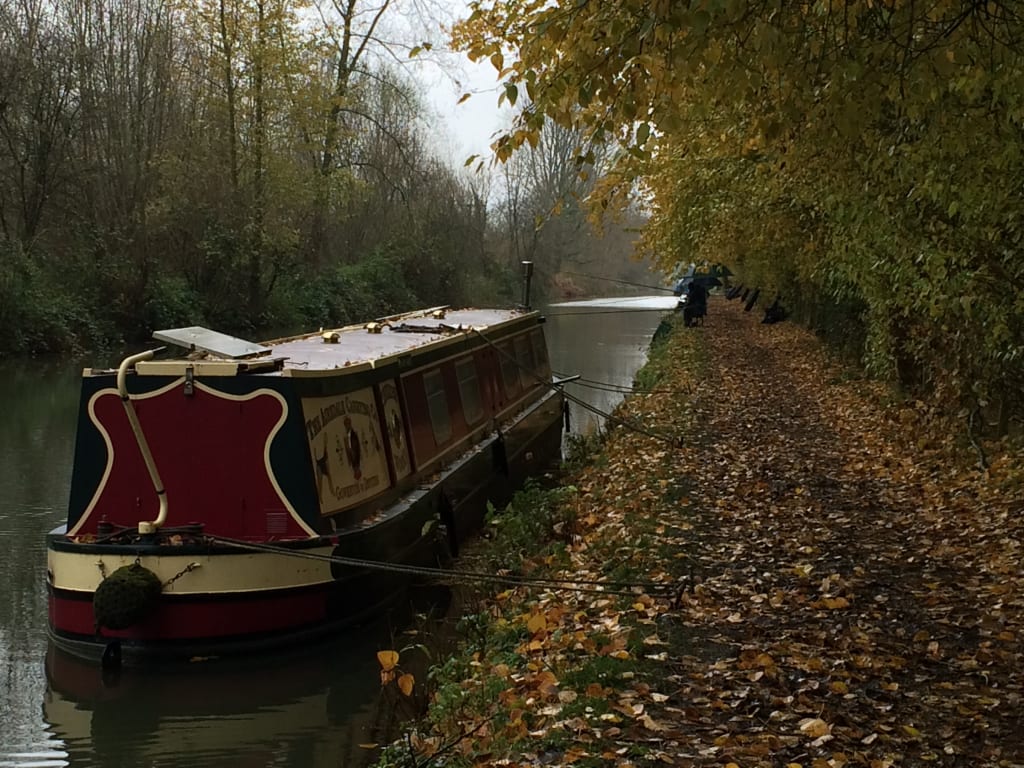
From a bridge I could see a canal barge moored and battened down for the winter. Beyond its forward bow was a silhouetted figure sitting on a box and dangling a rod over the water. Beyond him and beyond again were other similar figures. This is where the ‘army’ I had seen earlier had regrouped ready for combat with brown carp, bream or pike.
All of them were sitting in monastic stillness waiting for the ‘bite’ and their rods to shake excitedly. Or, perhaps none of them had put hooks on their lines and were only there on the pretense of having a good day out with a few mates.
The Picture
The header picture is one of several I took on my iPhone from near the bridge and the barge. I did not venture any closer to the "army" for fear of disturbing their monastic silence and stillness.
It is my favourite, hence its publication, from this trip to Hungerford. Despite the flat and dull light it is still possible to see the few remaining shades of autumn colors in the trees and amongst the fallen leaves in the foreground. And there is a pastel shaded hint of vibrant colors on the barge.
The original picture is not very different from the header picture. When taking land or seascape images I try my best to split the frame in the ratio of two thirds and one third. That is either one or two thirds of the view above or below the horizon line. With a small cropping tweak using Photoshop I have achieved this ratio as close as possible with my eyes rather than using a ruler. As for the composition; this was either entirely accidental or the result of a sub-conscious effort to create a pleasing image. The rear bow of the barge dominates the foreground and naturally draws the eye to it as a starting focal point. Then through curiosity the eye is drawn along the length of the barge and beyond to the first fisherman.
For me it captures the stillness and dullness of the day which is expressed in the flatness of the water and the men hunkered down for a day’s fishing. Much the same as nature herself is hunkers in readiness for the worst that winter can challenge her with.
For fun and out of interest, using Photoshop, I converted the header picture into black and white.

I much prefer the colour version.
About the Creator
Alan Russell
When you read my words they may not be perfect but I hope they:
1. Engage you
2. Entertain you
3. At least make you smile (Omar's Diaries) or
4. Think about this crazy world we live in and
5. Never accept anything at face value
Keep reading
More stories from Alan Russell and writers in Wander and other communities.
Durlston Castle to Anvil Point Lighthouse
As the crow flies, or given the location, as the seagull flies, the distance from Durlston Castle to Anvil Point Lighthouse is about 1000 metres. Without any foreknowledge the walker can see the lighthouse from the castle and, as in my case, set off in high expectation of a reasonable walk.
By Alan Russell6 years ago in Wander
A Fear for Travelers Escaping the Gulf: Are Flights Safe?
As tensions rise across the Persian Gulf region, thousands of travelers are increasingly asking a troubling question: are flights leaving the Gulf still safe? Airlines, aviation authorities, and governments have all moved to reassure passengers, but recent geopolitical developments have heightened anxieties among those attempting to leave the region or pass through its busy airspace. The Gulf has long been one of the most important aviation crossroads in the world. Major hubs such as Dubai International Airport, Hamad International Airport, and King Khalid International Airport connect Europe, Asia, and Africa through a dense network of international flights. Every day, hundreds of aircraft pass through regional airspace carrying business travelers, tourists, migrant workers, and cargo. However, the recent escalation of military tensions involving Iran and its regional rivals has raised concerns about aviation safety. Missile launches, drone activity, and military operations in nearby areas have made some passengers uneasy about flying through the region. Several governments have issued travel advisories urging airlines to review flight paths and exercise caution when operating near potential conflict zones. Despite these concerns, aviation experts stress that commercial aviation remains one of the most heavily monitored and regulated industries in the world. Airspace safety is continuously assessed by international bodies such as the International Civil Aviation Organization, as well as national aviation authorities that issue warnings and restrictions when necessary. In recent weeks, some airlines have slightly adjusted flight routes to avoid certain areas where military activity has increased. These adjustments can involve flying at different altitudes or diverting aircraft around particular air corridors. While such changes may add extra travel time, they are designed to maintain maximum safety for passengers and crew. Airlines based in the Gulf—including Emirates, Qatar Airways, and Etihad Airways—have emphasized that they are closely monitoring developments in coordination with aviation authorities. Company representatives say flight routes are reviewed constantly using real-time intelligence and airspace risk assessments. Aviation safety experts note that modern aircraft are equipped with sophisticated navigation systems that allow them to avoid restricted zones quickly. Additionally, pilots receive constant updates from air traffic controllers and global aviation monitoring networks. If conditions change during a flight, routes can be altered immediately. Still, the psychological impact of regional instability should not be underestimated. Travelers waiting at airports across the Gulf have described a sense of uncertainty, particularly those leaving areas closer to potential conflict zones. Social media images showing crowded departure halls and long lines at ticket counters reflect a growing urgency among some residents and visitors hoping to leave the region temporarily. For many passengers, the fear is rooted in memories of past aviation incidents linked to geopolitical conflict. Experts point to tragedies in previous decades where civilian aircraft were caught in dangerous airspace. These events led to stricter international regulations and more sophisticated monitoring systems designed to prevent similar situations. Governments across the region have also sought to reassure travelers. Officials stress that airports remain secure and that aviation authorities are working closely with international partners to maintain safe air routes. Security checks and surveillance at major airports have been increased, and contingency plans are in place should the situation worsen. Meanwhile, airlines continue to operate the majority of scheduled flights without interruption. Aviation analysts note that completely shutting down Gulf airspace would have enormous global economic consequences, given the region’s role as a central hub for long-distance travel and cargo transport. Ultimately, experts say the key factor is constant monitoring and rapid response to emerging risks. Aviation authorities around the world maintain detailed systems for assessing conflict zones, allowing airlines to adjust operations long before flights approach dangerous areas. For now, flights across the Gulf continue to operate under heightened awareness but with robust safety protocols in place. While regional tensions have understandably created anxiety among travelers, industry professionals insist that the global aviation system is designed precisely to manage such risks. For passengers boarding planes in the Gulf today, the journey may carry a heightened sense of uncertainty. Yet according to aviation experts and regulators, the safety measures protecting commercial flights remain among the most comprehensive of any form of transportation in the world. ✈️
By Fiaz Ahmed about 8 hours ago in Wander
Cairo: Everything I Wasn't Expecting and Everything It Gave Me Anyway
I landed in Cairo and someone immediately tried to take me somewhere. Not aggressively. Smoothly. The kind of smooth that makes you feel rude for saying no - like they're doing you a favor and you're the problem for not accepting it.
By Destiny S. Harris5 days ago in Wander
Two Grumpy Old Men Solve the Problem
Marty and Steve were two grumpy old men who lived together. They had known each other for years. Marty had been a bachelor all his life. Steve said it was because no one could stand to ever live with. Marty’s standard reply was “Well, you are, so what sort of a moron does that make you!”
By Calvin London4 days ago in Humor


Comments
There are no comments for this story
Be the first to respond and start the conversation.