
Cashless for 24 hours in Shenzhen China
Travel in the app era is...complicated

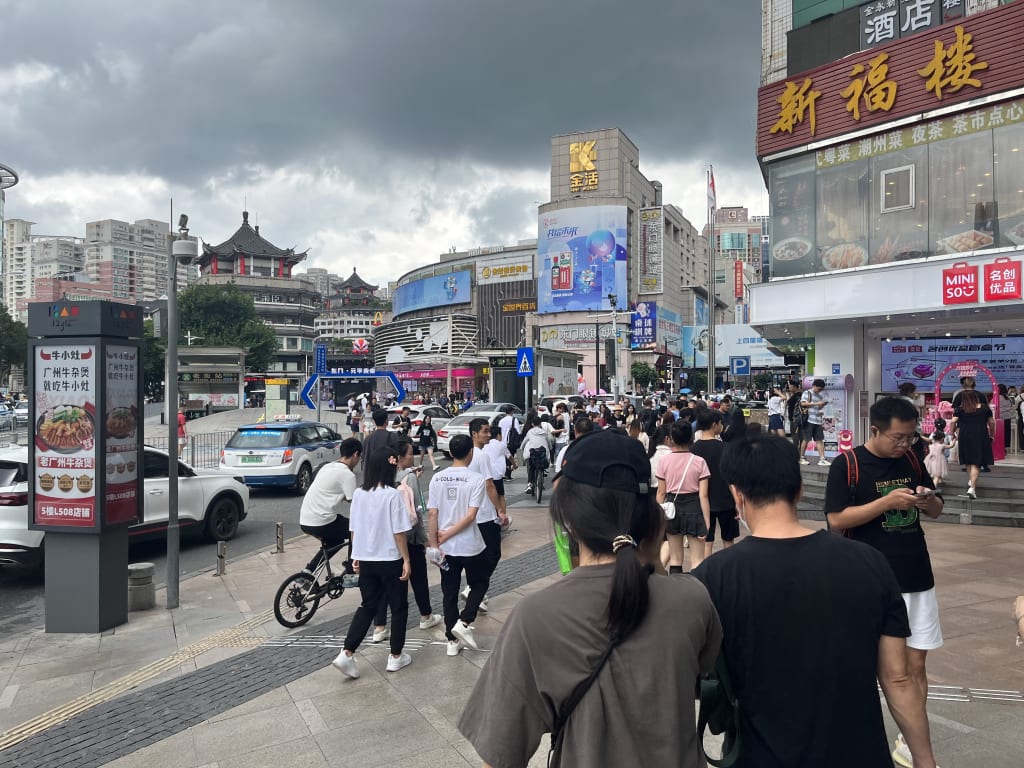
The perils of travel in China are not what you might expect: the ubiquitous police presence, the surveillance cameras on every street corner. No, for a tourist carrying their only passport and all their credit cards in a cheap backpack slung over a shoulder, a heavy security presence debatably works in their favor.
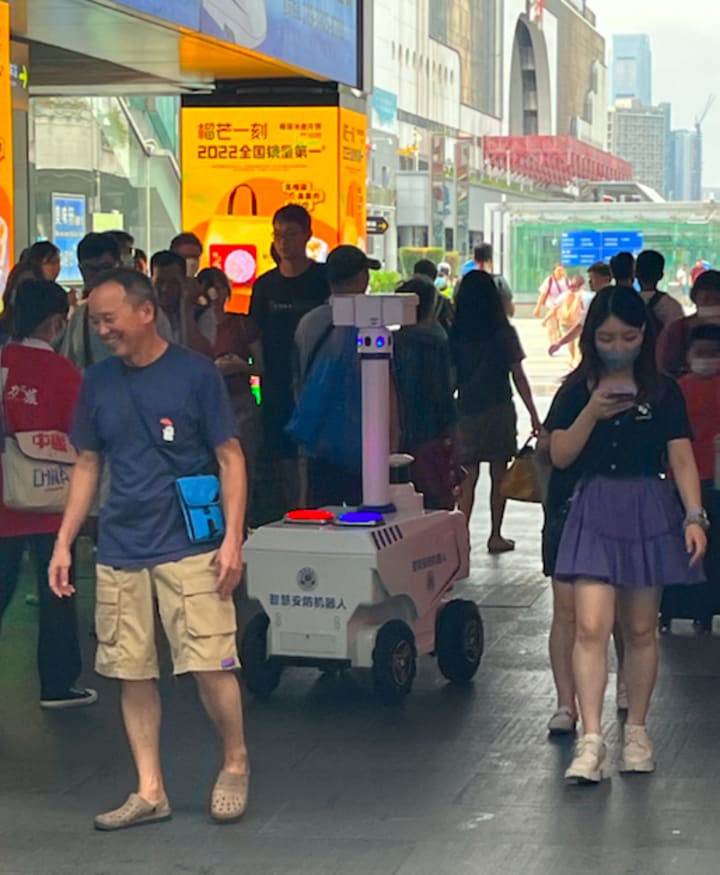
The real imminent danger for a tourist in China is QR codes. They are everywhere.
As I cross the land border into Shenzhen by train, I ponder on how Hong Kong, despite its political setbacks, remains an international city full of travelers and foreign business people. I see that for China these days, things appear very different. Out of the thousands of people lining up at the immigration checkpoint, I don’t spot a single other conspicuously foreign traveler.
I hand over my US passport and the immigration officer asks why I'm here. I mumble about plans to go shopping, eat spicy food, see the sights. “So, tourism?” he asks. “Yes, tourism,” I echo. I was worried he might think I'm some sort of American spy, but he appears to want to keep things simple and not hear a full travel blog.
He stamps my passport and lets me through. After weaving my way through touts peddling mobile phone cards outside, I cross an endlessly enormous pedestrian square. It’s 32C (90F) and I’m carrying a heavy backpack. I should go to a local coffee shop to settle in for a while, and get my bearings.
A trendy café on a side street looks promising, and I step in. I haven’t been to China for five years. Prices have gone up. A cappuccino is on the menu for 38 RMB ($5 USD).
I don’t want to embarrass myself leaving (and money is just a theory) so I pull out my mobile and open the Alipay app I’ve recently registered for. After the young barista at the cashier scans my phone, I see an error message. He shakes his head. They are both in agreement that I have not sent any money. I pull out cash. A 100 RMB note.
The young barista summons the manager, who needs to stop everything he is doing to come over and use a key to unlock the cash drawer. You see, China has gone cashless. I was probably the only one to ask to use cash at his store that day.
When I'm sitting down with my artisan handcrafted cappuccino, I open Google Maps to plot my way to my hotel. (My roaming data plan gets through the 'Great Firewall of China' and I can use all my usual apps.) Only 15-minute away, it's simpler to walk than to figure out the subway system. I return to Alipay, and go through checking the notifications, confirming my name, address, telephone number, identity document, credit card info... after I've laboriously entered and double checked everything, I decide to have another go. Preferably, an attempt to use the app with less downside for public embarrassment. I spot a small 7/11 across the street.
After I finish my coffee, I go over, step into the 7/11 and take a bottle of water to the cash register. It’s only 3RMB ($0.35). I look excitedly at the 7/11 cashier and point at my mobile. I smile as if I’m about to take a driver's license exam. She looks perplexed at my excitement, and points down toward the QR code scanner. I place my mobile in front of it and center the QR code. A second later, I feel the mobile vibrate briefly. My screen shows a 3 RMB deduction. Success! I walk out of the 7/11 feeling victorious.
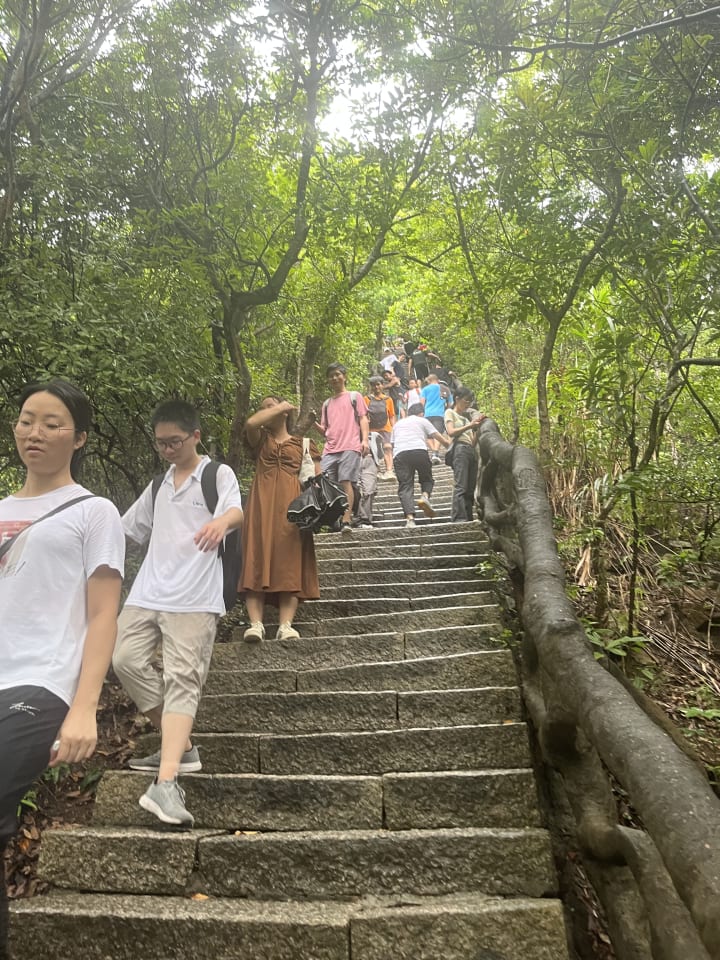
Feeling I’ve tackled a steep learning curve, I check in to the hotel and, feeling adventurous, take the subway five stops to Mt Wutong for a hike. The hike takes longer than planned, and I notice my mobile’s battery steadily dropping. Using roaming data is consuming far more power than usual. The phone feels warm. The next time I check, the battery level is down to 18%. If my mobile goes dead, I won’t have Alipay. I'll be living in virtual poverty. I switch it to airplane mode to conserve power and make a beeline back to the hotel to recharge. When I spot my hotel, I use the remaining 10% battery to buy a takeout dinner.
Exhausted, I sleep deeply and wake late the next day. I explore the nearby Dongmen shopping district, which among other things, has an amazing indoor go-kart track and game center. I take notes on places I will come back to visit again when I have more time. Dongmen is so crowded, and there are so many shops and restaurants, it's overwhelming. I’ve also walked for hours in vast crowds and have only spotted two other foreign tourists. Three years of Covid lockdowns and political tensions has profoundly changed travel in China.
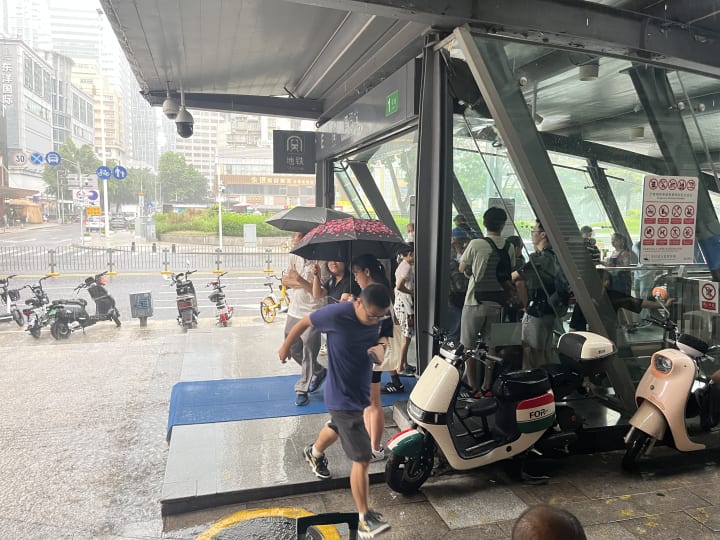
As I’m walking over an overpass, a sudden downpour hammers down. I rush to the far side to take shelter. Huddling with dozens of other people under an overhang, I check the time. It's 2pm. The heavy rain has given me an excuse to simply stop searching for the best possible food option in the entire city for lunch, and to just sit down and eat something. In the building I’m sheltering under, there are two noodle restaurants. Being allergic to shellfish, I choose the one that's less likely to use shrimp in every dish as they commonly do in Southern China. I go into the spicy beef noodle restaurant, point at their main dish on the menu at the cashier’s counter, and (yay!) successfully pay with Alipay.
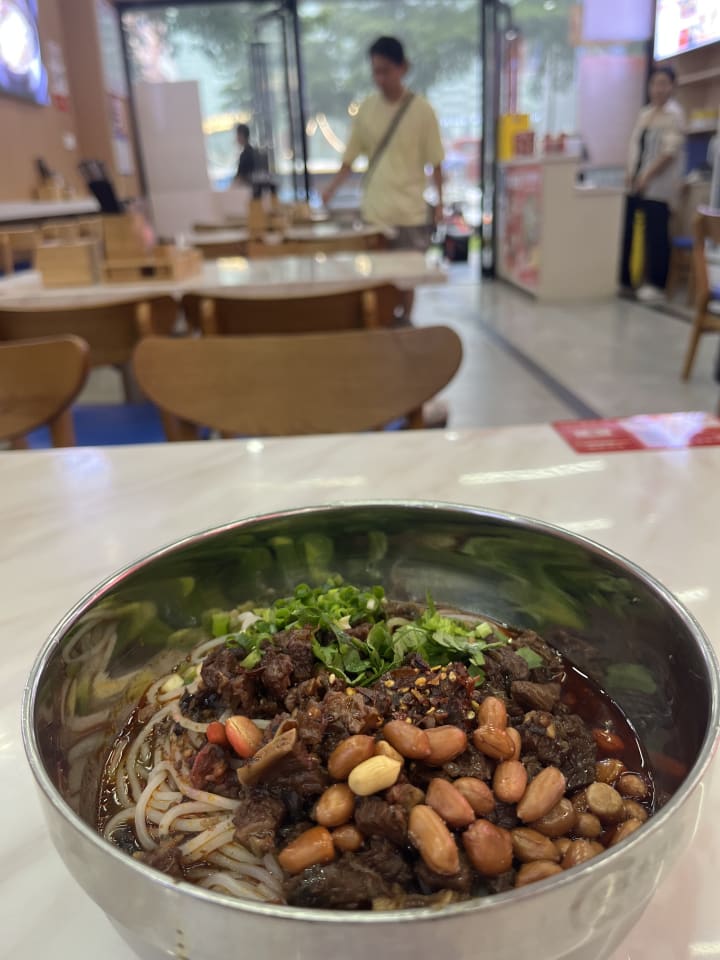
My shrimp-free beef noodles arrive. Being hungry, I dig in and push the savory beef, peanuts, and rice noodles in and relish the salty flavor. After a few big mouthfuls, the spicy noodles begin to burn my lips. I need water. I return to the cashier and ask her for “shui” (=water, one of the few Mandarin words I recall from previous travels). She points me toward a vending machine.
Inside are bottles of water, and on the outside Chinese instructions on how to get to them. I do my best impression of a clueless tourist that needs assistance.
The cashier keeps her distance. When she detects I’m not going to go away, she overcomes her reluctance to enter a strange customer’s personal space and steps closer, reaches over my shoulder, and points at which button to push on the Alipay app.
At the 7/11 they scanned my QR code. This machine works the other way, I scan its QR code.
I’m still confused what to do, so act like a dying man in need of water. She takes over my mobile, pushes all the buttons necessary to conduct the $0.50 transaction, then hands the mobile back to me. She smiles, signaling that her job is done, and that I’ll soon have a bottle of water.
My mobile vibrates. The screen fills with an error message.
She sees the red font and backs off to behind the counter. “Buyao.” Not possible.
“Buyao.” I say. It's not possible for her to explain to me what's wrong. It's probably not possible for me to figure out reverse QR code scanning this trip. I smile sheepishly and go back to sit down in front of my lunch. I might not have mastered using vending machines, but I think I have 7/11s and restaurants solved.
I add a big dash of Chinese black vinegar to my soup. The noodles turn out to be not that spicy after all, and in fact, I now think they are the most delicious thing I could possibly be eating on this rainy day in Shenzhen.
After lunch, I make my way to the familiarity of a close by Starbucks and order a sweet coffee drink to wash down the spicy noodles. I'll use my remaining time here to write down my observations before I begin the long subway journey back home to Hong Kong.
About the Creator
Scott Christenson🌴
Born and raised in Milwaukee WI, living in Hong Kong. Hoping to share some of my experiences w short story & non-fiction writing. Have a few shortlisted on Reedsy:
https://blog.reedsy.com/creative-writing-prompts/author/scott-christenson/
Reader insights
Outstanding
Excellent work. Looking forward to reading more!
Top insights
Easy to read and follow
Well-structured & engaging content
Expert insights and opinions
Arguments were carefully researched and presented
Eye opening
Niche topic & fresh perspectives
On-point and relevant
Writing reflected the title & theme
Keep reading
More stories from Scott Christenson🌴 and writers in Wander and other communities.
Worth the Wait: Puerto Viejo, Costa Rica
Beach bumming in a small Caribbean beach town sounded like a perfect way to end our 6-month trip through Mexico and Central America. Or so we thought. The foul, fishy stench of rotten seaweed hit our nostrils as we stepped from the cramped bus and looked out at a rather depressing, empty, and underwhelming black sand beach. It was pouring with rain, and we had to quickly fish out our ponchos. We thought, this couldn’t be it, could it?
By Sh*t Happens - Lost Girl Travel3 days ago in Wander




Comments (6)
This all sounds so challenging. I am way behind on adopting this. I've not been to Hong Kong since before the handover, it's interesting to hear there's still a check point in that way.
“money is just a theory” I want to applaud this!!! Yes!! Our fear of asking for and expecting more is the only reason we don’t have more!! It’s all in our mind 😉
its awesome
I cannot tell you how much I loved this! It's a cavalcade of China memories - the good and the bad, but when you've lived there a long time, all part of the experience! And that cover photo brought tears to my eyes. I know it's Shenzhen, but it really reminds me of Harbin! The funny thing is that at this time in my life, I'm in no position to venture my thoughts on how might it read to someone who's never been. But to someone who knows and loves China, it's the most beautifully nostalgic travelogue you can read. It's also one of my first glimpses into post-Covid China, for which I'm very grateful in the light of my present plans. We were always heading for a cashless China, so I can well imagine how much further along with that they are now after these three and a half years. You've also mentioned to me before that the absence of our lot these days has taken things back to how it was when we first went out there. Harbin was just the same even as late as 2009, when I taught students who'd never had a foreign teacher before. That Starbucks, by the way, ought to have had at least on barista on duty who could speak English, as that's their Mainland China policy! Totally loved this, Scott. "Shui," "Buyao," "Alipay..." how the magic words bring it all back!
Random thoughts on my trip this weekend. Sorry most of this is about a chinese payment app that probably isn't that relatable. Now that the country of has gone mostly cashless, it seems challenging for any foreign tourist to visit without having a lot of difficulty in the future.
"I'll be living in virtual poverty." - haha, that's quite an experience :-D