


A Merry-go-round has probably been part of many children's summer activities. As kids, my cousins, friends and I would make plans to go to the local fair.
We knew the Merry-go-round would be the place we all ended up going on, depending on whose parents were taking us. My parents would supervise the Merry-Go-Round turn with hawk like attention. We were a boisterous bunch.
Every time I see a carousel these days, happy summer memories immediately come to mind, like I did when I went down to the South Bank. It's a bright yellow and gold colour and hard to miss.
Origins
The carousel's roots trace to medieval times, inspired by a Byzantine game and later an Arabian exercise called "carosellos" or "little wars." Knights on horseback would toss clay balls filled with perfume to each other, a training activity observed by European soldiers.
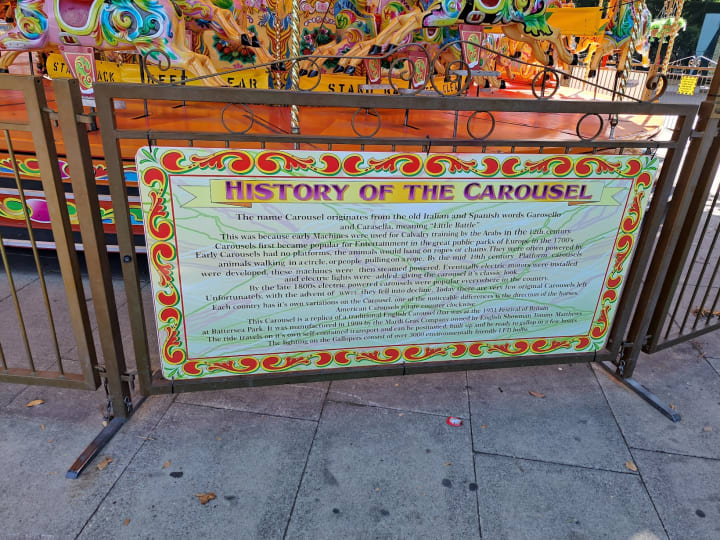
By the 17th century, this evolved into ceremonial displays in Europe, particularly in France, where riders speared rings while riding in circles.
Early Mechanical Carousels (17th–18th Century)
The modern carousel emerged in Europe as a mechanised version of these displays. Early carousels were powered by humans or animals turning a crank or walking in circles. Riders sat on wooden horses suspended from a rotating frame. By the late 1600s, French engineers developed carousels with seats resembling horses or chariots, used for both entertainment and royal pageantry.

Industrial Revolution (19th Century)
Steam power revolutionised carousels, enabling larger, faster rides. In the 1860s–1890s, carousels became a staple of fairs and amusement parks in Europe and America. Craftsmen in the U.S., particularly in Philadelphia (e.g., Gustav Dentzel) and Brooklyn (e.g., Charles Looff), began producing elaborately carved wooden animals, creating the "Golden Age" of carousels (1870–1930).
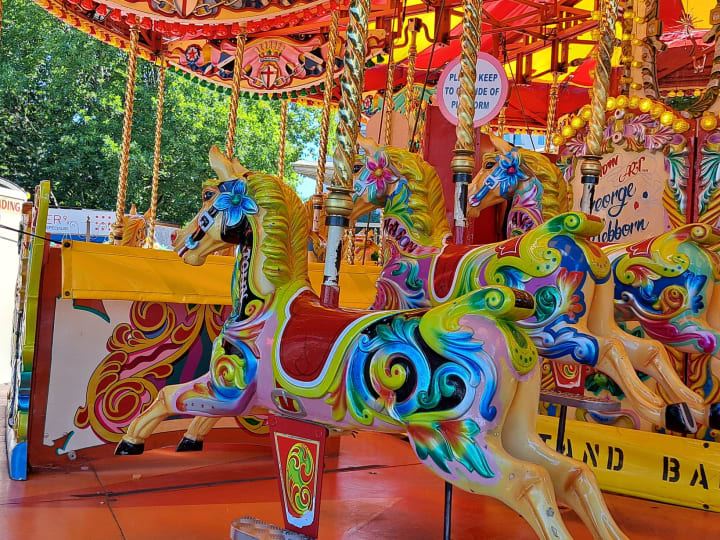
Styles varied:
- Philadelphia Style: Realistic, elegant carvings with lifelike animals.
- Coney Island Style: Flashy, ornate designs with jewel-encrusted saddles.
- Country Fair Style - Simpler, portable carousels for traveling carnivals.
- Music and Design: Carousels often featured band organs playing lively tunes, adding to the festive atmosphere. Mirrors, lights, and painted scenes enhanced their visual appeal. The term "merry-go-round" became common in the U.S., while "carousel" (from French *carrousel*) remained standard in Europe.
Decline and Revival (20th Century)
The Great Depression and World War II reduced carousel production, and many were dismantled or neglected. By the mid-20th century, aluminum and fiberglass replaced wood for durability, but these lacked the charm of hand-carved designs. Since the 1970s, preservation efforts and renewed interest in nostalgia have led to the restoration of historic carousels, with groups like the National Carousel Association documenting and protecting them.

Notable Carousels
Dingwall’s Steam Galloper (1860s, Carters Steam Fair): A restored 1880s Savage galloper, still touring with Carters Steam Fair, showcasing classic British fairground art and steam-era engineering.
Gavioli Organ Carousel (Margate, Dreamland): A 1920s carousel at Dreamland amusement park, restored with its original Gavioli organ, a highlight of the UK’s seaside heritage.
Golden Gallopers (Blackpool Pleasure Beach): A 1909 carousel, one of the oldest at this iconic resort, featuring hand-carved horses and traditional organ music.
World’s End Galloper (Chelsea, London): A restored 1911 ride, occasionally displayed at festivals, known for its intricate carvings.
Modern Carousels
Today, carousels range from traditional wooden restorations to modern versions with diverse themes. The rides rotate counterclockwise, unlike many American carousels. Decorative elements include painted fairground art, gilded details, and bright lights.

Parting Comments
Merry-Go-Rounds remind so many people of happy childhood mememories. I couldn't help myself by taking pictures of the Merry-Go-Round down by the South Bank. It's nice to see that some childhood amusement rides stand the test of time.
If you enjoyed reading this article and want to support my work, you can now buy me a coffee ☕️.
https://www.buymeacoffee.com/TabbyLondon
Thank you for your attention.
Best wishes
Tabby

About the Creator
Tabby London
The London I've been discovering is usually off the well-beaten track.I love the nooks and crannies and walking along the streets steeped in centuries worth of history. I'm fond of Zone 1 because that's where it all began centuries ago.
Keep reading
More stories from Tabby London and writers in Wander and other communities.
Off-The-Beaten-Track
I've been keen to show you a different side to London from the beginning when I created Tabby London. I hope I've doing just that. I'm also a big fan of going-off-the-beaten-track too. Even as a Londoner, I have yet to complete 50% of this list 🤣
By Tabby London8 months ago in Wander
Worth the Wait: Puerto Viejo, Costa Rica
Beach bumming in a small Caribbean beach town sounded like a perfect way to end our 6-month trip through Mexico and Central America. Or so we thought. The foul, fishy stench of rotten seaweed hit our nostrils as we stepped from the cramped bus and looked out at a rather depressing, empty, and underwhelming black sand beach. It was pouring with rain, and we had to quickly fish out our ponchos. We thought, this couldn’t be it, could it?
By Sh*t Happens - Lost Girl Travel5 days ago in Wander



Comments
There are no comments for this story
Be the first to respond and start the conversation.