
A Very Complicated Soup
Finding Home in Food Abroad

When a plant has an insufficient root system to support its desired growth, horticulturalists will often graft it to another, fusing its roots with those of a hardier specimen, allowing the initial plant to grow to its fullest and most pronounced potential. Sometimes, a phenomenon occurs known as a graft chimera, when some tissue from the root plant takes hold in the other, traveling up and expressing itself in new fusions of color and fruit. I believe this is nature’s way of showing, in vivid relief, that what you pick up along the way becomes part of who you are.
I am named after a mythic giant, Fionn Mac Cumhaill (said McCool). My driver’s license lists me at a lofty 5’8’’ which is, itself, a myth of an inch. I stand 5’7’’ above the flat prairie of my native Minnesota, known for another folkloric tallboy, Paul Bunyan. In the land of the lumberjacks, I am on the shorter end. In Ireland, the land of my ancestors, I assumed I would stand tall and proud, if not literally then figuratively, the ancient air filling my lungs with a sense of long overdue homecoming. I imagined my return might feel almost...mythic.
“Happens all the time,” the doctor assured me in his warm Irish brogue. “People don’t even realize they have allergies until they come to Ireland. We’re like a great floating mold spore in the middle of the Atlantic.” He said it cheerfully, as if it were a point of pride.
“Huh,” I said, or moaned more like, my sinuses feeling like someone had shoved a potato or two up there while I was asleep.
“You’ve got an Irish name, I see,” he said smiling, his nostrils flaring freely in the wind.
“Uh-huh.”
“More Irish than mine,” he joked. His name was Knut. It was a bit funny. His name was out of place here, and alongside his accent, but would have been quite at home in Minnesota, tucked in snugly among the Karls and Bjorns. I shared a name with one of Ireland’s totemic heroes, a name from which one of its folksy ethnonyms, Fianna, is derived.
“Yuh,” I agreed.
“What a way to spend Christmas,” he bemoaned.
“Yuh.”
In that moment, I did not care for Christmas, for names or accents, for cultural curiosities or charming banter. Ireland, birthplace of my progenitors, had declared me and my overactive immune system persona non grata.
I wished only for soup and Sudafed. But not just any soup.
This is a story about food and about travel, but not in the usual way. The discovery of new food while out and about in the world is a curious interplay between comfort and exposure. New flavors, new recipes, enter our nostrils and our imaginations in the same way new Sci-Fi worlds might. They excite and stimulate. We absorb them, roll them over on our tongues, bring them home with us, into our lives and our cupboards. We imagine ourselves in new costumes, with new aromas emanating from our cozy dwellings (hopefully in a culturally respectful way, mind you). We buy the spices and the pots to make our rich new discoveries and before we know it, we’re fashioning new shelves and racks to better accommodate their place in our life. They become indelible elements of our nourishment, items around which we build the daily ritual of our food-making.
But this is a different story of discovery. It takes place in Ireland, but only because I happened to be there when I realized what this particular food meant to me. It’s not an Irish dish, nor does it come from any exciting voyages abroad. And yet, it satisfied what I was searching for when I went to Ireland, and it taught me a surprising lesson about home and searching. About finding what you need, rather than what you’re looking for.
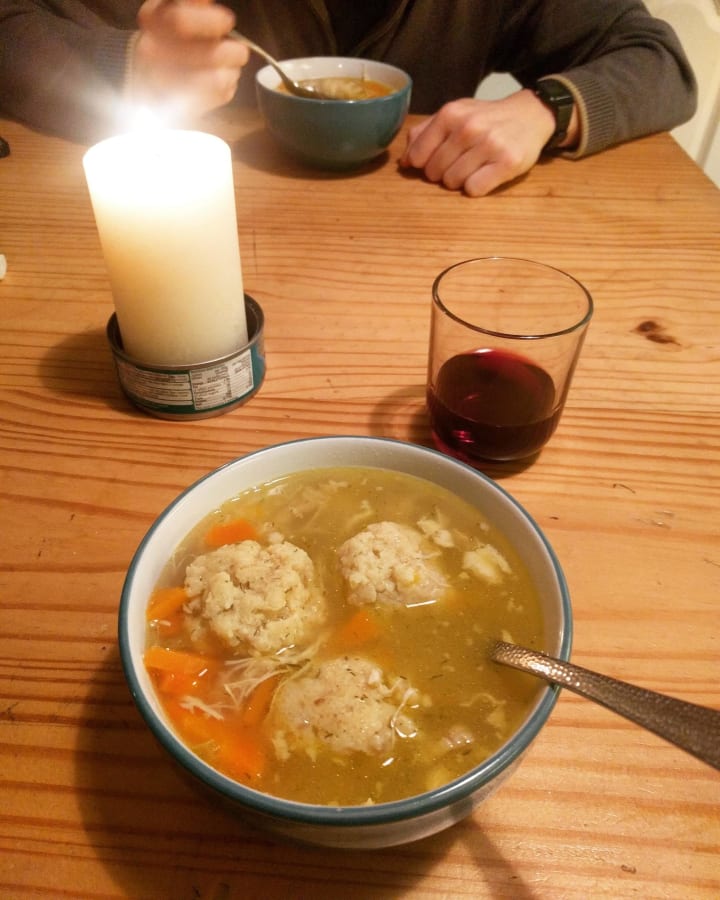
The dish: matzo ball soup, with a rich chicken broth and matzo balls that slice cleanly with a spoon.
Now, matzo ball soup is undeniably delicious, and undeniably un-Irish. Though it hails from the Jewish lands of Europe, it has become a dish of cultural significance internationally. As a variation of the American concept of "Chicken Noodle Soup”, it is both a dish you can serve with a ladle and a metaphor for the soothing of a struggle, and for the comforts of home.
Eaten primarily at Passover, it is the apex food of solace. Nothing heals quite like it. No rain or chill stands a chance against it. Chicken noodle soup for the lost and the dispossessed.
It is also a travel food, perhaps almost singularly so. A uniquely Ashkenazic recipe, it disappeared from its homeland, along with most of the Central and Eastern European Jews in the wake of the Holocaust. It traveled permanently, in the hearts and pots of Jews, now being eaten almost exclusively outside of Europe, among diasporic communities.
I am not Jewish. I am not 5’8’’. Not quite. Knut is not an Irish name, nor is he particularly important to this story. He was, however, a good doctor and to tell this story right, I have to explain how I found myself sitting in his one-room practice in a little brick house in Windy Arbour, Dublin, feeling as though I had an Aran fisherman’s sweater halfway up my nasal cavity.
The first part of the story starts four months earlier, in September, 2017.
I embarked on an open-ended trip to Europe with my partner, Amelia. We had just graduated University and decided that it was in our best interest to rack up a bit more debt before we entered the ‘paying it back’ phase. It started with my archaeological field school in the Greek Cycladic Islands. Picturesque rocky coastlines, white-washed huts and sapphire water; one of the world’s premier vacation destinations. I learned quickly, however, and painfully, that an archaeological excavation is no vacation. Waking before dawn, digging twelve hours in the hot sun and unending wind, and drinking into the wee hours of the morning clouded my vision and wearied my bones. Somewhere beyond the fog of my perpetual hangover and fatigue loomed paradise. Sometimes I caught glimpses of it.
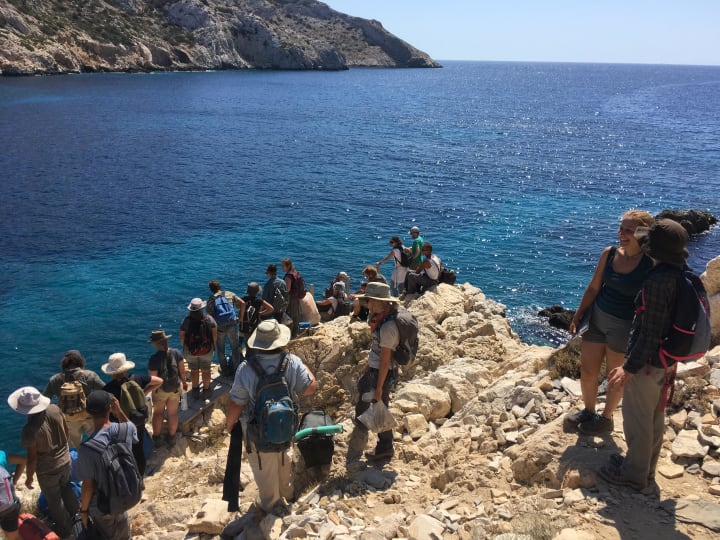
At night we dined in seaside Tavernas - 80 or so raucous, delirious archaeologists leaving dusty imprints wherever we sat. We ate fish and orzo by the kilo, and drank oceans of wine. And yet, all I could think about was that back home, apple season was getting underway, and soon the farmers' markets would be overflowing with perfect red and green apples, their soft white flesh crisp and brimming with tart sweetness. I must have told them all a thousand times that the best apples were not in Greece, as the Greeks foolishly believed, nor in England as thought the presumptuous Brits, but the best apples in the world were, definitively, in the orchards of Minnesota - home of the illustrious Honeycrisp, god of apples, and its fellow Olympians: the Zestar, State Fair, First Kiss, Sweet Tango, to name but a few.
Such was my curious lot: I ate figs on white-pebble beaches, my toes cooled by the wine-dark water, dreaming all the while of Midwestern apples.
After Greece, we spent a month in Puglia, working the olive harvest in exchange for room and pasta. Again, it was long hours and breathtaking scenery. Again, we drank our fill of cheap, local wine. One curiosity: I don’t remember being as cold in my entire life as I was in southern Italy. I come from the land of frost bite and polar vortexes, of dog sledding and ice fishing and yet, every night in that stone house the temperature would drop and the humid air would turn frigid. I remember lying awake at night and shivering.
In Florence we suffered our first pangs of homesickness. And so, amidst the best trattorias in the land, we prowled the old streets in search of a bowl of ramen - a comfort we had both developed while working in Japanese restaurants. We stumbled upon an adorable spot, an Italian cafe by day and a Japanese noodlery by night. To this day I’m not sure I’ve found a more charming noodle joint, or a more winning combo on offer. We assuaged our guilt by telling ourselves that ramen was still - sort of - pasta.
By the time Christmas came, we had made our way northwest and been in Ireland for a month.. The countryside was a dream; the allergies, a nightmare. We stayed in a little flat in Dublin over the holidays, dog-sitting for a nice couple we met online who happened to be - funny enough - archaeologists themselves, sneaking off to a sunny dig-site, while we inherited their cozy little flat and eccentric English Pointer, Moss, for a few cold and rainy weeks in December.
The neighborhood was cute. The dog was a handful, but charming. The fireplace was a welcome perk that brought us back to life after wet, chilly walks. It was cozy and sweet, but we were far from home and friends and it was the holiday season. We missed the conviviality of holidays at home. Dublin was like an ongoing Christmas Disney Land in many ways - the lights, the singing, the general warmth and cheer. But at the end of the day we would go home to a quiet house and the celebration would end a bit too soon. Despite our burning lump after lump of roasty peat in the fireplace, the chill was creeping through the walls slowly and settling over us. Hanukkah, that year, fell just before Christmas and, as the festival of lights was brightening up around the globe, we were sinking down, down into a dark and gloomy holiday rut.
On top of it, I was shoving saltwater up my nose like a fracking mine and talking like Daffy Duck. The congestion eventually got so bad that I had to go and meet Knut, who reminded me of two things. First, that I was in fact, Irish - by at least one interpretation. And second, that it was a downright shame that such a thing had to happen during Christmas of all times.
“I don’t thelebrate Chrithmuth,” I informed him. “I thelebrate Hangunguh.” It wasn’t so much a lie, as it was my way of giving a dejected ‘feck off’ to the oppressively cheery Christmas spirit that covered every inch of the city. While I have never celebrated Hangunguh, and I recommend checking with your doctor before you try it for yourself, I have celebrated Hanukkah regularly for the last fifteen or so years, as well as other holidays that mark the annum of cultural, if not religious, Judaism. This, I realized, was the first year that I hadn't.
And so, feeling lonely and misbegotten, allergic to my ancestral soil, and yearning for roots that felt more true to my own life and identity, roots that had been grafted on to me long ago, I found myself in the neighborhood Supervalu.
To my surprise and delight, in the hodgepodge aisle formerly known as ‘ethnic’, I stumbled across an old, but unexpired, box of Manischewitz matzo meal. And, like a true not-quite-Jew, I decided to make a steaming pot of matzo ball soup for the last night of Hanukkah. For those who don’t know, matzo is a Passover food, whereas Latkes are the iconic Hanukkah nosh, however, for those of us in chillier climes, matzo ball soup seems self-explanatory as a fare for the winter holiday.
We boiled the chicken, and after letting the resurfaced carcass cool, we downed a few pints of Guinness and rooted around in the bird, separating the bones from the meat, and chucking everything that wasn’t edible back into the pot to finish the stock. We cooked it all afternoon, gradually adding carrots, celery, onion, parsley and bay. To make the dumplings, we mixed matzo, oil, egg, herbs and broth and cooked them until they were firm enough to hold their shape, but soft enough to carve with a spoon.
By the time the sun set we had rich bowls of steaming loveliness, a good buzz from the stout, and wider smiles than we’d had in days. To round out the night, we lit a candle, sang a prayer, broke up a Hershey’s bar for gelt, and watched Star Trek by the light of the peat-burning fireplace.
And now the question presents itself: how did this soup, this iconic shtetl-serum, become the go-to comfort-food of a Midwestern gentile?
The answer to that, again, is travel. But of a distinctly different variety. More economic nomadism, actually. It is the story of my childhood, of displacement, of movement, and of the discovery of home.
My upbringing was marked, more than anything, by movement. It started when I was six months old. Fearing a collapsing home life and a partner who was slipping into alcoholism, my mother fled Minneapolis on a dark December night. We took refuge in a women’s shelter in Madison, WI and cobbled together a life in the vibrant, little college-town, hopping from place to place, shelter to apartment to commune. By day, my mother worked in retail and restaurants, and by night, somehow, brought up a singularly difficult child single-handedly.
When I was seven, we briefly returned to Minneapolis. My father had his feet under him and for a while, it seemed like we were picking up where we left off. Then, once more, it crumbled. I can’t say why, as these reasons aren’t usually discussed openly with a seven year old. I remember a new owner moving into the bottom of our duplex - or what I thought of as ‘our duplex’. He let me play games on his computer, but he demanded twice what my mother had been paying in rent and so, there was a yard sale and a moving truck. Things I remember not wanting to give up were taken home by eager hands in exchange for rumpled bills that my mom stuffed protectively into her jean shorts.
This time we moved to Milwaukee, to live with my grandparents. My grandmother listened to Rush Limbaugh on an old, flour-coated radio in the kitchen, while she kneaded bread hour after hour. I remember her making more bread than anyone could eat. Her arms were thick and powerful. At night she watched football and said the rosary. She sewed her own clothes and thought the world was changing too much, or too little, depending on the subject. My grandfather had an office with its own doorway. He was a phantom. Each night he would make a brief appearance and have a glass of red wine. He died of a heart attack in our second year there.
Eventually, we came back to Minnesota and finally found home when I was thirteen. By then, I’d lived in as many, or more, houses, apartments, rooms and YWCAs. I attended four different middle schools over the span of two years. I’d been the new kid so many times that I stopped trying to be anything else. Movement was now in my genes.
When we arrived in Minnesota again, I was starved. Starved for home, starved for stability, starved for roots that had withered after so many transplantings. My mother and I were close, or as close as a teenager and a single mother can be in real life. Rory and Lorelai Gilmore may have had us beat, but we had no blue-blooded revenue streams to wash away our hardships. My relationship with my father had patched itself up into a meaningful, albeit permanently long-distance affair. For the first time in my life, we owned our home.
A four-hundred square foot, one bedroom unit in an old colonial mansion retrofitted into an eight unit cohousing community, complete with a row of adjoining town-homes and an acre and some change of woods between it and the yeshiva down the block. The community, dubbed MoCoCo, was born in 1992 - the same year I was - by a collection of environmentally-friendly introverts who wanted a peaceful patch of land, with one foot in the city and one foot out, where they could garden, meditate, folk dance, and make dinner together twice a week.

Historically, somewhere around a third to a half of the residents have been Jews, primarily adherents of the canoe and velcro-sandal reform movement - a starkly more liberal bent than the makeup of the rest of the neighborhood. I soon learned, after inquiring as to the significant numbers of suit and top-hat wearing men out and about on-foot, that our new home was in right in the center of the Minnesota eruv - a neighborhood zone marked with wire to inoculate orthodox communities from incurring supernatural ire for Sabbath slip-ups, a protectorate of sorts - a scriptural safe-zone. Within the eruv, a one-mile radius around my mom’s apartment, there are four synagogues, two yeshivas, two mikvahs and two kosher delis - were I found one of my first jobs.
It was within this safe-zone, that I began to settle down and to rebuild. I was the new kid again, alas, but people were nice here, and, over all, I was able to go through the motions of a ‘normal’ teenage life. I went to high school, played sports, worked a part-time job, stayed out too late and sometimes showed up for dinner with my eyes looking a little too medium-rare for my mother’s peace of mind.
And when I say ‘showed up for dinner’, that’s a very important element. One of the things missed most in an upbringing such as mine was a reliable dinner-time. Or reliable dinner fare for that matter. My mom fed me well - I have no gripes there. But we were rolling stones without table-cloths or recipe books. We ate healthfully and opportunistically, but without tradition or the experience of a long-prepared meal. We were either too busy, too poor, or too divorced from our culture for that. And so, when one of the families in our community invited us, without reservation or awkwardness, to become honorary members of their household, it changed everything about the way I related to food and to meals.
It just so happened that they had a kid my age, too, named Ari, and it was to Ari’s house that I would go as often as I could. In Ari’s house, I found a new family - and I stress here that new means only a beautiful addition, and implies nothing in the direction of replacement. In Ari's house, my eyes were opened to the idea that dinner can start at noon and end at midnight. That it can begin, not with turning on the stove or opening the fridge, but with an idea, a memory, even. That what can continue from there is a group expedition through tattered cookbooks, basement pantries, or a piling into the station-wagon to raid the grocery store en masse (the joyful chaos of pre-covid shopping).
I made up for lost time, relishing in all aspects of ‘the meal’. I learned how to select vegetables, then to cut and cook them. I learned about ingredients and herbs that had never found their way into my life before. And, for the first time, I was exposed to the concept of a dish: something that had requirements all its own, like a magic spell, that transcended the reality of what happened to be in the fridge at that moment. I remember being struck by the idea that a dish could be handed down in entirety, unchanging, revered. That it could mark the passing of the seasons, sometimes the passing of people, that it could be relied upon to call back bittersweet memories. In sum, that it was a thing unto itself, a sturdy thing that, as long as you sought it out with respect and devotion, could be called upon whenever you needed it. A dish had a life and a life force all its own.
And the dish that sat at the altar of comfort and reliability, the dish that was nearly impossible to corrupt and could always be counted on to vanquish whatever enemy was at the gate, the dish that was the antithesis of all things cold and lonely and despairing was, of course, matzo ball soup - the dish that Ari’s grandparents had brought over from Poland just before the war.
One of the joys of traveling, for me, is the glimpses I get into all the lives I’m not living. Perhaps it is the nomad in me, or perhaps it is the anthropologist, but I love to suspend my sense of self, and imagine what my life might be if I were surrounded by the sights and scents and sounds and tastes of wherever I happen to be.
It’s an exciting and insightful way to be in the world, but it’s a dangerous one, too. As writers know too well, the more we suspend ourselves and dive into the worlds of our imaginations and our characters, the more we cultivate a sense of belonging only in the worlds that we create. They become our only safe-zones, and we run the risk of forgetting to nourish our real bodies and our real relationships. Traveling can elicit a similar sense of absorption and loss.
I feel lucky to say that we have only grown closer over the years and that I now think of Ari’s family as my own family, too. The lessons they taught me were vital, especially at the time of their coming. I was resilient and self-reliant, but had little sense of home or community. This rounding out of myself and my kin often becomes all the more apparent in moments when my individuality leads me past the sparkling shores and into the dense, dark forests. That is to say, when I am lonely and wandering. That is to say, when I am in Ireland during Christmas, in a gloomy neighborhood, an ocean away from my family, with a quart of Vick’s VapoRub smeared over my chest.
I cherish all the elements that wove together to make me the person I am. Like so many of us, I am a product of grafting, perhaps even a bit of a chimera. After all, roots are deep and messy, and there’s no telling that what’s above ground dictates what’s below. I’ve learned that roots are far more about recipes than they are about pedigrees, and that names can be misleading.
It was the fortitude of my mother that made me someone with the pluck to head out into the world with a backpack and the knowledge that some way, no matter how hard it may be, I would make it work. It was the vulnerability of my father that taught me that loneliness is a lesson, but not an ideal. And it was Ari’s family that taught me how to overcome that loneliness, how to connect myself back to something older and enduring, that I have the ability to conjure up the taste of home, on those dark and lonesome nights. It is something I carry within me. Wherever I go, I belong somewhere and therefore, I can belong anywhere.
So now, when I’m out and about in the world, my fear is tempered. I can stand up a bit straighter, perhaps even hit 5’8’’. I can travel farther, meet more people, see more, taste more, because when I need home, as every traveler at some point does, home is waiting for me, not in the Emerald Isle, I now know, but in the aisle formerly known as ‘ethnic’.
About the Creator
Keep reading
More stories from Fionn Mallon and writers in Wander and other communities.
Toward Ardara
I told Fionn we were headed somewhere safe. He just nodded, eyes full of sleep. It never ceases to amaze me how much my son trusts my every word. Not only that I would take him somewhere safe - of course I would. But he trusted without so much as his usual ‘why?’.
By Fionn Mallon5 years ago in Fiction
What I Learned Is Considered Disrespectful in Morocco by Morocco Family Vacation
Before visiting Morocco with my family, I read countless articles about customs, etiquette, and cultural differences. Still, I worried I’d make a mistake especially traveling as a mom with children who ask questions loudly, touch everything, and don’t always understand unspoken rules.
By Ariel Cohen2 days ago in Wander
What a Truly Comfortable Travel Experience Feels Like — Beyond Hotels and Flights
When people talk about comfortable travel, the conversation usually revolves around hotels, flight classes, or airport lounges. While these details matter, comfort in travel often comes from something less visible: how smoothly everything fits together.
By Jeffrey Mathew7 days ago in Wander
How to Succeed at the Benson Directory®
Congratulations and welcome to the Benson Directory® employee #22391! As our newest call handler, you will have the privilege of speaking with dozens of unique and interesting people on a daily basis as well as the opportunity to earn bonuses for high performance. Contained within this handbook you will find a set of ease to follow instructions designed to help you settle in to your new role and begin paving the way to success.
By S. A. Crawford4 days ago in Fiction



Comments
There are no comments for this story
Be the first to respond and start the conversation.