
1. Crocker Land: On First Sight
It was 1906, the Arctic Circle. Admiral Robert Peary, explorer in round goggles, scuffed reindeer parka, snow and ice a mile thick under his feet and caked in his beard and eyebrows, had destiny and the end of the world behind him. He had come close to the North Pole, but his dash an exit across miles of rough sea ice, escaping the vast melting shelf with twenty-six dogs, four Inuit mushers, fourteen crew men, and his life, but without seven of his toes. It was another foiled attempt at reaching the pole.
When the ice wasn’t a field of frozen boulders, when it was at all possible, and the water wasn’t open, they ran. Feet half-frozen in mukluk boots, matted polar bear knickers, fur frozen around their hoods. Ice cracking under the sledges was the sound of the earth ripping, and crevasses, twenty feet across, open all around them, ready to drop the entire expedition into the center of the earth.
Peary was running in victory, not retreat, convinced he’d gotten closest to the Pole, without a compass, without a navigator. The men leapt across ice bridges, keeping the leather reins loose on the dogs, trusting them to avoid open water, sliding over pancake ice.
On the frozen, windswept trek back to the ship, trudging along the western shore of Ellesmere Island, the group stopped to set up camp. Stakes were set, dogs were unharnessed, pemmican was all that was left of the food supply and the men gnawed every bit of frozen fat. Anything that fell on the ice was snared by the dogs.
Peary, still restless, walked a half-mile from camp and climbed to the summit of Cape Hubbard, and there, he stopped. He was alone, the men and dogs resting behind him. He peered into the distance, across the water, and there he saw an uncharted piece of the world. From that high rocky point, on the northernmost spit of the Canadian Arctic's Ellesmere Island, he dug for his binoculars and pressed them hard into his eyes. Blocking out wind, anything peripheral, leaning forward. He saw a distant alpine range in the middle of the Arctic Sea.
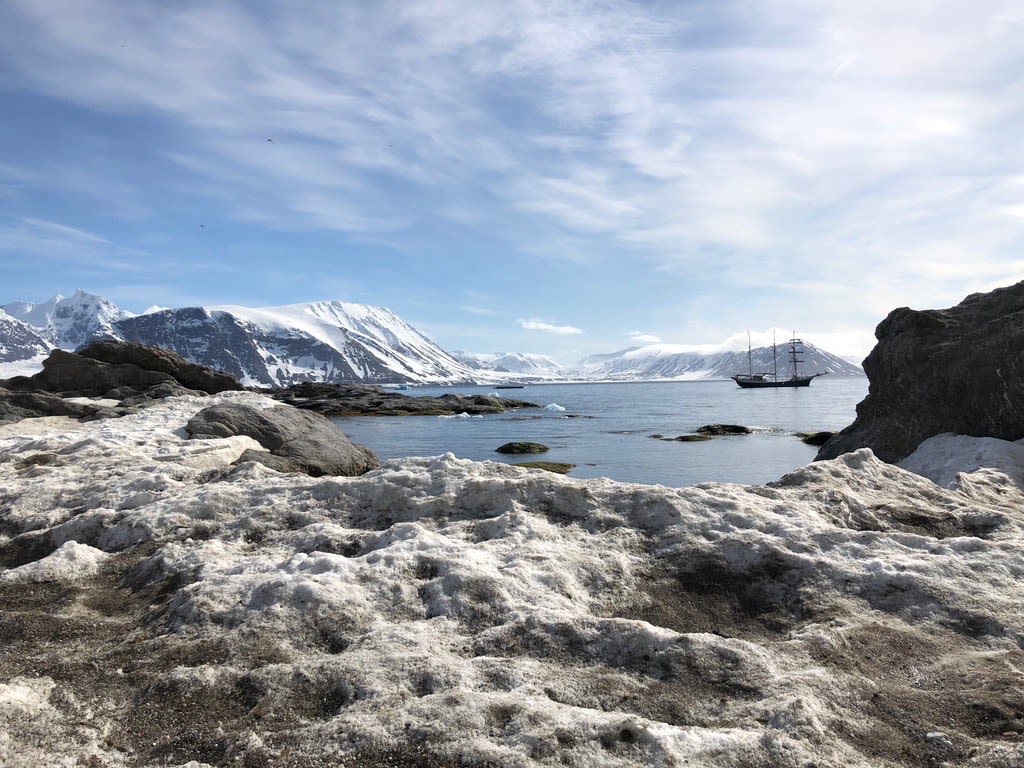
He blinked, rubbed his eyes, let the binoculars drop to his chest, turned away, shook his head, adjusted the binoculars, and held them back up to his eyes. There it was. An island, or an entire uncharted continent glittering in the polar sun. A long, snowy spine of mountain range. Beautiful peaks where there was supposed to be nothing but sheet ice and brutal wind. Between his binoculars and the coast of that new land, along the horizon, two schooners with full sails.
Peary knew he had discovered new land at the top of the planet. The greatest opportunity for any explorer. He stood on the low summit, and looked west and north across the sea. It was brilliant in the sun, stunning. Mountains glistening and rugged. As unknown as El Dorado. But by calculations the land he saw was 130 miles away, too far for Peary in 1906, with supplies so low.
His expedition was nearly over. The food was nearly gone, the dogs exhausted, and his own ship was waiting, 2o miles on foot over ice and land. It was very cold that day, or he'd have stayed longer, taking more calculations of distance and navigation. On the way back to camp, Peary held a pen in his mittened hand and drew a rough map.
The island seemed to vanish as the June sun shifted but he was focused on the future. He named the uncharted place Crocker Land, after his expedition’s benefactor.
When Peary returned to camp, map in hand, he was eager. Kallik, the Inuit guide, shook his head and told the admiral that this island, those mountains, the new continent, were an illusion. There was nothing but sea and ice separating them from the rest of the world. But Peary already had his sights set on the next expedition.
“It's a wish," Kallik told him. "A wish is not an island, it's a dream.”
“It isn’t a dream,” Peary pushed the map toward him, kneeling in the snow beside the fire. "There's more land up here than we know. It could be an entire continent."
But in 1906, maps and dreams, as well as destinies, were open to interpretation.
2. Crocker Land: The Expedition
In 1913, four years after Peary claimed that he was the first to reach the North Pole and fame resuscitated his career, the Crocker Land expedition began. It was an ill-fated search to find the next last unreachable place.
The goal was to locate a safe harbor, chart the coast and mountains, catalog musk ox, arctic fox, and any new ornithological species. A more elusive hope was to find whoever had been sailing the ghostly schooners in 1906, and determine how they had skimmed the horizon at the top of the world.
But Crocker Land was a dream, an illusion, a Fata Morgana, a trick of bent light. A breach in the atmosphere where mountains and ships appear to float above the water. It was a mirage of epic proportion. The expedition was a failure. There was murder, a lack of food, snow blindness, all to find a land that didn't exist.
If not for the plate ice that forced them back, the Crocker Land expedition might have sailed over the top of the world, and back down the other side, confused if not lost. There were no schooners floating on air, no arctic Atlantis, no eighth continent, no fame. There was only ice. And wind.
The world is full of mirages, difficult to ignore and a refraction of what we dream of, nothing more than air and light, disguised as hope.
About the Creator
Beth Jones
Journalist, educator, author.
Keep reading
More stories from Beth Jones and writers in Wander and other communities.
The Ghosts of Fabbriche di Careggine
Jessa was raised by ghosts. Her great grandfather, Gino Della Nebbia, and his great grandfather, and grandfathers back to the 1200's, had formed a long line of callous-fingered iron workers, farmers, and quarrymen in the Tuscan village of Fabbriche di Careggine.
By Beth Jones5 years ago in Families
Worth the Wait: Puerto Viejo, Costa Rica
Beach bumming in a small Caribbean beach town sounded like a perfect way to end our 6-month trip through Mexico and Central America. Or so we thought. The foul, fishy stench of rotten seaweed hit our nostrils as we stepped from the cramped bus and looked out at a rather depressing, empty, and underwhelming black sand beach. It was pouring with rain, and we had to quickly fish out our ponchos. We thought, this couldn’t be it, could it?
By Sh*t Happens - Lost Girl Travel7 days ago in Wander




Comments
There are no comments for this story
Be the first to respond and start the conversation.