history
The roots of feminism were planted millennia ago; we must understand feminism throughout history to contemplate how much farther we can go.
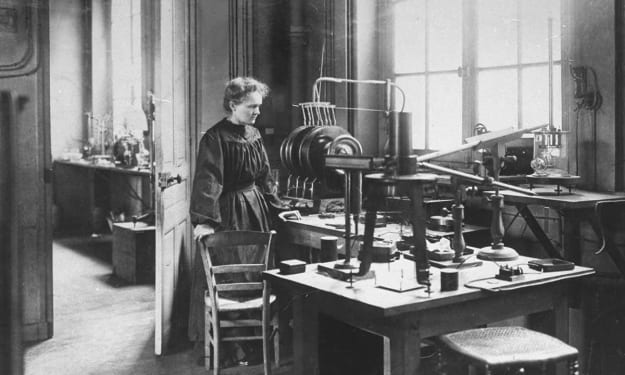
Marie Curie
“We must believe that we are gifted for something and that this thing must be attained.” We all know the name but --- is that all? The first woman to be given a Nobel Prize and the first person to win 2 Nobel Prizes, this woman ‘blazed’ the trail where cancer research is concerned. Who was Marie Curie?
By Ruth Elizabeth Stiff5 years ago in Viva
An African Female Heroine and Racism
I studied Kinesiology at UCLA. I graduated in 1980 with a Bachelor in Science. I like science and I have studied science my whole life. Unfortunatly, not everyone studies science, grows up in Southern California, or takes the time to question the constant propaganda being put in front of them by media, corporations and especially political groups mainly for power and profit.
By John Charles Harman5 years ago in Viva
Sister Circle
Sister Circle Dear Harriet Tubman, You don't know me. Still, you are in my sister circle. You are just like one of my pals. I don't have many friends. I haven't met many people who have good friendship qualities; but, even while you don't know me, and I've never met you, you are in my sister circle.
By Shahidah Ahmad5 years ago in Viva
My dear Hypatia
My dear Hypatia, you were the greatest astronomer and mathematician of your time. You were a professor at the University of Alexandria one and a half millennia ago, teaching mathematics, astronomy, and philosophy, writing books on algebra and geometry. I learned about you through study, would you believe? In your age, it was not common for women to lead an academic life like you did but now we are free to pursue this to our heart’s content. I know you had your father, Theon, to thank; he taught you his trade as a professor like people would usually teach their sons. I did not take the trades of my family; I am forever a student, a learner, a teacher – just like you were!
By Eloise Robertson 5 years ago in Viva
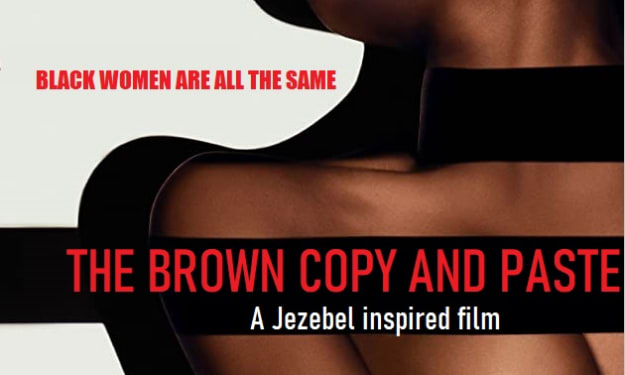
The Brown copy and paste
One of the crucial parts of sexuality representation is the study of the people it actually includes. Black women being portrayed as hypersexual beings has been part of the White imaginary for a long time, this belief spreading onto many stereotypes such as the Jezebel. While those are old, they persist in our society, including films, through a remolding of those racist and misogynistic ideas. This essay will touch on the ways that, due to the limited representation of Black female sexuality in cinema, the few examples available could hold more weight, including the stereotypical ideas they contain, such as the resemblance to the Jezebel stereotype and how their ‘‘promiscuous’’ sexuality affects the rest of their life.
By Allie Pauld5 years ago in Viva
The story of Secretary Frances Perkins, the first woman to hold a Cabinet position
Recently there has been a lot of attention being paid to barriers being shattered by women and minorities (as well as to the various barriers that remain standing that need to be shattered). In light of this, and of the fact that it is currently Women’s History Month, let us reflect on a somewhat lesser known example, the life and career of Frances Perkins.
By Austin Blessing-Nelson (Blessing)5 years ago in Viva
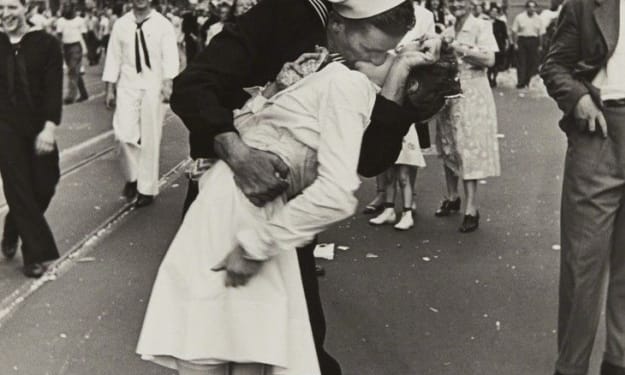
The Fairy Tale That Never Was
It’s an enchanting photograph. The black and white image of “The Kissing Sailor” romanticizes Americans’ joy and relief at the announcement that World War II was coming to an end. When I first saw it, I was convinced that the sailor and the nurse were reunited lovers who were expressing their happiness over the long awaited news. Their poignant uniforms evoked images of two people committed to service in a time of national need. They, more than most, deserved a moment of bliss after sacrificing so much.
By Mansura Ghaffar5 years ago in Viva
The Woman of History
In a society that undermines women in almost every aspect of life, often we forget to recognize the women of history that shaped the society of which we live in. Such women include, the commemorated military leader, Jeanne d'Arc. Her role as a female leader in the hundred years' war has earned her the title as the National Heroine and Saint. For centuries women have been subjected to the collective inequalities, discrimination and prejudice inflicted by men. However, it is women like those of Jeanne d'Arc that has shaped women's representation over the course of history.
By Ezra Scarlet 5 years ago in Viva
BLACK INNOVATION
Say what?? You want me to narrow this story down to just one person? This was my reaction to this month's writing challenge. The challenge is to pick a black person whom I admire that has been an innovator, inventor, or creator. The actual challenge is there are too many to choose from. Alas, the educator in me wins out yet again. I choose Bellen Woodard.
By Lisa Brasher5 years ago in Viva
The Enlightened Woman. Top Story - March 2021.
Over the last year, I've been upgrading some high school courses in order to bolster my university applications (29 year old, going to post-secondary for the first time here! Woohoo!). One of the courses I'm taking is World History, which has been extremely insightful considering the global events that have transpired since March 2020. Recently, I had the opportunity to select a topic of my choice for an essay. There was a list of suggestions I could pick from, or I could present an idea of my own. On the list I saw two intriguing topics right next to each-other:
By Samantha Kaszas5 years ago in Viva