
Esperanza Rising
An incredible novel for young girls...


Esperanza Rising- Literature review
Esperanza Rising transports us into the lives of Mexican-American immigrant agriculture workers and we get to see the kind of extreme hardships they had to suffer during the 1930’s depression era in the United States. What makes this novel so important is the representation of strong, independent, minority women and girls who were able to overcome the challenges of systemic racism, extreme poverty and all while living under the rule of a patriarchal society. Children, especially young girls, need to have access to more powerful stories like Esperanza Rising which provides worthy role models and important messages like never being afraid to start over. Books that defy gender stereotypes and teach young girls that they have more choices than they realized, and that they might be more powerful and capable than they could have ever imagined are critical in the fostering of the future female leaders of the United States, and the world; books are powerful. Nelson Mandela asserts, “Education is the most powerful weapon which you can use to change the world” (Duncan, A., 2013).
We see the strength and courage of Esperanza’s mother Ramona early in the novel. When Esperanza’s father dies, we discover that because Sixto had no male heir, his lands would be given to his brother instead of his wife and daughter. Esperanza’s mother has the choice to marry the wealthy brother of her deceased husband and to be able to continue to live the life of a wealthy-landowner’s wife, but she refuses. The whole reason Esperanza and her family end up fleeing Mexico to start a new life in the United States is because of the sexist laws that allow only men to be in positions of power and become landowners. If Esperanza had been a son, then Ramona would not have had to make the choice between marrying a man she did not love for security or immigrating to another country to try to start a new life.
Ramona realizes quickly that their position in life has changed, but even when she was of higher status, seemed to always possess respect and kindness for others. Esperanza has a more difficult time adjusting to their new circumstances and understanding that their position in life has changed. Esperanza clutches the porcelain doll, which is the last thing her father gave her. When a young girl on the train ride wants to touch and play with Esperanza’s doll, Esperanza pulls it away from her. The doll seems to represent not only her connection to her father, but also the life of luxury she has been forced to leave behind. In a way Esperanza too is like the doll itself, women and girls, even of higher status in patriarchal societies are often objectified and not valued for much else. Ramona apologizes for the poor manners of her daughter and makes a yarn doll for the little girl and has Esperanza help her (Ryan, 2000, p. 69-71). Ryan (2000) asserts, “Esperanza was glad the girl got off the train and took the silly yarn doll with her. Otherwise, she would have been reminded of her own selfishness and Mama’s disapproval for miles to come” (p. 72). This shows us what kind of person Ramona is, she proves herself to be a good role model.
Esperanza’s Abuelita is another strong and kind woman in her life. When she’s teaching Esperanza to crochet the blanket, this begins one of the most important leitmotifs in the novel which connects all of the different generations of women in Esperanza Rising; the blanket represents their strength in this connection. Abuelita is gone for most of the book, but remains with Esperanza in spirit and during dark times, this gives her hope.
Ryan (2000) asserts:
Abuelita—said thoughtfully, ’There is no rose without thorns.’ Esperanza smiled, knowing that Abuelita wasn’t talking about flowers at all but that there was no life without difficulties--- when a strand of hair fell [from Abuelita’s head, she] stitched it into the blanket [and said] ‘Esperanza, in this way my love and good wishes will be in the blanket forever (p. 14). --[Esperanza struggles to crochet without making a huge mess of mistakes in the blanket], Abuelita declares, ‘Do not be afraid to start over,’ (Ryan, 2000, p. 15).
I think that is one of the main lessons of the book, because the entire story is about starting over. Ramona and Esperanza leave their old life, to start a new one in another country, just like Abuelita did many decades earlier.
Ryan (2000) asserts:
Abuelita squeezed Esperanza’s hand. ‘Do not be afraid to start over. When I was your age, I left Spain with my mother, father, and sisters. I Mexican official had offered my father a job here in Mexico. So we came. We had to take several ships and the journey lasted months. When we arrived, nothing was as promised. There were many hard times. But life was also exciting. And we had each other. Esperanza do you remember the story of the phoenix, the lovely young bird that is reborn from its own ashes?— We are like the phoenix—Rising again with new life ahead of us’ (p. 49-50).
Abuelita imparts wisdom and life experience, but then disappears until the end of the novel. Ramona also gets sick with Valley Fever so Esperanza has to learn how to start taking care of herself, but of course still has Hortensia, Alfonso, Miguel, Isabel and others looking out for her and providing emotional support. Despite the support system, losing both her parents and grandmother in such a short time is difficult for Esperanza, but she overcomes every obstacle that comes her way. Esperanza makes arrangements for other women to help watch the twins so she is able to go to work and become her own provider.
Esperanza works hard and pays for her own expenses, her mother’s hospital bills, and starts saving money to try to bring Abuelita into the United States. Working and learning how to take care of others changes Esperanza, she matures and starts seeing the world much differently than she used to. Esperanza builds a strong bond in particular with Isabel, who helped her from the day of her arrival and had been always kind to her. One day when teaching Isabel to make yarn dolls together, they start discussing what they would like for Christmas this year. Esperanza says what she really wants most is for her mother to get better, to have more work so she can save more money, and for her rough hands to be soft once again--- Isabel says she wants anything (Ryan, 2000, p. 175). When they go to bed, Esperanza starts silently crying in bed and Isabel comes to comfort her and this is when Esperanza has her epiphany. Ryan (2000) declares, “Esperanza stared into the dark. Isabel had nothing, but she also had everything. Esperanza wanted what she had. She wanted so few worries that something as simple as a yarn doll would make her happy” (p. 176). I think this is when we see Esperanza has truly changed from the girl she once was when she first arrived. At the end of the novel Isabel loses the Queen of May contest, due to racism within the school, and Esperanza ends up giving away her once most prized possession, her porcelain doll to Isabel, then introduces Isabel to her Abuelita and all of the women sit together and teach Isabel about crocheting. Isabel becomes connected to these women further, accepted as one of the family in this gesture of allowing her to learn their family crocheting style.
Another strong female character in the novel is Marta, a young Mexican-American teenager who lives in another camp with her mother. Because they do not have a man to act as their ‘head of household’ they are unable to stay in the nicer camp that Esperanza stays in. When Marta first meets Esperanza they clash, but eventually end up gaining each others’ respect. Marta is one of the young girls who has been encouraging all of the workers to strike for better wages and better living conditions. Some of the camps, according to Marta and Isabel, have no bathrooms and people have to go relieve themselves in ditches. We also discover that unlike the camp that Esperanza and Isabel are staying at, one of the camp’s Marta and her mother have been living at does not even have buildings for them to live in, just tents which make it difficult to protect themselves from the elements. While Esperanza, Miguel, Alfonso and Hortensia, as well as many others are against striking, it is only out of fear that they could end up losing their jobs or worst, end up being deported. Even Mexican-Americans who have never even stepped foot in Mexico were being deported for striking. Anyone who was a problem was taken and deported to Mexico. I think that if they had all gone on strike together, perhaps they could have improved conditions, but I also understand that it is hard to strike when you can’t afford taking even just a few days off from work or you wouldn’t be able to feed your children. It makes sense why so many did not choose to join the strikes. While all of this happened almost 100 years ago during the great depression, it seems relevant even today. There are still those in agriculture who exploit immigrant workers and pay them below minimum wage, and if they complain they could easily be replaced by someone else. There are some higher paying, but more dangerous jobs, also offered to Mexican-immigrants such as, asbestos removal. Because of the rising crime rates and corruption of the Mexican government, more and more immigrants are willing to take any job, at any pay, to be able to get a chance to live here in the United States. What they still need are more strong women like Marta, speaking up for their rights and helping them get paid what is fair.
Strong, smart, hard-working women are all around us, but sometimes we forget or allow ourselves to be manipulated by the lies that are told about women by the media, film industry, and in literature. Children’s literature in particular has so much power to reshape this world, its messages should empower readers, not teach them that if they are a girl, their only goal in life should be to find a prince to marry and take care of them, so they can live that ‘happily ever after.’ Girls need to know they have more choices. Boys should see more women and girls in positions of power, working alongside boys and men. Perhaps then it would not be such a struggle to gain their respect, and when asking for equality, women wouldn’t be treated with such strong negative backlash. My hope is that one day everyone will come together and see that everyone should have the same freedoms and be treated with equality, kindness and respect.
Work Cited
Duncan, A. (2013). Education: The most powerful weapon for changing the world. https://blog.usaid.gov/2013/04/education-the-most-powerful-weapon/#:~:text=As%20Nelson%20Mandela%20says%2C%20%E2%80%9C%20Educa ion%20is%20the,needless%20deaths%20and%20illness%2C%20and%20to%20fostering%20peace.
Ryan, P.M. (2000). Esperanza rising. Scholastic Inc.
About the Creator
Keep reading
More stories from Fearless Warrior and writers in Viva and other communities.
Negative Effects of Youth Sports
A Summary Review of Research: Sport sociologist James Frey conducted and collected research that has exposed the truth about sport socialization, and what stands out most is how sport has influenced youth. Many parents get their children involved in sport, because they believe it will teach them good values and character traits such as, leadership, self-discipline, and integrity, but Frey asserts there is little evidence to support this common myth. Stanley Eitzen, another influential sport sociologist, writes an expose regarding what he calls ‘the darker side of competition’ in which he argues that the longer someone plays sport, the more likely they are to have poor morals, because coaches often encourage cheating and other unethical behaviors. When reviewing the following articles, Sport and Society (Frey), Ethical Dilemmas in American Sport (Eitzen), NFL: Dodging the Concussion Discussion (Deford), State of Play (The Aspen Institute Project Play), Parents’ Perceptions of Child-to-Parent Socialization in Organized Youth Sport (Dorsch, Smith, McDonough), The Sanctity of Sunday Football (Hartmann), and ESPN’s Sportcenter: Socialization of America’s Athletes, Coaches and Workers (Aicinena), there is an obvious common theme among all of these articles which is that there is great potential for harm of children within youth sport, not only physical harm from injuries, but psychological harm as well. However, now that we have become aware of these issues, sport sociologists say it’s time for us to take action and create positive changes; they stress the significance of improving youth sport so that we can ensure that children have positive experiences that will encourage them to be engaged in physical activity throughout their lifespan.
By Fearless Warrior5 years ago in Unbalanced
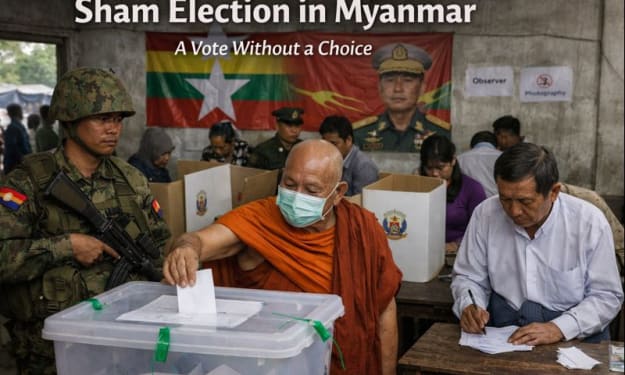
Myanmar’s Junta Election: A Vote Without a Choice
Myanmar’s military government has held the second phase of its planned election, but many people inside and outside the country say the vote is not real democracy. Critics describe it as a “sham election” designed to keep the generals in power, not to return the country to civilian rule. The election comes while Myanmar is still facing war, poverty, and deep political repression.
By dua fatima5 days ago in Viva
Why an Oval Diamond Engagement Ring Is Perfect for Valentine’s Day
Valentine’s Day is more than just a date on the calendar; it is a global celebration of devotion, passion, and the beautiful promise of a future together. For many couples, February 14th marks the most romantic milestone of their lives—the proposal. While the moment itself is unforgettable, the ring you choose serves as a lifelong symbol of that commitment.
By Mohd Kaish3 days ago in Viva



Comments
There are no comments for this story
Be the first to respond and start the conversation.