

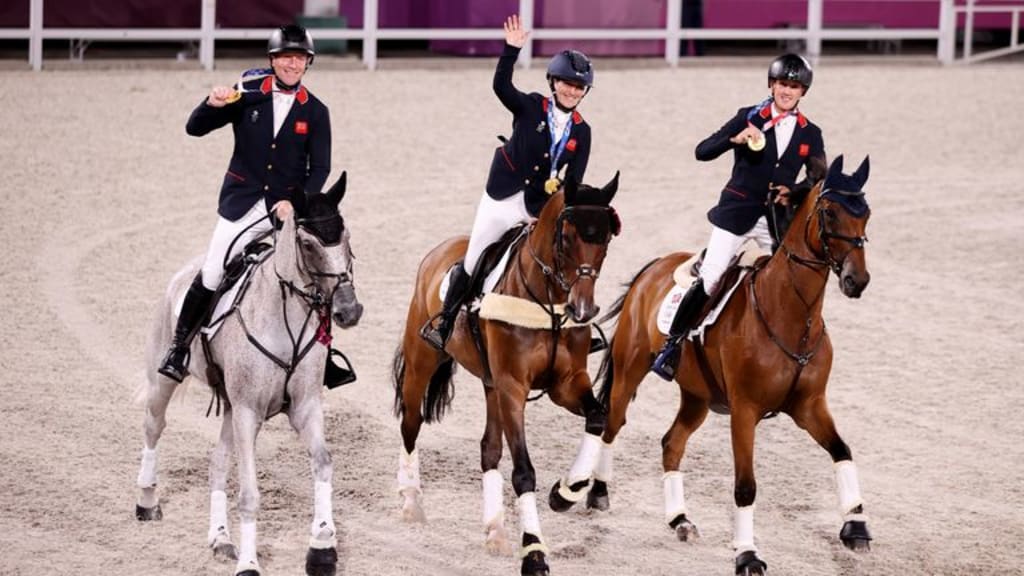
With the Olympics in Tokyo (this year, but it really should have been 2020), I tuned into one of my favourite sports --- the Equestrian Events of Dressage, Show Jumping and Cross-Country. Seeing such beautiful horses reminded me of my very deep love for these remarkable creatures. We become so busy in our every-day lives that we forget the very basic things that we have loved from childhood. I say this because I remember starting a “project” on The Horse when I was in the first year of my junior school. It was one of those lessons when we went to the library and, I believe, I took out every book they had on The Horse. Over my teenage years, my parents brought me some amazing books on horses, and I built up quite a ‘study library’, with L/A files filled with information and pictures on horses. It became a real hobby for me (although I have never ridden a horse and am actually quite nervous of the creatures).
Then I left school, started full-time work and got married. “The Horse” was neatly tucked away in a corner of my mind, to be ‘brought out’ when I watched the Olympics. What nice memories I have of “studying” this creature and spending hours over my books.
Equus ferus caballus --- or The Horse --- is a domesticated, one-toed, hoofed mammal which has evolved over the past 45 to 55 million years. It became ‘domesticated’ around 4000 BC, however, there are still truly wild horses even today. Horses can run extremely fast, up to 55mph at a gallop, outrunning many predators. These animals reach maturity at 5 years of age, and the average lifespan of a horse is between 25 to 30 years. A mare (female horse) is pregnant for roughly 11 months and the foal (baby horse) can stand and run shortly after birth. Most domesticated horses start training at the ages of 2 and 4.
There are 3 'categories’ of horses => 1) hot-bloods which have speed and endurance, 2) cold-bloods which are suitable for heavy work, and 3) warm-bloods which are a cross between hot and cold bloods. There are more than 300 breeds of horses worldwide.
Over the years, man and horse have helped each other in many different ways. At one point in human history, the horse was the only means of transport that we had, either riding the horse or in a horse and carriage. The massive Shire horses were always used for farm work and for pulling the big barrels of beer. During World War One, horses were used in the actual fighting. Today, we have Police horses, as well as Therapy horses, and, of course, horses which are used in the 3 Day Eventing. Also today, our knowledge of the horse has advanced and vets can ‘heal’ horses who, just a few years ago, would have been put down. There are still Blacksmiths today, skilled workers who can ‘shoe a horse’, as well as making all the tack (the bridle, saddle, blanket, headpiece, bit, girth --- in fact, everything that is needed to ride a horse).
Although horses are not expected to live after 30 years, there have been ‘a few’ who have lived longer. For example, a 19th Century horse called “Old Billy” lived up to the ripe old age of 62, and, in more modern times, “Sugar Puff” (who was a pony) lived up to 56 years of age, dying in 2007. When reading about famous horses in history, three stand out to me personally. “Sergeant Reckless” was a mare of Mangolian horse breeding and started her life as a pack horse in the Korean War. She was purchased in October, 1952, for $250 and trained for the Rocoilless Rifle Platoon as a packhorse. Reckless soon became part of the unit and was allowed to roam freely through the camp, and she would eat almost anything that was put in front of her, including scrambled eggs, Coca Cola and even poker chips! Reckless served in numerous ways during the Korean War, carrying supplies and ammunition, and also helping to evacuate the wounded. Sergeant Reckless was given several awards, including Purple Heart, National Defense Medal and the Animals in War and Peace Medal for Bravery.
“Marengo” was the horse of Napoleon Bonaparte, ‘fighting’ in the battles of Austerlitz and Waterloo. Marengo was a grey Arabian, 14.1 hands (145cm) and reliable, steady and courageous. He was capable of going as far as 80 miles in 5 hours and was known for his long-distance gallops.
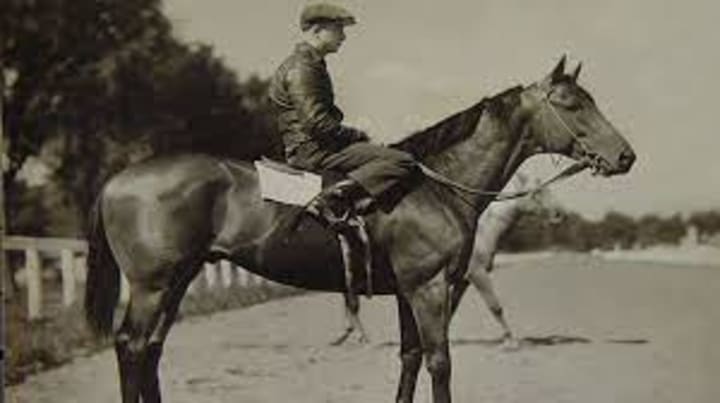
Being one of the famous racehorses of the 20th Century, “Seabiscuit” put his heart into racing. He won America’s Horse of the Year in 1938 and people, as well as the media, loved this race horse. Seabiscuit ran 89 races, won 33 and came 2nd in 15 races. In 1958, this famous horse was inducted into the United States Racing Hall of Fame. Seabiscuit sired 108 foals after he retired in 1940, and enjoyed a quiet life as a ranch horse. The Horse may have been domesticated (first) in Southern Russia and Kazakhstan and was used as a means of transport, pulling chariots, wagons, etc, and have always been used in war and hunting. Arabian horses have always been ‘sought after’ to breed and were introduced into Britain in the 17th and 18th Centuries for ‘selective breeding’. Horses have always been used on farms, being the main force in agriculture before the tractor came on the scene. A special harness was used so the horse could plow in the fields, the horse’s power doing the work of 50 men --- hence the term “horsepower”. Farmers could cultivate their land much quicker by using horses, making farming more efficient. With their assistance, crops had better results. In 1920, more than 25 million horses (and mules) were worked in the farms. Today, the tractor has replaced the horse where crops are concerned, but horses are still used to help herd large groups of animals.
Today, we are dominated by cars, trains and planes for transportation. Until recently, the horse was our only means of land transport (apart from our own legs as in walking). In ancient Egypt, horses were used to drive the pharaoh's chariot. In the 19th Century, horses were used to drive Queen Victoria’s carriage. Even today, at special Royal events, we still see the horse and carriage used --- mainly for display purposes.
Of course, one way in which horses are still ‘useful’ is in the Equestrian Sports. The Three-Day Eventing --- Dressage, Show Jumping, Cross-Country --- rely heavily on the skills of the horse and rider. Some start training for this at a very young age (rider AND horse), dreaming and achieving that Gold Medal at the Olympics.
Dressage is like watching ballet, the foot-work that rider and horse learn and do is actually beautiful to watch. The word “Dressage” is a French term meaning “training”. The ‘exercise’ helps to develop the horse’s flexibility and response to aids, as well as balance. This makes the horse strong and a pleasure to ride. This is the most “artistic” of the equestrian sports and is traced as far back as the ancient Greeks. The ‘performance’ is a walk, trot and canter, and the tests are ridden from memory as well as following a pattern of movements. The Freestyle is specially choreographed for each individual horse and is performed to music. Dressage is beautiful to watch!
Show Jumping is also known as “stadium jumping”, “open jumping” or just “jumping”. This event improves the agility of the horse, and focuses on both the rider and the horse. It uses physical skills to “negotiate a series of obstacles” (jumps), as well as the mental skills needed to plan the proper lines and approaches in order to allow the horse to jump the obstacle, and all of this is usually done within a certain time limit. This event I find exciting to watch. Will the horse clear the jump? Turn the corner in time for the jump? Complete the course within the time allowed?
Cross-Country is exactly what it says --- going across country, jumping fences, again within a certain time. This event is more of an endurance test, showing skill and agility following a course through forest and fields. Horse and rider negotiate ‘natural’ obstacles (logs, ditches, fences, water-jumps, etc), trying not to knock over the fences, fall over or run in the wrong direction. When I watch this on television, I am amazed at how the rider stays on the horse!

There are so many colours, breeds and personalities in “The Horse World”. It is no wonder that they are so beautiful, with their long, flowing manes and tails. It is impossible to say which breed is the most beautiful, but the breed that does stand out is “The Shire”. It is a British breed of ‘draught horse’ (a large horse suitable for farm or heavy work), which is usually black, bay or grey in colour. It is a large horse which was used for plowing on the farms, or pulling barges on the canals, or pulling brewer’s drays to deliver beer. They were used in Henry VIII’s time during the many wars, and we can believe this seeing (from the many pictures) the heavy armour that was used by the ‘knights’. Today, the magnificent horses are rarely used for work, being ‘put on show’ in such annual shows as “The National Shire Horse Spring Show”, which is the largest Shire horse show in Great Britain. If you ever get a chance to go and see these animals, I can recommend this as a good day out!

At the time of writing (6-8-2021), Team GB got --- 5 Gold medals, 1 Silver medal and 2 Bronze medals --- for Equestrian Sports. Well Done Team GB!
About the Creator
Ruth Elizabeth Stiff
I love all things Earthy and Self-Help
History is one of my favourite subjects and I love to write short fiction
Research is so interesting for me too
Keep reading
More stories from Ruth Elizabeth Stiff and writers in Unbalanced and other communities.
Elizabeth of York
By marrying Henry VII, Elizabeth of York helped to unite two families and end “The Wars if the Roses.” She was mother to Henry VIII and grandmother to Elizabeth I and, with her husband, started the Tudor Dynasty. This Queen of England is sometimes overlooked, but Elizabeth of York played an important role in English history.
By Ruth Elizabeth Stiff4 years ago in FYI
Somers Dominates at John Jay
Scroll down for photos vs John Jay, Panas and Put Valley After beating Croton-Harmon to open the season, Somers traveled to John Jay on Saturday, December 6 with a long memory. “They beat us up pretty bad last year,” said Leo Keimig. But going up 18 half way through the third certainly seemed to alleviate old wounds. That is until John Jay cut the lead to ten. So an answer was needed, and Keimig made the grade, according to Coach Loughlan.
By Rich Monetti3 days ago in Unbalanced
“I Didn’t Set Out to Break Records”: Pakistan’s First Female MMA Fighter
When people talk about mixed martial arts (MMA), Pakistan is rarely part of the conversation—especially when it comes to women. Yet one young woman has quietly rewritten that narrative, not by chasing headlines, but by stepping into a cage where few Pakistani women have dared to stand. Pakistan’s first female MMA fighter did not begin her journey to shatter records or challenge tradition. She began it simply because she loved to fight—and believed she had the right to. A Dream Born in Defiance Growing up in Pakistan, combat sports were never presented as a viable path for girls. Boxing gyms, wrestling mats, and fight promotions were overwhelmingly male spaces. For a young girl interested in MMA, the obstacles came early and often—raised eyebrows, discouraging comments, and the constant reminder that “this isn’t for you.” Yet the fighter recalls that her earliest motivation had nothing to do with proving society wrong. She trained because MMA made her feel strong, focused, and free. “I didn’t set out to break records,” she has said in interviews. “I just wanted to see how far I could push myself.” Training Without a Roadmap Unlike athletes in countries where MMA is well established, Pakistan’s first female MMA fighter had no clear roadmap. There were few female coaches, no local women’s leagues, and limited facilities that welcomed women. Training often meant improvisation—borrowing gym hours, practicing with male fighters, and learning techniques from online videos. Her discipline, however, set her apart. MMA demands mastery across multiple fighting styles: striking, grappling, wrestling, and Brazilian jiu-jitsu. Balancing these skills required relentless dedication. She trained through injuries, financial constraints, and social pressure, often without knowing whether there would be an actual fight waiting at the end. Breaking Barriers Without Breaking Herself What makes her story remarkable is not just that she entered the MMA world, but how she did it. Rather than positioning herself as a rebel against culture, she framed her journey as one of personal growth and professionalism. She emphasized fitness, discipline, and sportsmanship—values deeply respected across Pakistani society. This approach helped shift perceptions. Slowly, resistance turned into curiosity, and curiosity into support. Family members who once questioned her choices became her biggest allies. Coaches who were hesitant to train a woman began to see her commitment and skill. The First Step Into the Cage Her debut fight marked a historic moment. Stepping into the cage was not just about winning—it was about visibility. For the first time, young girls across Pakistan could see a woman representing their country in a sport often viewed as aggressive and inaccessible. The fight itself was a test of nerves as much as technique. Under bright lights and intense scrutiny, she fought with composure and confidence. Regardless of the result, the message was clear: Pakistani women belong in MMA. A Symbol, Not a Slogan While media attention labeled her a trailblazer, she resisted being boxed into symbolism alone. She insisted she was an athlete first. “If I’m treated as an exception, the door closes behind me,” she once noted. “If I’m treated as a professional, the door stays open.” That mindset has influenced a new generation. Gyms in major cities are now seeing more women sign up for combat sports. Conversations around women’s self-defense, strength training, and athletic ambition are growing louder. Redefining Strength in Pakistan Her journey challenges a narrow definition of femininity that still exists in many parts of the world. Strength, she demonstrates, does not erase grace or values. Instead, it complements them. By embracing MMA, she has expanded what is socially imaginable for Pakistani women—not just in sports, but in any male-dominated field. The Road Ahead Despite her achievements, the road ahead remains difficult. Sponsorship opportunities are limited, international exposure is costly, and institutional support for women’s MMA is still developing. Yet her presence alone has already shifted the landscape. She now speaks openly about mental resilience, discipline, and self-belief—lessons that extend far beyond the cage. For her, success is not measured by medals or records, but by impact. More Than a Fighter Pakistan’s first female MMA fighter didn’t set out to break records—but she broke a barrier far more significant. She proved that courage doesn’t always roar; sometimes it trains quietly, shows up consistently, and steps forward when the moment arrives. Her story is not just about fighting. It’s about choosing one’s own path—and daring others to imagine new ones.
By Fiaz Ahmed 4 days ago in Unbalanced


Comments
There are no comments for this story
Be the first to respond and start the conversation.