
The Rise of Ethan Quinn and Spizzirri’s Quiet Supremacy in College Tennis
How an unassuming Texan became the fulcrum of NCAA tennis dominance, showing that greatness doesn’t always roar — sometimes, it just keeps winning.


College tennis doesn’t get the airtime it deserves, and that’s fine with me. That might sound strange coming from someone who’s spent too many spring afternoons in creaky bleachers at college courts, but that’s part of what makes it special. There’s an intimacy to it — an edge softened by community, an energy honed by self-awareness. When I first saw Eliot Spizzirri play for the Texas Longhorns, I felt that rare inconsistency between what the eye sees and what the mind expects. He wasn’t loud, he wasn’t theatrically confident, and yet you couldn’t look away.
Spizzirri is that understated player who seems to embody equilibrium. Where another athlete might play for flair, he plays for feel. Every rally is a negotiation — a conversation conducted in rhythm, spin, and geometry. What I’ve come to realize over time is that watching him is a comprehension exercise. You begin a match thinking he’s merely composed; you end it realizing he’s clinically dismantled an opponent through restraint.
In an era of oversized personalities and highlight-chasing athletes, Spizzirri’s presence almost feels out of sync with college sports culture. Yet, it’s precisely that dissonance that defines his game. You can trace his lineage back through the quiet assassins of tennis: David Ferrer’s discipline, Tomas Berdych’s stoicism, a dash of Federer’s timing. But there’s a distinctly modern awareness in how Spizzirri carries himself. He knows the ecosystem he’s in — how social media amplifies noise — and he consciously opts out.
That defiance feels radical because subtlety has become rare currency. Every swing, every serve, every deadpan walk back to the baseline reminds me that tennis, at its best, rewards patience in a world drunk on immediacy. I once saw him clinch a team match where the crowd barely registered the final point before he was already at the net shaking hands. There was no theatrics, no chest pounding. Just completion. That quiet professionalism seeps through the Texas lineup — it becomes culture, not just personality.
I’ve often wondered whether players like Spizzirri feel underappreciated in the broader sports conversation. Tennis in America has shrunk under the weight of its professional exclusivity — the Nadal-Federer epoch has made it feel like magic belongs only to the elite few. Yet here’s a collegiate player showing that discipline, consistency, and small, efficient movement still translate into joy for those watching closely. To me, this isn’t about Spizzirri being an underdog—it’s about revisiting the meaning of dominance.
Dominance, in Spizzirri’s form, isn’t about fireworks or heavy topspin forehands that make crowds gasp. It’s about duration. It’s about showing up for every ball and extracting an outcome through accumulated reason. In another sport, that would be called game management. In tennis, it looks like art disguised as repetition. Watching him makes me reflect on the psychology of control — how we measure strength not in explosions but in sustained attention.
That’s why I think Spizzirri’s influence stretches beyond courts or trophies. He’s a study in composure, a live demonstration of focus, maintaining integrity in environments designed for distraction. This resonates beyond tennis — into academia, career, and even daily mental health. We underestimate how much college athletes model cognitive endurance. When I see players like Spizzirri refusing to indulge volatility, I think about how that attitude reflects a generational divergence from the loud, performative leadership we’ve normalized elsewhere.
Tennis, particularly at the collegiate level, still rewards self-mastery. You can’t fake footwork, and you can’t delegate instinct. Every rally is private accountability under public scrutiny, repeated until it becomes identity. That’s why coaches love guys like Spizzirri — they’re executable philosophy. In him, I see the argument for preserving institutions like NCAA tennis: they’re incubators not just of athletes, but of thinkers who practice focus through physical expression.
I don’t know what the next step looks like for Spizzirri. Professional tennis chews up consistency and spits out fragments. But I’d argue that even if he never swings a racquet on the ATP main draw, his impact has already solidified inside a quieter lineage — those few college players who model balance so convincingly that they leave programs stronger than they found them.
When I left the Texas courts after one of his late-season matches, the bleachers emptied quickly. The crowd was polite, almost detached. Yet, walking to the parking lot, I realized that people like him alter what we think poise looks like. He’s redefining excellence as composure performed in real time — not for broadcast, not for likes, but because it works. In an environment where sports often demand spectacle, Eliot Spizzirri reminds me that the truest form of authority never has to raise its voice.
About the Creator
Trend Vantage
Covering the latest trends across business, tech, and culture. From finance to futuristic innovations, delivering insights that keep you ahead of the curve. Stay tuned for what’s next!
Keep reading
More stories from Trend Vantage and writers in Unbalanced and other communities.
When Styles Collide: What the Suns vs. Hawks Game Revealed About Modern Basketball
The Suns and Hawks don’t just play basketball—they represent two competing ideologies that the modern NBA hasn’t quite reconciled. Sitting through their matchup this week, I found myself less consumed by who was scoring and more fascinated by how the game itself has changed. The Suns, with their carefully designed sets and deliberate pace, feel like a throwback to a time when basketball was an execution contest. The Hawks, meanwhile, embody raw chaos—the kind of improvisation that can either redefine the game or unravel it entirely.
By Trend Vantagea day ago in Unbalanced
Wild Card Weekend Recap: What Happens Now?
I think I figured out why I love Wild Card Weekend so much. It's because it's the first playoff anything of the calendar year. The NFL season starts in the fall, and once upon a time, the champion was crowned either on or slightly before New Year's. The evolution of the NFL schedule has resulted in the playoffs starting just into the New Year, and currently, the final week of the season falls on the first weekend of the New Year, with Wild Card Weekend coming a week after that. So yes, chronologically, the NFL's Wild Card Weekend serves as the first playoff anything of the calendar year.
By Clyde E. Dawkins12 days ago in Unbalanced
Homestand Part IV: Crushed
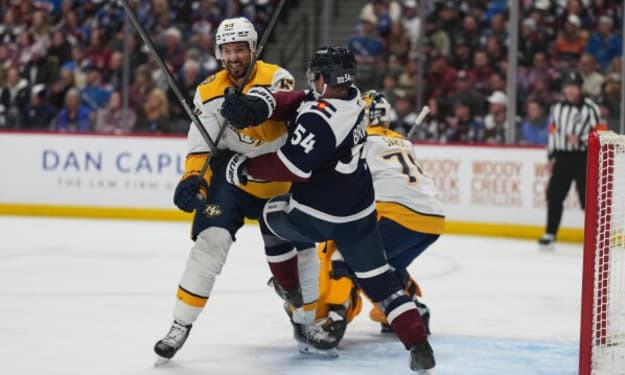
Well... that happened. The Colorado Avalanche had a long layoff after the overtime loss to the Toronto Maple Leafs. That loss snapped a 17-game home winning streak, but the points streak remained. 22 home games, lost three--all past regulation. After three days off, the Avs were back in action against the Nashville Predators, and I always get nostalgic when the Avs and Preds get together. The teams met twice in the playoffs, in 2018 and 2022, and because of those meetings, I've always said that it's fun when these teams get together.
By Clyde E. Dawkins6 days ago in Unbalanced



Comments
There are no comments for this story
Be the first to respond and start the conversation.